It's 2 a.m. Your first mainnet call is rate-limited, the token price in your UI is ten seconds stale, and the wallet balance only updates when you refresh. Your swap button works in a demo, but you still can't tell whether a failed trade came from your code, your endpoint, or the token itself.
Every Solana build starts with the same three blockers: reliable chain access, readable data, and execution with risk context. Remote procedure call, or RPC, gives your application access to the chain. It doesn't automatically give you clean portfolio data, a fresh trading price, or a safe counterparty.
The ten resources below follow the problems you encounter while shipping, not marketing budgets. The fixed order starts with integrated tooling, moves through infrastructure and data choices, and ends with a supported development workflow. Several providers solve overlapping problems. You don't need accounts with all of them.
Start small: Choose an endpoint and a wallet you control. Make that combination reliable before adding more providers or trading strategies.
This is a crypto-only block chain dev list. No general Web3 hand-waving, just resources touching Solana tokens, wallets, trades, and swaps. For broader discovery, the SubmitMySaas blockchain listings can help you identify other candidates, but a directory listing isn't a production benchmark.
Skim the comparison table, then jump to the entry matching your current blocker.
1. Solana Tracker
Verdict: A practical starting point when your blocker spans chain access, parsed balances, live prices, swap routing, and token risk. The benefit is fewer integrations. The trade-off is evaluating a broader platform than a basic RPC service.
Our Data API joins mints, decimals, prices, and liquidity server-side for wallet requests. Standard Solana RPC doesn't perform that entire join for you. For a portfolio screen, that distinction matters more than getting another raw account response.
Make the balance update without refreshing
Use an initial wallet snapshot, then subscribe to wallet:{address}:balance. Each message contains { wallet, token, amount }, where amount is the new UI balance, not a delta or raw base-unit value.
Copy-paste-sized setup note: Set ST_DATASTREAM_KEY in the solana-wallet-portfolio-api example to follow balance changes with reconnect-aware snapshot refreshes. Datastream balance rooms require Premium, Business, or Enterprise access.
- Crypto use case: Show a trader's updated token holdings after a swap without repeatedly polling every token account.
- Execution option: Raptor Swap API provides hosted routing and a self-hostable option. Trading tools combine charts, portfolio tracking, swaps, and Rugcheck signals.
- Infrastructure option: Our Solana RPC includes WebSocket subscriptions, Shredstream, and RidgeDB-powered methods. Dedicated Nodes and Yellowstone gRPC address more specialized workloads.
Go elsewhere when: You need only a plain endpoint and don't want indexed data or execution tooling. Also, don't treat a Rugcheck result as permission to trade: a program can behave correctly while its token or liquidity remains dangerous.
Keep timestamp semantics explicit. Our live events use observation time at processed commitment, while REST uses canonical block time. Those timestamps aren't interchangeable when measuring latency.
2. Helius
A wallet history that displays signatures but can't explain a swap isn't finished. Helius is worth testing when raw transactions become your next parsing problem.
Its Solana-focused offering combines RPC, enhanced transaction data, and streaming through LaserStream. Verdict: Choose it when transaction interpretation would otherwise become a substantial internal project, not because you need an endpoint.
Crypto use case: Build a wallet activity screen that distinguishes a token transfer from a decentralized exchange trade. Retain the original signature so users and support staff can inspect the underlying transaction.
Test the parser against your actual trades
Copy-paste-sized setup note: Start your transaction fixture with {"signature":"<TRANSACTION_SIGNATURE>","expectedType":"swap"}. Send that signature through the documented enhanced transaction workflow, then compare its interpretation with token balance changes.
Don't validate only successful, straightforward swaps. Include failed transactions, account creation, and trades involving unfamiliar programs.
- What works: Solana-specific parsing can remove repetitive decoding work.
- What needs care: A provider's transaction categories may not match your accounting categories.
Go elsewhere when: You need unrestricted low-level streaming on an entry plan, or exact program-specific interpretation that its parser doesn't supply. Advanced mainnet streaming and transaction submission features can have separate access requirements. Verify those before designing around them.
3. QuickNode
Verdict: QuickNode suits a team whose first endpoint works, but whose application now needs managed capacity, event delivery, and clearer operational boundaries. RPC, WebSockets, Streams, and Webhooks give you different ways to receive updates.
For a crypto deposit service, Webhooks can fit server-side notifications, while WebSockets suit an open connection receiving updates. Neither removes the need to reconcile your stored state against the chain.
Copy-paste-sized setup note: Send {"jsonrpc":"2.0","id":1,"method":"getHealth"} to your assigned HTTP endpoint. Log the HTTP status, RPC error, elapsed time, and network alongside the response.
Measure the workload, not the demo
QuickNode's Solana ecosystem report describes roughly 400-millisecond block times in the first half of 2025. That's network context, not a promise about your application's delivery or execution latency.
- Crypto use case: Notify an exchange backend about incoming token activity, then reconcile before crediting a customer.
- Trade-off: Shared service credits simplify usage tracking, but different operations can consume capacity differently.
Go elsewhere when: Your budget assumes every call has the same cost, or you require gRPC without moving to the relevant higher tier. Test reconnects and event duplication before using a successful subscription as evidence that your deposit pipeline is complete.
4. Triton One
Your live feed reconnects. What happened while it was disconnected?
That question makes Triton One relevant. Its services include Dragon's Mouth for Yellowstone gRPC subscriptions and Old Faithful for historical ledger access. Verdict: Consider it when streaming and recovery matter as much as making requests.
Yellowstone gRPC is a structured streaming interface for updates such as accounts, transactions, and slots. It's useful infrastructure, but you still own filtering, storage, and recovery logic.
A fast stream without a recovery plan is a trading signal you can't reliably audit.
Crypto use case: Maintain a pool-state index for a trading strategy, then reconstruct the interval around an unexpected liquidity change.
Copy-paste-sized setup note: Start your consumer configuration with {"lastProcessedSlot":null,"commitment":"confirmed"}. Persist the latest successfully handled position rather than merely the latest received message.
Separate speed from completeness
Benchmark the time to receive an update separately from the time to decode and persist it. A growing consumer queue can make a fast upstream connection irrelevant.
Go elsewhere when: You only need occasional wallet reads or a basic application endpoint. Specialized streaming and historical services add integration work, and you should establish current commercial terms before committing. Also confirm exactly how your chosen service handles replay, gaps, and historical coverage rather than assuming every stream includes them.
5. Alchemy
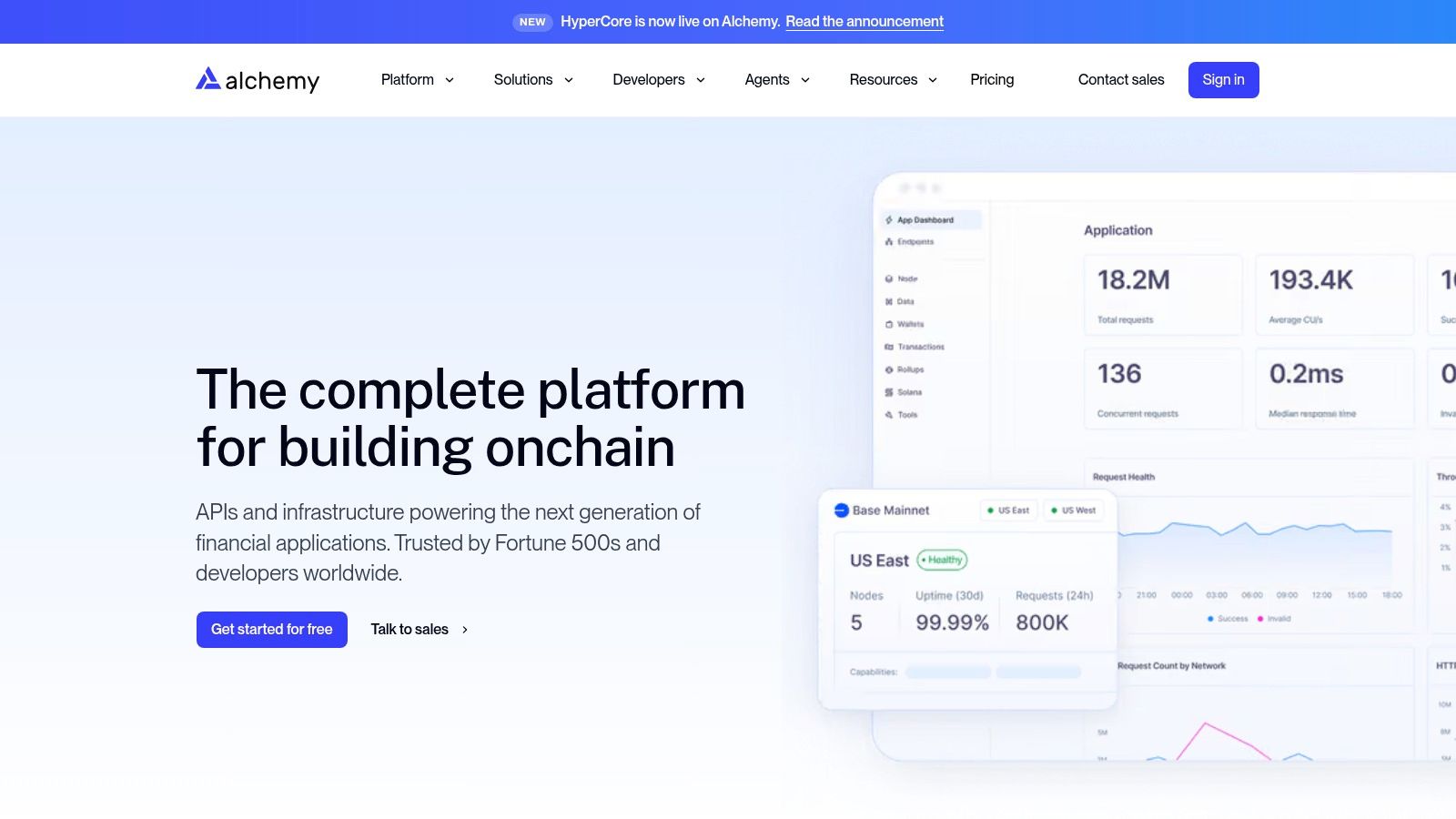
Alchemy becomes interesting when your Solana build sits beside an existing multi-chain application. Reusing an operational dashboard can be sensible. Assuming every network has identical APIs isn't.
Verdict: A convenient candidate for teams already using Alchemy elsewhere, provided its Solana methods and subscriptions meet the actual workload.
A cross-chain wallet is the concrete example. You can share authentication, logging, and provider configuration while keeping Solana account handling separate from Ethereum-style address and balance logic.
Share the adapter, not the assumptions
Copy-paste-sized setup note: Use {"chain":"solana","network":"devnet","rpcUrl":"<SERVER_SIDE_RPC_URL>"} as an application configuration record. Keep provider credentials out of browser bundles unless the access controls explicitly support that use.
- What works: A common operational platform can reduce dashboard switching and duplicated account administration.
- What doesn't: Treating a native SOL balance as a complete token portfolio.
- Billing detail: Compute Unit billing means method choice and frequency affect consumption, not just the number of user sessions.
Go elsewhere when: Your application depends on Solana-specific indexed data or streaming behavior that the selected service doesn't cover. Test those requirements directly before migrating existing infrastructure. A familiar dashboard is helpful, but it isn't a substitute for compatible methods, clear errors, and a measurable recovery path.
6. Ankr
A small token dashboard may generate little traffic until a launch sends users to it. Ankr is a candidate for that variable workload because it offers multi-chain RPC with usage-based access.
Verdict: Evaluate it for current-state requests and flexible usage, but treat historical availability as a separate purchasing decision. Don't build a wallet-history product around an endpoint merely because it answers recent calls.
Crypto use case: Read current SOL balances and simulate a proposed transaction for a lightweight trading interface. Those needs differ from reconstructing a wallet's complete trading history.
Copy-paste-sized setup note: Try {"jsonrpc":"2.0","id":1,"method":"getBalance","params":["<WALLET_ADDRESS>",{"commitment":"confirmed"}]} against the assigned Solana endpoint.
Put boundaries around retries
- Retry selectively: Back off on throttling and temporary transport failures.
- Stop on invalid input: Repeating a malformed request wastes budget without fixing it.
- Separate billing paths: Model HTTP, WebSocket, and gRPC consumption according to the service you use.
Go elsewhere when: You need deep transaction history, guaranteed archival reads, or predictable costs under sustained heavy traffic. Test a known older signature before approving the provider for historical work. A successful current balance read tells you nothing about whether an older transaction will remain retrievable.
7. GetBlock
Verdict: GetBlock is useful when the blocker changes from getting connected to controlling infrastructure capacity. Its shared and dedicated Solana options support different stages of that decision.
Say you operate a swap interface and transaction simulation now competes with portfolio refreshes. Before buying dedicated hardware, isolate the request classes. Otherwise, you may pay more while retaining an inefficient application.
Copy-paste-sized setup note: Split configuration into {"readRpc":"<READ_ENDPOINT>","sendRpc":"<SUBMISSION_ENDPOINT>"}. Both values can initially use the same service, but the separation makes later routing changes easier.
Buy isolation for a measured reason
GetBlock offers WebSockets and dedicated-node options, with Yellowstone gRPC requiring a Dedicated Node subscription under its documented setup model. Confirm the region and configuration against where your consumers run.
Capacity rule: Move to dedicated infrastructure because you measured a constraint, not because dedicated sounds faster.
Crypto use case: Separate a trading backend's simulations and submissions from a public portfolio page's read traffic.
Go elsewhere when: Shared access already meets your reliability target, or a dedicated subscription doesn't fit the project's budget. Dedicated capacity also won't correct stale blockhash handling, incorrect account lists, or a transaction that exceeds its slippage constraint. Keep those failures distinct in your logs so an application bug doesn't become an infrastructure purchase.
8. Shyft
If your application keeps downloading broad responses and discarding most fields, Shyft deserves a look. It combines Solana RPC with APIs and GraphQL, a query interface that lets clients request specified fields.
Verdict: A useful candidate when shaping readable application data matters more than owning every decoding step. Its tiered RPC and API capacity should be evaluated separately.
Crypto use case: Build a token analytics panel that retrieves the fields your interface needs without turning every screen load into a custom indexing job.
Define the response before the integration
Copy-paste-sized setup note: Write a target fixture such as {"mint":"<TOKEN_MINT>","owner":"<WALLET_ADDRESS>","balanceUi":null}. Map the documented response into that shape and keep provider-specific field names inside the adapter.
- Useful distinction: RPC throughput and API or GraphQL limits aren't necessarily the same allowance.
- Streaming constraint: Don't assume WebSockets or gRPC are included because HTTP access works.
- Maintenance cost: Convenient parsed fields still need tests when schemas or supported programs change.
Go elsewhere when: You require gRPC within a standard listed plan or need raw, highly specialized program decoding. Confirm current availability before adopting a streaming design. For a dashboard, simpler parsed access may be enough; for a trading engine, you may need lower-level data and tighter control over interpretation.
9. Chainstack
A successful swap route doesn't end the infrastructure work. You still need to reconcile execution, watch balances, and stop trading when required risk inputs disappear.
Chainstack provides managed multi-chain infrastructure with Solana RPC, WebSockets, and Yellowstone gRPC as an add-on. Verdict: Consider it when you want managed access across networks while preserving an explicit streaming upgrade path.
Copy-paste-sized setup note: Add {"riskStatus":"unknown","allowTrade":false} to your pre-trade state. Only change that state after the required checks return usable results.
Use RPC to verify the risk input
For a newly launched token, inspect authority configuration rather than relying only on a badge. The Solana token documentation distinguishes mint authority, which can increase supply, from freeze authority, which can restrict token-account activity; setting an authority to None permanently revokes that role.
Crypto use case: Recheck a token's authority state before submitting a swap, then record the result alongside the trade decision.
- Operational benefit: RPC and subscription access fit a broader reconciliation service.
- Cost trade-off: Request units aren't automatically equivalent to raw request counts, and gRPC adds another commercial consideration.
Go elsewhere when: You need an interpreted rug score rather than the infrastructure to inspect underlying state. A revoked authority also doesn't establish safe liquidity, fair distribution, or trustworthy counterparties.
10. Solana Developer Platform
Solana Developer Platform is the official platform to examine when your blocker is organizing a supported development workflow rather than selecting another standalone endpoint.
Verdict: A useful starting point for dashboard and REST-based workflows, with an important qualification: the platform is under active development. Endpoints, features, and documentation may change.
Its documented Devnet and Mainnet paths help frame a staged rollout. Provider options can also keep your workflow from depending on an unexamined default.
Promote deliberately to Mainnet
Copy-paste-sized setup note: Keep {"network":"devnet","allowMainnetWrites":false} in your deployment configuration. Require an explicit environment change before enabling production transaction submission.
Crypto use case: Build a wallet-connected token workflow on Devnet, validate the requests, then prepare a controlled Mainnet release.
- What works: Official API references and a documented workspace flow provide a clear place to begin.
- What needs checking: Provider availability can differ between Devnet and Mainnet.
- What remains your responsibility: Signing boundaries, secret storage, risk decisions, and recovery procedures.
Go elsewhere when: You need a stable contractual interface or a clearly priced production service that current platform documentation doesn't establish. Keep your integration behind an adapter while the platform evolves.
For fundraising preparation, the investor outreach guide for technical founders is separate reading. A functioning crypto demo helps explain the product, but it doesn't replace evidence of reliable operation.
Solana Resources Side by Side
Read this table by blocker, not by brand. The useful question is which failure you hit first: RPC access, a parsed wallet balance, a live stream, a swap route, or a rug check. For wallet balances specifically, standard RPC leaves you joining mints, decimals, prices and liquidity yourself; Solana Tracker's wallet endpoint does that server side.
| Resource | Best For | Free Tier | Streaming Support | Main Limitation |
|---|---|---|---|---|
| Solana Tracker | Trading terminal, Solana data API, swaps, and RPC in one platform | Free tier available | Datastream WebSocket rooms for prices, trades, launches and wallet activity; Yellowstone gRPC also listed | Broad feature set takes evaluation; risk scores are signals, not guarantees |
| Helius | Solana dApps, analytics, and trading systems | Free plan with modest limits | WebSockets and LaserStream; some advanced streaming requires higher-tier access or extra charges | Free limits may not suit production workloads |
| QuickNode | Managed Solana infrastructure that can scale with demand | Free option to test platform features | WebSockets, Streams, and Webhooks; gRPC on Scale and Enterprise tiers | Costs vary by plan and usage; gRPC is not on lower tiers |
| Triton One | Low-latency data, archival access, and indexing | No assumed free quota | Yellowstone gRPC and other streaming tools | Pricing and capacity need to be confirmed directly |
| Alchemy | Teams building across multiple blockchain networks | Free tier available | WebSockets and other developer tools | Compute Unit billing makes costs workload-dependent |
| Ankr | Flexible, pay-as-you-go access across multiple chains | Usage-based entry | WebSocket and gRPC interactions have separate billing metrics | Billing differs by protocol, so archive and stream needs need checking |
| GetBlock | Teams starting with shared RPC and potentially moving to dedicated nodes | Shared RPC first | WebSockets; Yellowstone gRPC requires a dedicated node | Dedicated nodes cost substantially more than shared plans |
| Shyft | Solana RPC plus API and GraphQL services | Free tier available | WebSockets on listed paid plans; gRPC not included in listed plans | Higher traffic or dedicated RPC may require a paid or enterprise plan |
| Chainstack | Multi-chain infrastructure with optional Solana streaming | Free Developer plan | WebSockets; Yellowstone gRPC available as a separate add-on | Request units vary by service, and gRPC adds cost |
| Solana Developer Platform | Official starting point for Solana workflows and provider discovery | Provider-dependent | Depends on selected ecosystem provider | Platform is under active development, and provider availability can vary |
If the blocker is a first swap route, keep the boundary clear: swaps execute on-chain through decentralized protocols, and Solana Tracker acts only as the interface. That makes route quality, slippage and confirmation behavior your test cases.
Pick One RPC, Ship One Swap, Then Scale
Give yourself a 30-day build sequence with observable results, not a collection of provider accounts. Keep the scope to a wallet, a token pair, and a trading path you can explain.
Week One and Week Two
Week one: Get a Devnet endpoint and health check running. Record throttling, transport errors, and RPC failures separately so you notice rate limits before users report frozen screens.
Keep credentials in server-side configuration. Add bounded retries with backoff, and verify that an unavailable endpoint produces an honest error state rather than an endlessly spinning interface.
Week two: Add a single data source and parse a wallet balance properly. Distinguish native SOL from token accounts, preserve decimal precision, and verify whether incoming amounts are raw units, UI balances, or changes to a balance.
Raw RPC responses give you accounts and amounts; decimals, prices, and liquidity context are yours to assemble unless your data source joins them server-side. Decide that boundary now, because it shapes every later step. If you subscribe to a live balance stream, check whether it pushes each new amount as it changes or leaves you polling for updates.
Test refresh and reconnect behavior. The screen should recover from a dropped connection without doubling holdings or retaining outdated values.
Week Three and Week Four
Week three: Wire a swap path and measure slippage and failure rates. Devnet validates mechanics, but it doesn't reproduce Mainnet liquidity; use tightly limited Mainnet exposure only after the basic workflow passes.
Record the quote, minimum acceptable output, transaction signature, and final outcome. A submission response isn't the same as a confirmed successful trade. Swaps execute on-chain through decentralized protocols regardless of which interface routes them, so your logs are the only place the full decision trail exists.
Week four: Add a risk check before any real-size trade and write down the rule you'll follow. For example, block submission when required authority information is missing or a liquidity condition fails.
Automated findings need human explanation and review. Treat every flag as a prompt to inspect the mint, its authorities, and its liquidity yourself, then record why you proceeded or stopped.
Confirmed Solana transactions are irreversible. The risk step is not optional, and no provider removes execution risk.
Keep a stop-trading switch and a named person responsible for using it. If you're evaluating a swap ecosystem as a product category, browse Fundl's Kedolik campaign separately from your infrastructure and token-safety decisions.
For an integrated starting point, consider the featured option rather than assembling every layer immediately. Regardless of the provider, store your own normalized records and keep credentials, parsing, and execution behind replaceable interfaces.
Pick a provider you can leave, and keep your data layer swappable.
Solana Tracker combines indexed token and wallet data, live streams, RPC infrastructure, swap routing, and risk tools for Solana builds. Visit Solana Tracker to start with the free Data API tier, then test a wallet snapshot and a swap workflow before expanding your integration.