It's late. The chart is a near-vertical line, and a token you had not heard of an hour ago is up several hundred percent. The group chat is full of screenshots, someone says a listing is coming, and your finger sits on the buy button.
Searching what is rug pull crypto at that hour needs a better test than a green candle. Ask who can take your exit away, and how fast.
A rug pull works like a club you already paid to enter, while one person still holds the only door key. The room can look full. Lock the door and the ticket no longer gets you out.
People sell and stories fade without anyone stealing the exit. Insiders pull the rug once buyers' money sits in a token or DeFi project and selling is shut off. That is a control problem.
One open door does not make the room safe. A second key can remain: permission to change the rules, or the pool a sell must pass through. Clearing one worry leaves the other keys unchecked.
What a Rug Pull Means in Crypto
Picture a corner shop that takes deposits for a weekly grocery delivery. The shelves are stocked, the receipts are printed and the staff know your name. One morning the shutters are down, the shelves are bare and the deposits are gone. Nothing was announced. The doors just stopped opening.
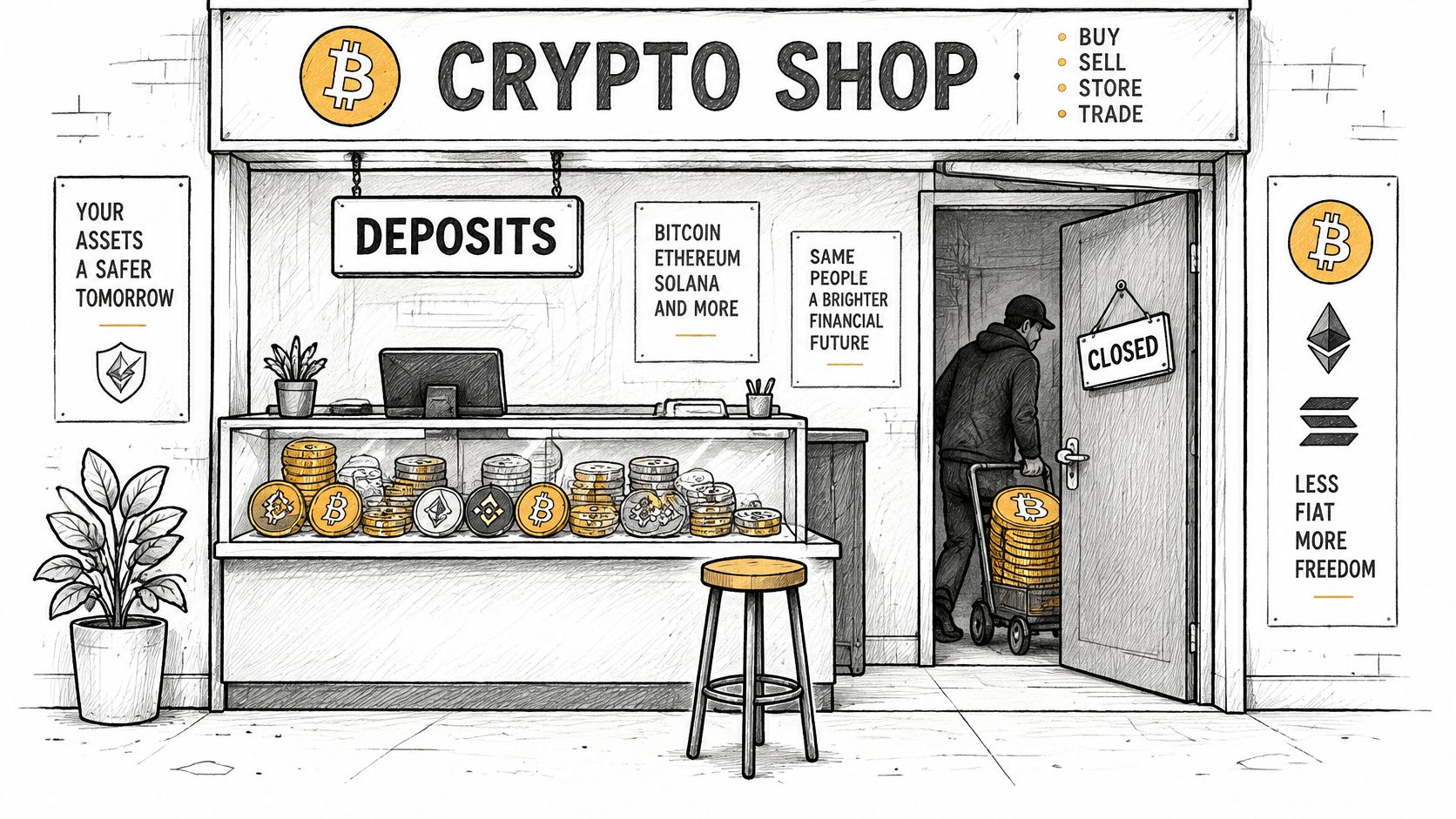
A rug pull is an exit scam in which a crypto token or DeFi project looks functional long enough to collect buyers' money, and then insiders withdraw the liquidity, misuse project-controlled assets or abandon development. The load-bearing word is insiders. Someone held the keys, someone held the permission, and someone used both.
A price falling on its own is not a rug pull. People sell, narratives fade, and tokens lose value every hour of the day. A rug pull is different because the exit itself gets taken away. Chainalysis puts the scale at 3.59% of all newly launched tokens in 2024 displaying patterns potentially linked to rug-pull schemes.
Say you buy $200 of a new token at 2 a.m. The chart is green and the pool looks deep. An hour later your wallet still shows the same balance, but a sell quote comes back far below the market price, or the swap fails outright, because the wallet that owned most of the pool took it out.
The test that matters: don't ask whether the chart can go higher. Ask who can pull the liquidity, who can mint more supply, and who can stop your sell from landing.
That's the frame. A rug pull is a control problem, and two questions cover most of it: who holds the money, and who can stop you from selling.
How a Rug Pull Unfolds on Solana
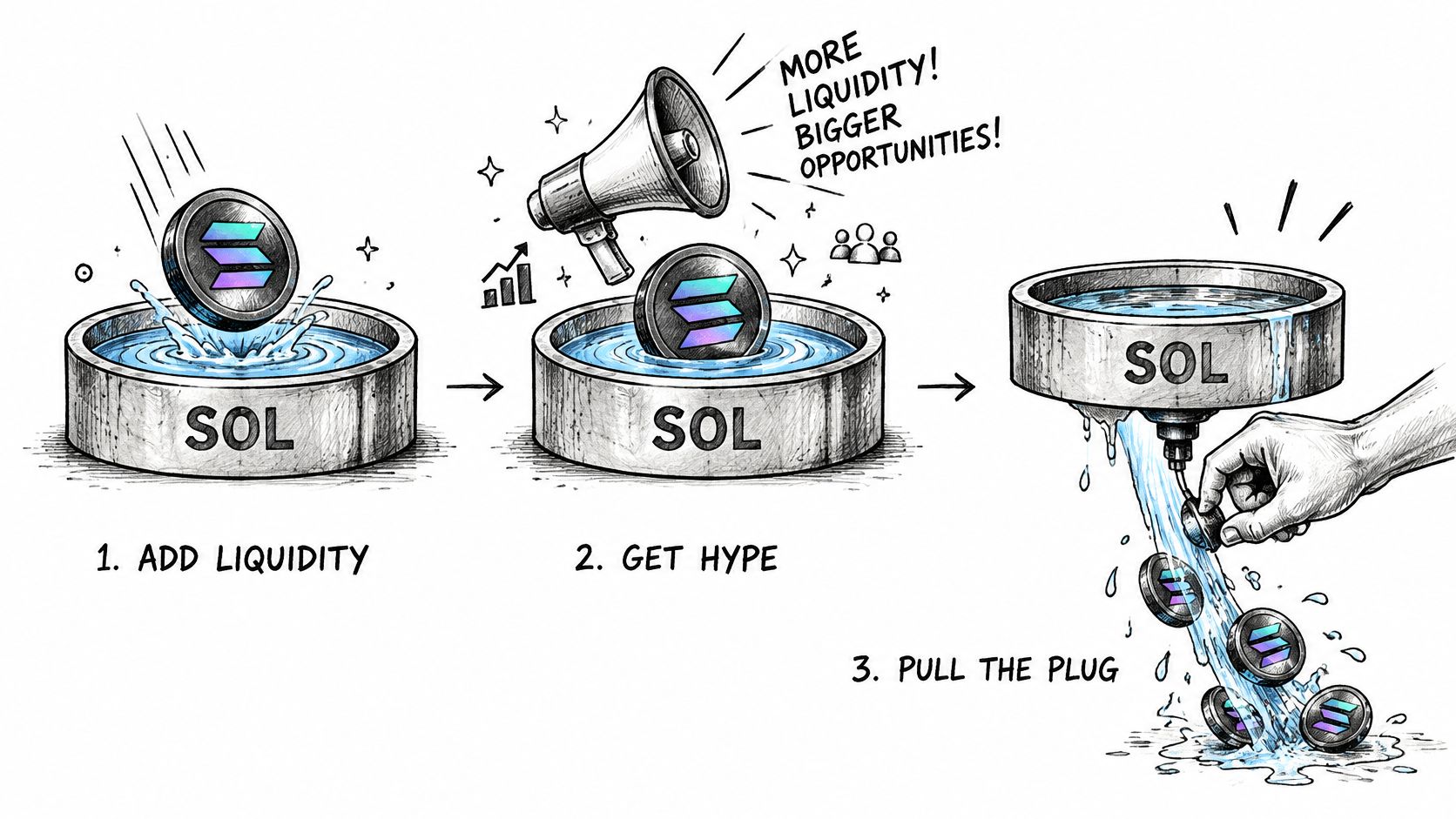
A Solana rug pull commonly follows three stages: token offering, promotion and execution, as a study of verified Solana rug pulls describes. Split it into four steps and you can watch the whole thing happen on a swap screen.
- Launch. The creator deploys a new SPL token and pairs it with SOL in a pool on a venue like Raydium, Meteora or PumpSwap. What you see is a pair minutes old with no history. What it signals is nothing yet, because every token starts here, including honest ones.
- Promote. The operators inflate attention through marketing, impersonating a known project, or wash trading between wallets they control. What you see is volume climbing faster than the holder count. What it signals is that some of those buys may be the team paying itself.
- Attract. Independent buyers arrive, the price climbs, and the pool deepens because buyers become the liquidity. What you see is a staircase chart and messages insisting it's still early. What it signals is that your entry price is somebody else's exit price.
- Execute. The operators withdraw the valuable side of the pool or sell their own holdings. What you see is a vertical candle down, sells that won't fill, and a chat group that goes quiet. What it signals is that the exit you were counting on no longer exists.
A newly launched Solana meme coin makes a useful worked example. Volume rises sharply, but creator-linked wallets still hold a large slice of supply and trades arrive in coordinated bursts from addresses funded by the same source. That combination points to manufactured demand rather than independent buyers.
The same study manually verified 117 Solana rug-pull tokens and found liquidity withdrawal, freeze-authority abuse and pump-and-dump behavior as the recurring patterns. Three failures, three different fingerprints: one moves the pool, one changes permissions, one hands the loss to whoever bought last.
Rug Pull Types and Warning Signs Compared
You buy a new Solana meme coin while the chart is still climbing and the pool still looks deep. Then one account freezes your transfer, mints a fresh pile of tokens, or sells into the bids you just created. The pool never had to hit zero. A rug pull is a control problem: someone keeps a switch that can empty the market, block selling, dilute supply, or exit ahead of you. Turning one switch off leaves the others live.
| Type | How It Works | Warning Sign | Example |
|---|---|---|---|
| Liquidity pull | The creator removes most of the pool so holders can't sell | Liquidity drops sharply soon after launch | Deployer withdrawals take a pool from $100,000 to $1,000 |
| Freeze authority abuse | An active freeze authority can block transfers or selling | Freeze authority still enabled | Transfers restricted in Solana rug-pull research |
| Mint authority dilution | A retained mint authority creates new units and dilutes holders | Mint authority still active | Deployer mints new tokens and sells them into the pool |
| Pump and dump | Insiders promote, sell first and leave late buyers holding | Volume from related wallets, then creator-linked selling | Coordinated selling into rising demand |
The liquidity pull is the version people picture first, and it does not have to drain the pool completely. A shop can look open while the owner carries most of the stock out the back. A pool thinned to a fraction of its opening size makes an ordinary sell move the price far past what the last trade implied. Pool depth is the signal. The last traded price is not.
Permission abuse is quieter. Your balance can sit there the way money sits on a card that the teller will not let you spend. The pool stays full, other trades keep printing, and your sell never lands because a privileged account can refuse the transfer. Dilution works through arithmetic instead of one withdrawal. Each new unit minted into circulation takes a bite out of every existing holder's share, the way cutting a pizza into more slices shrinks the piece you already paid for. The on-chain check is simple: mint authority still active, then new supply appearing and hitting the pool.
Pump and dump hands the loss to whoever bought last. Research on Solana launchpad manipulation describes the pattern as organizers promoting a digital asset, selling first, and leaving later participants to sell into a collapsing market. That research also identifies wash trading, creator-address obfuscation, coordinated selling, copycat coins and social-media manipulation as distinct tactics. Chainalysis counted approximately 90,408 Ethereum tokens launched in 2023 that met behavioral criteria associated with pump-and-dump activity, equal to 24.4% of all Ethereum launches, in its 2024 crypto crime report.
Coordinated selling is a warning, not a verdict. Without ownership evidence linking those wallets, you are looking at a pattern rather than proof of intent. Renouncing one authority, or locking liquidity, closes one pathway. It does not clear the other three.
The useful question is which of these four mechanisms fits this token, and what you would see first if it were that one.
Tools That Score Token Risk on Solana
Rugcheck scores every Solana token from 0 to 10 across more than 20 risk factors, including snipers, bundlers, insider wallets and whether mint or freeze authority is still active, and it updates from the moment a token launches. It gives you a first pass in seconds, and it's the tool we run in Rugcheck on Solana Tracker.
| Rugcheck Score | Risk Label | Practical Response |
|---|---|---|
| 0 to 2 | Low on-chain risk | Still verify authorities and holders before buying |
| 3 to 5 | Moderate risk | Check the flagged factors and keep the position small |
| 6 to 8 | High risk | Avoid unless you accept a near-total loss |
| 9 to 10 | Critical risk | Do not buy |
| No liquidity left, any score | Rugged | Treat as lost, since no exit route remains |
Two limits sit beside that table and they matter more than the numbers. The score reads token mechanics and holder data, so it cannot verify off-chain claims such as asset backing, and a low score does not make a token safe.
Liquidity is where a score meets hard research. One research framework labels a token a rug pull when total value locked falls below 1% of its previous level, a decline of at least 99%, or when the token stays inactive for more than 80% of its lifetime. A pool that touches $250,000 and gets drained to $2,000 clears that bar. It's a screening rule, not evidence of intent.
So check the pool before the chart. How deep is it, who holds the LP tokens, and did it shrink in the past hour. Run the score as one input among several, keep the position small enough to survive being wrong, and let the label start your questions rather than end them.
A clean score on a token with unlocked liquidity and one dominant holder is still a token with unlocked liquidity and one dominant holder.
Red Flags and Pre-Buy Checks
Six checks take about five minutes and cover most of the ways a Solana token can trap you. Run them in this order.
- Mint or freeze authority still enabled. Open the mint account on a Solana explorer such as Solscan and read the authority fields. If either is set, a wallet somewhere can still act on the token after you buy.
- LP not burned or locked. If the creator can withdraw the pool at will, your exit depends on their mood rather than on the market.
- Supply concentrated in one holder or the top 10. Read the holder list before the chart. A few wallets holding most of the supply can end the market with one sell.
- A drop of more than 50% in 24 hours. A fall that steep right after launch usually means insiders are leaving, not that the token is on sale.
- Creator wallets with a long list of quick launches. Serial deployers relaunch under fresh names. In a study of Ethereum NFT rug pulls, one creator attempted 37 rug pulls within three months, according to Cambridge research on rug-pull creators.
- Coordinated buying between related wallets during a spike. Volume from linked addresses is a flag rather than proof, because joint buying and shared funding can have innocent explanations at small scale.
What Mint and Freeze Authority Actually Do
A mint authority can create new units of the token, which dilutes everyone who isn't doing the minting. A freeze authority can freeze token accounts, stopping transfers and burns. Solana's token documentation is explicit that only a mint retaining freeze authority can execute a freeze-account instruction, and that the instruction has to be authorized by that authority.
Neither power is proof of fraud. A project with controlled issuance or compliance needs may require both, and plenty of legitimate tokens keep them. What matters is whether the authority is disclosed, which public key holds it, and whether that key changes after launch. A privileged account touching the token or the pool in the first hours is worth an alert.
If you want a wider due-diligence habit beyond the chain, this scam checklist for cautious individual investors from Kons Law covers the human side: pressure tactics, guaranteed returns, and the documentation that never arrives.
The rule I'd give a friend: one flag means slow down and look closer. Three flags mean walk away. No score, badge or audit replaces the six checks above.
Size every position so a total loss is annoying rather than life-changing. That habit does more than any detector.
What to Do If You Are Hit
A rug pull is a control problem, not only a drained pool. The useful picture is a shared storeroom: the person holding the keys can empty the shelves, print extra inventory, or lock everyone else's boxes. On Solana those keys are the pool, the mint authority, and the freeze authority. Once a transfer is confirmed, the payment is final. Crypto payments do not reverse the way a card chargeback does. Assets can be bridged or moved again within minutes, and what counts as a crime depends on the jurisdiction. Recovery is hard. The first hour still decides what you can prove.
- Capture the evidence while it is fresh. Save transaction signatures, token and pool addresses, wallet addresses, timestamps, screenshots of the marketing claims, and the chat logs. Groups get deleted and sites go offline, so keep copies outside the browser. Treat it like photographing a break-in before anyone tidies the room.
- Revoke unnecessary approvals. An approval you granted to a contract you no longer trust is a spare key still in that contract's pocket. Revoking it closes that access. It does not pull back tokens already taken.
- Report on three fronts. The exchange where funds landed may freeze a deposit if you are quick. Then notify the chain ecosystem, and file with the securities or law-enforcement authority in your jurisdiction. Each report is a different door, and the first one often closes fastest.
- Refuse every unsolicited recovery agent. Someone who messages you offering to retrieve funds for an upfront fee is running a second scam on the same victim. Real recovery does not start with a stranger asking to be paid before any funds move.
Enforcement does happen. The SEC alleged in a 2025 case that an issuer kept liquidity-provider tokens accessible, withdrew roughly $553,000, and caused the token price to fall about 12%, according to the SEC litigation release. Cross-border investment fraud shows the same practical problem at a larger scale: funds hop jurisdictions after the first transfer, and recovery teams are chasing wallets that have already moved.
A detector cannot recover a loss or prove intent. What you can build beforehand is a simple workflow: an evidence folder with a fixed naming convention, wallet-flow tracing outward from the deployer address, alerts on liquidity removal and authority changes, and a named list of who to escalate to. A low risk score is a reason to keep looking. Removing one control, or seeing one clean check, does not prove the token is safe.
The part nobody plans for: the losses that hurt most are the ones sized for a win. Decide what a total loss means to you before the chart turns.
Solana Tracker puts these checks in one place. Rugcheck scores every token from 0 to 10 across more than 20 risk factors, including mint and freeze authority, liquidity, holder concentration, snipers, bundlers, and insider wallets, and labels any token with no liquidity left as Rugged at any score. The Trading Terminal pairs those signals with real-time charts, one-click swaps, and portfolio tracking, so you can see the pool and the permissions before you swap. Visit Solana Tracker and run your next Solana token through Rugcheck before you buy.