A new token just launched on Solana, the chart is already vertical, and your group chat is split between "aped" and "it's a rug." You need a price, a risk score, and a read on which wallets are buying, and you need them before the pool gets thin. That is the job of blockchain analytics tools. A pretty homepage does not help at 2 a.m.
This list is not a flat ranking. It groups 10 blockchain analytics tools by the job they do best: real-time trading and launch risk, custom research, wallet intelligence, fundamentals, and compliance. Each pick includes a crypto use case, a trade-off, and where I would not force the product to do work it was not built for. If you already push on-chain numbers into data reporting and dashboard tools, treat these products as the chain-side layer that feeds those dashboards, not as a replacement for them.
1. Solana Tracker
You are staring at a fresh mint. The useful question is not "is there a chart?" It is "can I see price, route a swap, and read mint or freeze authority before I size the trade?"
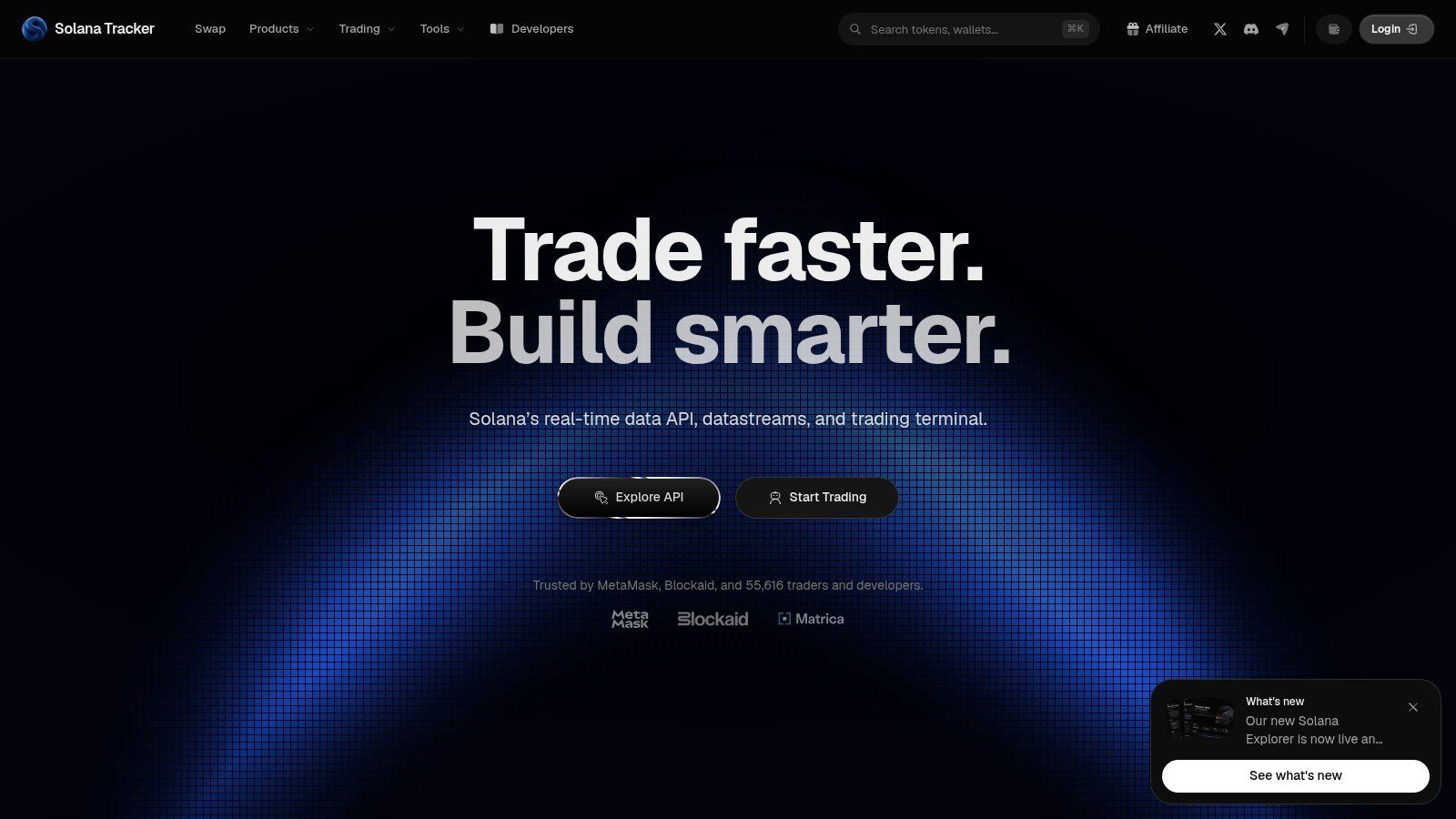
Solana Tracker is the live trading and developer layer in this list. The trading terminal covers charts, one-click swaps, portfolio tracking, and rug detection from the moment a Solana token launches. The Data API exposes 70+ endpoints for tokens, wallets, trades, prices, and risk scores, indexed and served in milliseconds. Datastream adds WebSocket rooms for prices, trades, launches, and wallet activity, with 20+ room types. Rugcheck scores every token from 0 to 10 across 20+ risk factors, including snipers, bundlers, insider wallets, and authority status.
Say a memecoin prints on a new pool. You open the terminal, check whether freeze authority is still live, then pull liquidity additions and removals for that mint. If liquidity can leave in one signature, you size down or you pass. Routing sits on the Raptor Swap API, which aggregates 20+ Solana DEXes, so you are not stuck watching a single venue while price discovery happens somewhere else. Galaxy's Solana Q4 2025 research put Solana decentralized-exchange volume at about $364 billion in Q4 2025, roughly 29% of total on-chain DEX volume that quarter. A one-venue terminal will miss a lot of that flow.
What the risk flags actually mean
A single red badge hides the mechanism. Streamflow's summary of SolRugDetector classified 60,402 of 76,469 flagged Solana tokens as pump-and-dumps, 15,606 as liquidity withdrawal, and 461 as freeze-authority abuse. Those are different trades.
- Concentrated holders: coordinated selling risk, so you watch top wallets, not just the chart.
- Removable liquidity: exit-scam risk, so you read LP events before you buy size.
- Active freeze authority: you can be blocked from selling, so the score is a hard stop until you understand who holds that key.
Practical rule: treat the score as a pre-trade filter, not a promise. I still read authority status and liquidity events myself before I leave a market order working.
Developers get REST, WebSocket, and a TypeScript SDK, plus a free tier if you want to prototype. For polling many wallets, use a basic balance call. Open the full wallet method when someone lands on a wallet page. RPC options include Shredstream and RidgeDB-backed V2 methods built to use about 90% fewer credits, with dedicated nodes and Yellowstone gRPC when a bot or indexer cannot share a public endpoint. We serve 12B+ API calls a month, and teams including MetaMask and Blockaid ship with the data.
What does not work: using the free tier as a production firehose, or treating automated flags as a substitute for your own loss limit. Higher-volume infrastructure is a plan conversation, not a number I will invent here.
2. Dune
You have a hypothesis, not a trade. "Did this Solana launchpad's fee wallets keep more SOL this week than last week?" A terminal will not answer that cleanly. SQL will.
Dune is the custom-research pick. You write queries, fork community dashboards, and publish charts across more than 130 chains. A free tier lets you poke around. Paid plans change export limits, API access, and private workspace features.
The workflow I like is boring on purpose. Clone a dashboard that already decodes the program you care about, then change one filter, such as a fee account or a pool creator. That is faster than rebuilding a warehouse because you wanted a weekly bar chart. It is the same idea that turned Bitcoin's full history into a relationship graph in a 2018 peer-reviewed study: raw ledger rows become addresses, paths, and clusters you can ask questions of.
Where Dune loses to a live book
SQL shines after the launch, not during the first minute.
- Protocol research: fee, user, and volume cuts you define yourself.
- Ecosystem monitoring: one dashboard for several programs, shared with the team.
- Slow questions: cohort retention, wash-trade suspects, or a bridge's weekly volume.
You will struggle if nobody on the team writes SQL, or if the table you need is decoded late. Do not use Dune as your swap button. Usage and private features also move with the plan, so check limits before you promise a client an hourly export.
3. Nansen
A wallet just bought 4% of the supply in two transactions. You do not want another candle. You want a name, a history, and whether that address usually dumps into retail.
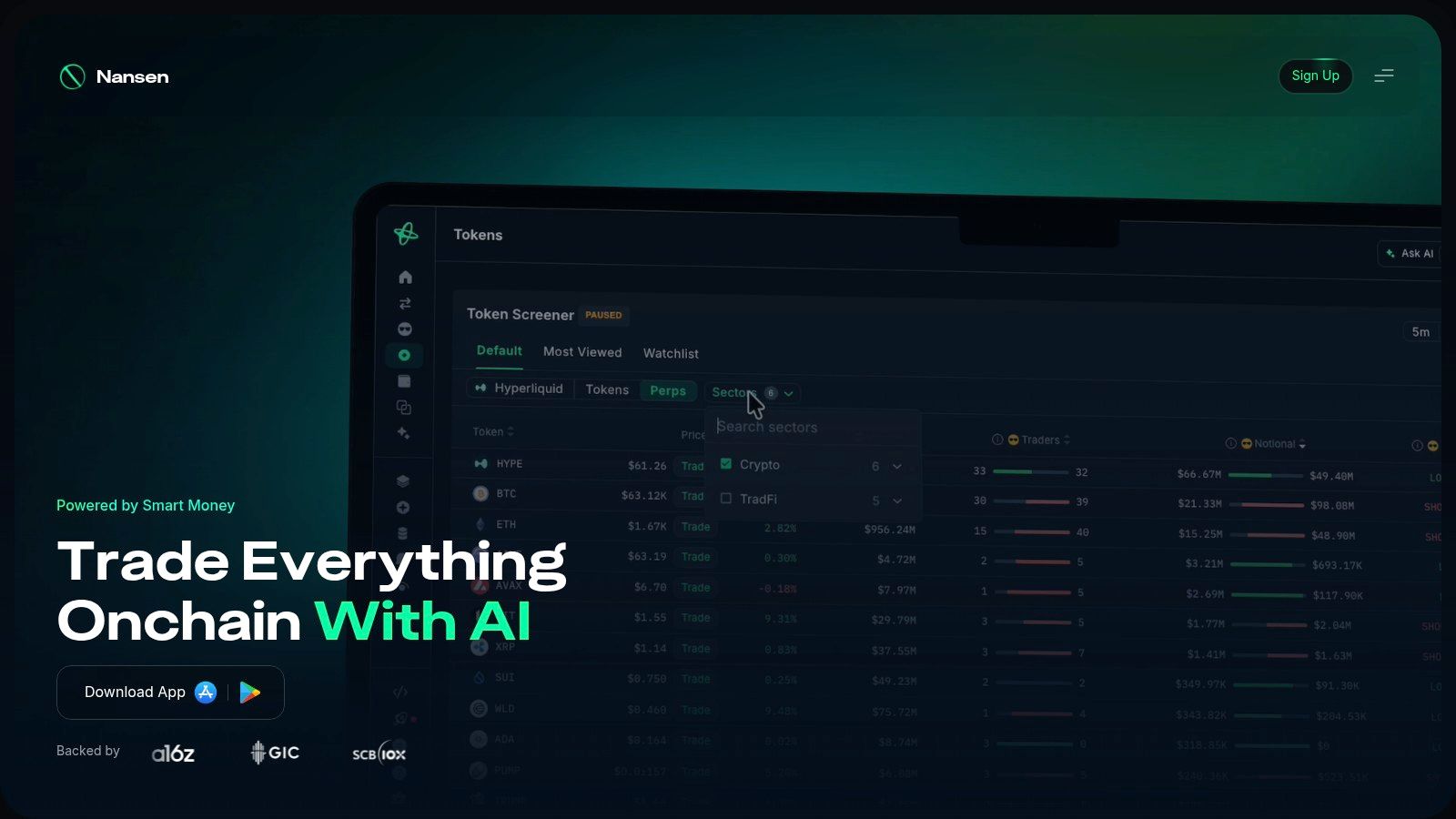
Nansen is labeled-wallet intelligence with Smart Money views, PnL, portfolios, and alerts, on web and mobile, with Solana in the coverage set. API credits are priced separately from the consumer plan. That split matters. A trader can live in the app. A startup piping labels into its own product pays for credits on top.
Labels beat a bare base58 string when you are triaging. They are still intelligence, not a signed confession of ownership. I use them to decide who to watch, then I confirm behavior on-chain. For a Solana-native stream of large wallets beside that research, our whale watch view is the live tape, not a substitute for Nansen's tag set.
Premium features sit on a recurring plan. If you only need a one-off wallet PnL, do not buy a suite you will open twice. If you run a book across Solana and EVM, the cross-ecosystem labels are the reason to stay.
4. Arkham
Someone bridged size, split it across fresh addresses, and started bidding your token. You need an entity page and a picture of the flows, not another SQL dialect.
Arkham connects addresses to entities and people, with transaction history, portfolios, a visualizer, alerts, and an API. Enterprise access is separate. API and Enterprise access is arranged through a sales conversation, so budget a sales cycle if you are embedding it. I open it when the question is "who is on the other side?" rather than "what is the five-minute return?"
A label is a claim with a confidence level. If you cannot see why two addresses were tied together, do not freeze a user or fade a trade on that claim alone.
Investigative work has hard edges. Cross-chain tracking, DeFi interactions, privacy protocols, attribution upkeep, and false positives all create blind spots, and a 2025 survey of blockchain forensics limits notes that models weaken when adversaries change tactics. That matters when an entity cluster is clean today and noisy tomorrow. Arkham's visualizer is still the right tool for walking a counterparty graph. It is the wrong tool if you need a guaranteed owner or uniform depth on every new Solana vanity address.
5. Glassnode
You are not hunting a mint. You are asking whether long-term holders are distributing, and whether derivatives positioning agrees with spot.
Glassnode Studio is structured on-chain and market metrics: supply, holder behavior, realized profit and loss, and derivatives, plus research, API, and newer MCP and CLI access. Higher tiers buy longer history and finer resolution. That is the right shape for a weekly risk meeting. It is a poor shape for a token that did not exist nine minutes ago.
Use it to set context before you trade size in majors. Example: realized profit is high, exchange balances are rising, and funding is stretched. You tighten inventory limits on SOL perps even if a meme on a side pool looks hot. You do not use those same charts to decide whether a brand-new Solana mint is safe. Commercial use and data caps follow the plan you buy, so a shared login for a whole desk will hit the wall.
6. Token Terminal
Two Solana apps both "did a lot of volume." One earns fees. You need comparable numbers, not two screenshots from different Twitter threads.
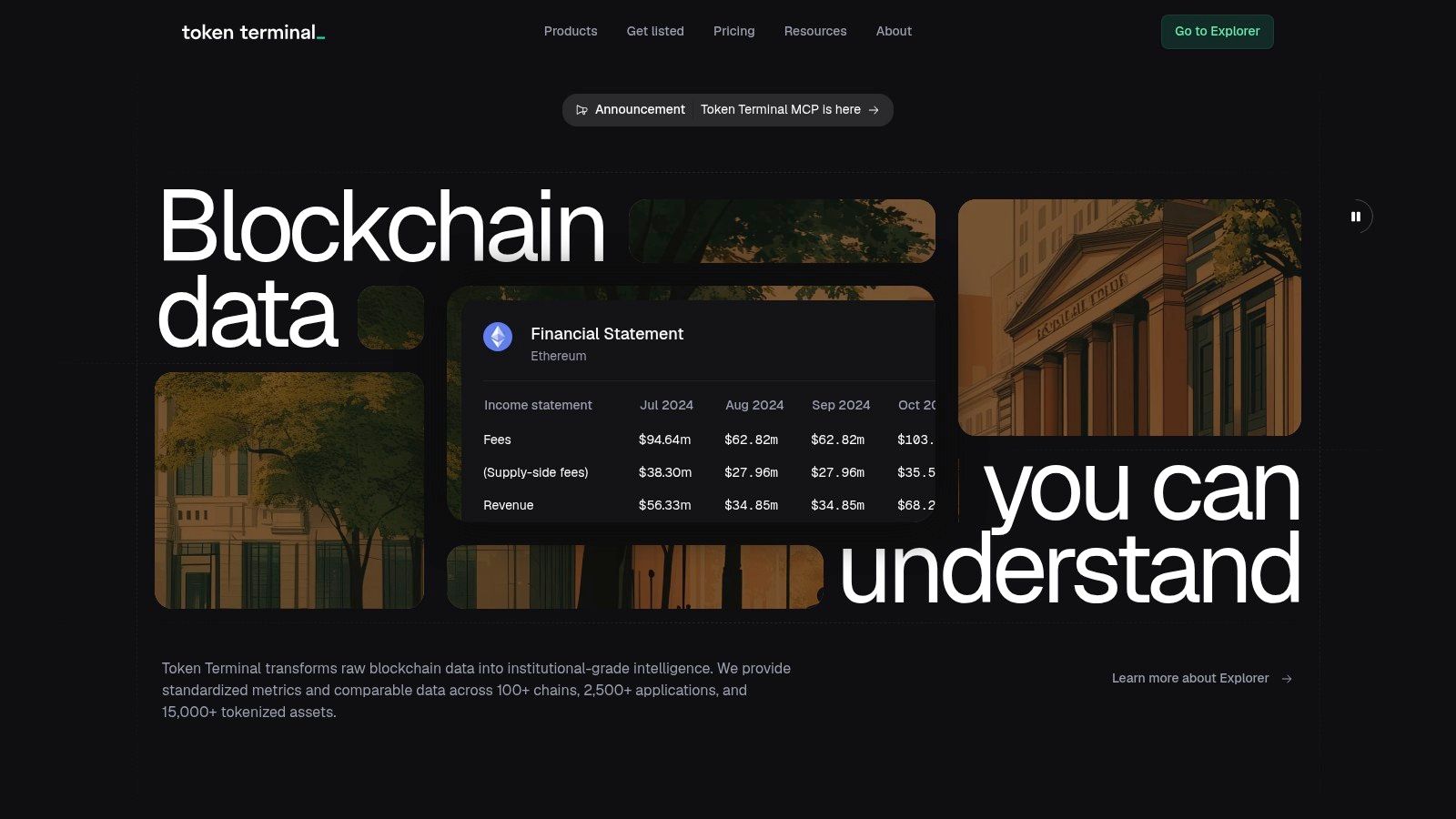
Token Terminal standardizes fees, revenue, users, and history. The company says it covers more than 100 chains and 2,500 applications. You get an explorer, custom dashboards, API and MCP access, plus spreadsheet and enterprise export paths. Free access includes historical data and several analysis features. API and institutional sharing are custom-priced.
This is how I compare a DEX to a perps app without mixing vanity volume and fees. Standardized metrics still miss odd token designs, so I read the fee definition before I rank a protocol in a memo. It will not watch a single whale in real time, and it should not. Pair it with a wallet tool when the question shifts from "is the business real?" to "who is trading it tonight?"
7. CryptoQuant
Your desk cares about coins moving onto exchanges, not about rewriting a SQL model of a lending program.
CryptoQuant leans on exchange flows, reserves, holder behavior, and related market charts, with alerts, saved layouts, research on eligible plans, and a REST API whose history and credits depend on the tier. The free tier is enough to see whether a metric exists. The series you will alert on usually sits behind a paid plan. Retail plans are single-user. Institutional access is custom.
A survey of institutional crypto risk practices found that 47% of surveyed institutions use real-time on-chain analytics to monitor transaction risk and counterparty behavior, and 43% use forensics tools to trace flows. CryptoQuant fits the market-monitoring half of that loop: an inflow spike hits your chat, you cut spot inventory, you do not open a custom query. It is weaker when the question is app-level SQL or a brand-new Solana pool with no exchange footprint. Do not expect it to replace an investigation suite.
8. Artemis
Bridge inflows and app activity are climbing on Solana while another L2 is flat. Stablecoins are the tell. Artemis helps answer where the float is moving before you staff a listing or commit a market-making book.
Artemis standardizes chain and application metrics, with stablecoin activity, cross-chain flows, and ecosystem comparisons. It fits attention allocation: compare ecosystems, spot the venue where activity is concentrating, then point research effort there. It is weak for tracing one wallet or clicking a swap. Use a wallet tracker for address-level PnL and trade history. Use a trading terminal when the next decision is execution.
Venue type still matters inside headline volume. CoinGecko's 2025 industry report recorded $543.6 billion in Solana transactions through proprietary automated market makers, against $671.4 billion through traditional Solana venues. If your dashboard adds those together and calls it one pool, your slippage model is wrong. Artemis gives the ecosystem frame. Pool-level data still decides routing.
Pricing and chain coverage are arranged by quote, so confirm both before you standardize the team on it. That matters most if the desk spans multiple chains and needs the same metric definitions in every review. For a Solana-heavy workflow, I would pair ecosystem comparisons with a terminal that has real-time charts, one-click swaps, portfolio tracking, and built-in rug detection for every Solana token from launch. Artemis tells you where to look. The execution stack tells you what you can trade.
9. Chainalysis
A customer deposited from an address your sanctions list might care about. You need an investigation workflow, an entity link, and a file you can hand to compliance, not a meme chart.
Chainalysis builds Reactor-style tracing and broader risk products for agencies, exchanges, and financial institutions. Access and pricing generally start with a sales conversation. That is a feature if you are an exchange. It is friction if you are a solo trader.
Scale is why the category exists. Chainalysis reported that illicit addresses received about $40.9 billion in 2024, with a provisional path toward $51 billion as more history gets attributed, yet illicit activity was 0.14% of attributed crypto transaction volume in 2024, down from 0.61% in 2023. Stablecoins were 63% of illicit transaction volume in that analysis. A raw transfer does not tell you the category. An investigation product tries to.
I would not buy this stack to snipe launches. I would buy it when an exchange or fintech must trace flows, document exposure, and live with the fact that attributions get revised. Individuals and tiny startups usually overpay for depth they will not staff.
10. Elliptic
Screening a withdrawal wallet at an exchange is a different job from spotting a bundler on a new mint. You want rules you can tune, alerts you can audit, and a way to follow funds across bridges.
Elliptic covers wallet and transaction screening, ongoing monitoring, cross-chain tracing, and configurable risk logic with APIs. Access and pricing are arranged through a business conversation and quoted per engagement. That suits compliance teams with defined policies and review workflows. It adds friction for a solo trader trying to check a launch before buying.
Dataintelo's blockchain-analysis software assessment put compliance management at 38.2% of application demand, which matches where this product sits: screening through investigation, not token discovery. Configurable rules matter because a mixer hop and a sanctioned entity should not land in the same bucket when your policy treats them differently. Cross-chain tracing matters when funds leave the original chain and the case still needs a documented path.
The trade-off is scope. A retail trader wants fast answers on a fresh mint: liquidity, holders, authority status, and whether wallets are clustered around the launch. Elliptic is built for teams that need screening decisions, monitoring, and audit-ready investigation workflows. If your startup only needs a launch-time rug check, the sales cycle and compliance depth will feel oversized.
Blockchain Analytics Tools at a Glance
| Tool | Best For | Free Access | Solana Coverage | Skill Needed |
|---|---|---|---|---|
| Solana Tracker | Solana trading, on-chain data, and risk checks | Free tier available, with paths to higher request volume | Deep, Solana-focused coverage across tokens, wallets, trades, prices, risk scores, liquidity events, and PnL | Beginner-friendly terminal; technical skills for APIs |
| Dune | Custom on-chain analytics and dashboards | Free tier available | Multi-chain data, including Solana datasets | SQL and dataset familiarity |
| Nansen | Wallet intelligence and Smart Money research | Paid plans for premium features | Multi-chain wallet research, including Solana | Basic analytics skills |
| Arkham | Entity-focused address and transaction investigations | Public platform available | Multi-chain coverage for address and transaction research | Basic investigation skills |
| Glassnode | Structured on-chain and market research | Paid plans | Multi-chain market research, with coverage that should be checked against current supported assets | Familiarity with market metrics |
| Token Terminal | Comparing protocol fundamentals and usage | Free access includes historical data and analysis features | Broad chain coverage, with current Solana support checked against the platform | Basic financial and analytics skills |
| CryptoQuant | Exchange flows and market indicators | Free tier for basic metrics | Market and exchange datasets, with current Solana support checked against the platform | Basic chart and market-data skills |
| Artemis | Comparing ecosystem activity, stablecoins, and flows | Free and paid access options vary by dataset | Multi-chain ecosystem analytics, with current Solana support checked against the platform | Basic analytics skills |
| Chainalysis | Enterprise investigations and compliance | Enterprise access; contact the company | Multi-chain compliance and investigation coverage | Professional investigation or compliance experience |
| Elliptic | Business compliance, screening, and risk investigations | Access generally arranged through consultation | Cross-chain screening and tracing tools | Compliance or risk expertise |
The useful split here is workflow, not brand recognition. A trader watching a Solana mint needs live charts, swaps, wallet context, and a rug score in one place. A researcher answering a custom question needs query access. A compliance team needs audit trails and entity risk, not a faster dex route.
| Job to Be Done | Pick | Why It Fits |
|---|---|---|
| Real-time Solana trading and launch checks | Solana Tracker | The terminal combines real-time charts, one-click swaps, portfolio tracking, and built-in rug detection for Solana tokens from launch. Rugcheck scores tokens from 0 to 10 across 20+ risk factors, including snipers, bundlers, insider wallets, and authority status. |
| Developer data and infrastructure work | Solana Tracker | The Data API exposes 70+ endpoints covering tokens, wallets, trades, prices, and risk scores, indexed and served in milliseconds. The product set also includes Solana RPC, Dedicated Nodes, Yellowstone gRPC, and Raptor Swap API. |
| Custom dashboards and historical queries | Dune | SQL-led research works best when the question changes often and the output is a reusable dashboard rather than a trade ticket. |
| Wallet behavior and labeled flows | Nansen | Wallet intelligence is the point, especially when tracking labeled cohorts and Smart Money behavior across ecosystems. |
| Address and entity investigations | Arkham | Entity graphs help when the question is who controls what cluster and how funds moved between addresses. |
| Market structure and exchange data | Glassnode, CryptoQuant | These fit macro and exchange-flow questions: what wallets, exchanges, and market participants are doing over time. |
| Protocol fundamentals | Token Terminal, Artemis | Fees, users, stablecoins, and ecosystem activity matter more here than tick-level execution or meme rotation. |
| Compliance screening and investigations | Chainalysis, Elliptic | These are built for risk decisions, tracing, and review processes, where auditability matters more than a fast UI. |
For Solana-native work, Solana Tracker is the practical default in this list. It is a trading terminal, data API, and RPC platform, with Wallet Tracker showing holdings, PnL, and trade history, and KOL Tracker showing live trades from tracked KOL wallets. KOLScan ranks tracked KOL wallets by all-time performance or over the last 7, 30, or 90 days. That is a tight loop for anyone tracking wallets around a launch.
The trade-off is scope. Solana Tracker is strongest when the asset is Solana and the decision is close to the chain: a token mint, a wallet, a liquidity event, a risk score, or an API call. Dune is better when you want to define the query yourself. Nansen and Arkham fit wallet attribution. Glassnode, CryptoQuant, Token Terminal, and Artemis sit higher up the abstraction stack. Chainalysis and Elliptic sit in a different operating model entirely, where the output feeds a compliance decision.
One practical filter: decide what the output has to be. If it is a fill, a wallet shortlist, or a launch-time risk call, stay close to Solana data and execution tools. If it is a dashboard, an entity map, or a reviewable risk decision, use the tool built for that artifact. Pairing the wrong tool to the job is usually what wastes the most time.
Matching the Tool to the Task: Your Next Step
Match the product to the hour you are in.
- Real-time Solana trading and risk: Solana Tracker, when the token is live and you need charts, routing, and a risk read together.
- Custom research: Dune, when the question is yours and SQL is acceptable.
- Wallet intelligence: Nansen for labeled behavior and Smart Money context, Arkham when you need an entity graph.
- Fundamentals: Glassnode and CryptoQuant for market structure and exchange flows, Token Terminal and Artemis for fees, users, stablecoins, and chain comparisons.
- Compliance: Chainalysis and Elliptic, when the output is an investigation or a screening decision, not a fill.
A practical loop looks like this. A mint appears. You score it and check freeze authority plus liquidity events before you buy. If the score is ugly because of bundlers, you either pass or you size as a scalp with a hard exit. If you take the trade, you trace the top holder wallets in a wallet-intelligence tool and ask whether those labels are observed facts or inferred clusters. The next morning you drop the protocol, if it still exists, into a fundamentals dashboard and see whether fees showed up or only wash volume did. If you run an exchange, the same deposit address goes through a compliance product before you credit the account.
High historical detection rates still fail traders when the alert lands after the exit. One Solana study manually checked 117 rug-pull tokens and, across 100,063 tokens launched on Orca, Raydium, and Meteora in the first half of 2025, classified a large majority as rug pulls, with a random audit putting labeling false positives near 0.26%, while a related test tried to predict trouble from only the first five minutes of trading, as described in this Solana rug-pull paper. I care more about alert latency and what the flag means than about a perfect backtest.
The takeaway is simple. One real-time terminal plus one research layer beats any single tool. The terminal keeps you alive during the launch. The research layer tells you whether the activity was real after the adrenaline fades. Compliance stays a third system if you custody customer funds. Do not ask a SQL notebook to route a swap, and do not ask an enterprise tracer to be your midnight chart.
If you trade or build on Solana, Solana Tracker puts real-time charts, one-click routing across Solana DEXes, wallet reads, and Rugcheck scores in one place so you can judge a launch before liquidity moves. The Data API and live streams are there when you need indexed token, wallet, price, and risk data inside your own app instead of another static screenshot. Visit Solana Tracker and hook the terminal or the API into the workflow you run.