You're watching crypto move fast, you don't have all day to stare at charts, and a trader on your feed keeps posting winning trades. Copying them sounds like the shortcut. You click follow, set an amount, and hope their next win becomes yours too.
That hope is understandable, but it skips a key question. What do you keep after the profit share, trading fees, a later entry price, and any price move caused by followers piling in? A leader can show a strong return while you end up flat or down. Judging crypto copy trading by what lands in your account, not by a headline rank, changes every decision that follows.
What Crypto Copy Trading Means
Crypto copy trading lets you automatically repeat the trades of an experienced trader on a crypto exchange or a Solana DEX. Think of it as following a chef's recipe, except the orders are placed in your own account with your own funds. You choose the chef, but you buy the ingredients and you eat the result.
Three terms cover most of what you'll see. The leader is the trader being copied, the follower is the person copying, and the copied trade is the mirrored order that lands in the follower's account.
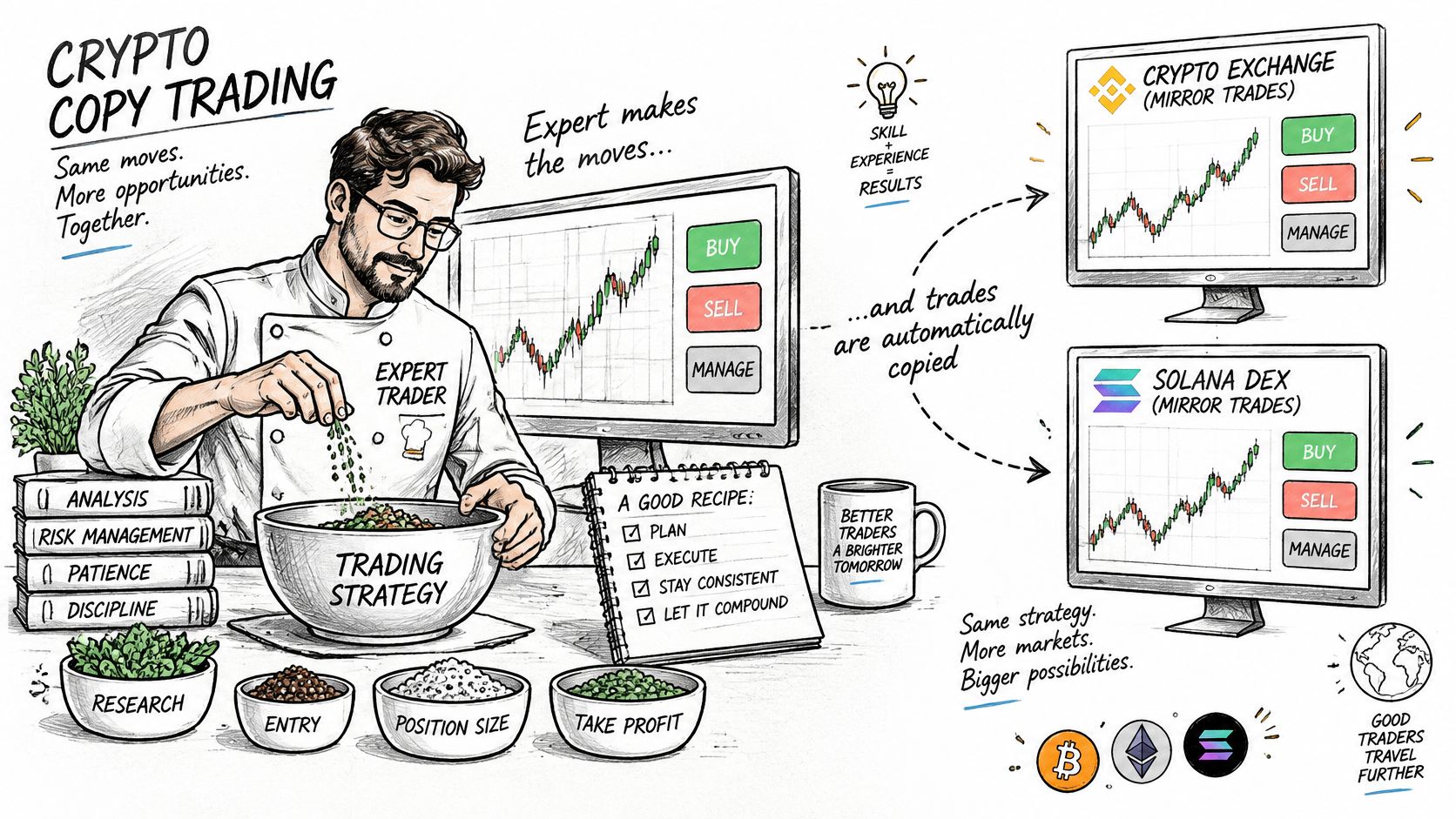
Say a leader buys 0.5 ETH on a spot exchange. Your copy setup doesn't give you their ETH. It places a matching buy for you, sized to the allocation you've set, and later sells when they sell. If you want the basics in plain terms first, an introduction to copying trades from Colibri Trader is a useful starting point.
The idea grew out of social trading. The BIT knowledge hub on social trading traces the model's modern roots to eToro's OpenBook launch in 2010, after which copy trading expanded from traditional markets into cryptocurrency exchanges and derivatives. Crypto suits it well because exchange APIs, perpetual futures, and highly liquid assets let positions be replicated quickly and at scale.
You'll also see big platform numbers quoted online. Treat them carefully. They usually describe one exchange over one chosen period, they're not independently audited, and they don't tell you what a typical follower kept after costs.
In one sentence, a copy setup works like this. You choose a leader, set an allocation, and let the platform mirror each fill into your account.
How a Copied Trade Travels From Leader to Follower
A copied trade isn't one trade shared by everyone. It's a chain of separate orders, and each link can change your price, size, or timing.
The Five Steps
The leader opens a position. They place a trade on an exchange or a Solana DEX with their own capital, at their own price. Nothing has happened in your account yet.
The platform detects the fill. Once the leader's order is filled, the copy system sends a matching order to each follower. That detection and sending takes time, even if it's only moments.
Your size is worked out from your allocation. You don't copy the leader's dollar size, you copy the proportion. The FeeOtter platform comparison gives this example, a lead trader opening a $50,000 Bitcoin perpetual position with $10,000 of trading capital means a follower allocating $1,000 under proportional copying could receive an approximately $5,000 position, subject to platform limits, available margin, rounding, and execution differences.
Your order fills after the leader's. Because your order goes in second, the price may have moved. In fast or thin markets, that gap matters a lot, which is why Telegram copy trading latency and slippage from copyfomo is worth reading if you're copying through chat based tools where delays can be larger.
The leader closes, and your copy closes too. The platform mirrors the exit into your account. If you're in profit, any agreed profit share is then taken from your gain.
The trade sits in your own account the whole time. You hold the position, you carry the loss if it goes wrong, and you pay the costs.
That last point confuses a lot of beginners. You're not sending money to the leader to trade for you. The position is yours, opened in your account, and you'll normally pay the exchange's own maker or taker fee on it. Profit sharing, where it applies, comes on top of that fee rather than replacing it.
Every step after step 1 is a place where your result can drift away from the leader's. The trade idea is the same, but the timing, price, size, and costs aren't.
Why a Leader's Results Rarely Match Yours
Say a leader buys a thin meme token early, when there's hardly any selling pressure. Seconds later, hundreds of follower orders hit the same token. That buying pushes the price up, so later copiers pay more than the leader did. If the price then falls back, the leader may still be in profit while followers who bought higher are already down.
That's the core problem. Crypto copy trading is an execution problem, not just a choice of who to follow. Your order is submitted after the leader's fill, so latency, changing liquidity, spread, and price impact can make your entry and exit materially different, as explained in the ACM quantitative analysis of two major cryptocurrency copy-trading platforms.
The gap can be large. The DropsTab research summary on crypto copy trading reports a sample exceeding 100,000 copy-trading outcomes across three major platforms, where 48.48% of followers were profitable over 90 days, compared with 97% of leaders. That doesn't prove anyone cheated. Leaders often get better liquidity, lower slippage, different position sizing, and faster execution, while followers enter after a signal becomes crowded.
For a broader view of how these gaps show up in practice, copy trading insights from MyFundedCapital can help you compare what platforms promise with what followers receive.
Controls That Limit the Drift
- Maximum execution delay: Skip the copy if too much time has passed since the leader's fill.
- Maximum price deviation: Don't chase the trade if your entry would be too far from the leader's price.
- Liquidity thresholds: Avoid tokens where a small order moves the price.
- Per-token exposure caps: Limit how much one token can take from your allocation.
- Automatic cancellation: Cancel if the leader's position has already changed substantially before your order fills.
Before you risk real money, replay the leader's recent trades on paper. Use your expected delay, your size, and the price you'd likely have got, then compare that result with the leader's headline numbers.
Benefits, Costs and Leverage Risk
Copying can help a lot. It saves research time, lets you spread attention across several traders instead of one idea, and gives you a visible history to study. Watching how a careful trader sizes positions, enters, and exits can also teach you faster than reading theory alone.
But every benefit has a cost attached. This table puts them side by side.
| Factor | Potential Benefit | Main Risk |
|---|---|---|
| Time and research | Copies a strategy without full analysis | Follows a leader who changes approach without notice |
| Entry timing | Mirrors trades automatically | Late fills and slippage can erase the leader's edge |
| Fees | Same exchange fee as manual trading | Profit share of roughly 8% to 20% of profitable returns |
| Leverage | Reproduces the leader's gains | At 100x, a move of under 1% can liquidate the margin |
| Track record | Visible history and follower counts | Short records and rankings can be gamed |
Working Through the Cost Stack
1. Profit share. The Spark Money platform comparison notes exchange-native programs may take roughly 8% to 20% of a copier's profitable returns. In its example, if a copier earns $100 before sharing and the lead trader receives 10%, the copier keeps $90 before trading fees. So the leader's headline gain isn't your gain.
2. Trading fees. You also pay the platform's normal maker or taker fee on your own position. That same comparison shows a $10,000 futures round trip at a 0.05% taker fee would add about $10 in execution costs. One trade looks small. A leader who trades all day can stack those fees up quickly in your account.
3. Entry gap. Here's a hypothetical example. A leader enters a token and later exits with a 2% gain. You entered 2% higher because your order arrived later and follower buying lifted the price. Before fees or profit share, most of that gain is already gone for you, even though you copied the same trade.
4. Amplified exposure. Here, small moves become account ending events. The CoinCodeCap guide to copy trading platforms explains that at 100x margin multiplier, a position's notional value is about 100 times the margin, so a move of less than 1% against the position can consume the initial margin before fees, maintenance-margin requirements, and liquidation rules are considered. In plain terms, $1,000 of margin controlling a $100,000 perpetual position can face liquidation after an adverse move near 1%.
Practical rule: If you copy a highly leveraged leader, you're not just copying their gains. You're copying their liquidation risk too.
Your Net Return Is the Only Number That Counts
Estimate your result this way. Start with the leader's headline return, then subtract the profit share, your trading fees, and the entry gap. What's left is closer to your real outcome.
That simple sum explains a painful surprise many followers meet. The leader shows a profit, the leaderboard looks green, and your account is still down after costs. Nothing went wrong with the copy button. The maths was against you from the start because the strategy's edge was too small to survive fees, sharing, and a worse entry price.
Copy only when the leader's fees, typical exposure, and history are clear, and your own limits are set before the first trade copies. If you can't see those details, you can't judge what you'll keep.
Using Wallet Tracking to Judge a Trader
On a public blockchain, you don't have to trust a screenshot. A wallet's trades, deposits, and withdrawals are visible on chain, so you can check what a Solana trader did rather than what a profile page claims.
Tools make that checking practical. Our KOL Tracker shows live trades from tracked KOL wallets, and wallet tracking lets you follow a single wallet's activity over time. The transfers endpoint is used for deposits, withdrawals, payouts, airdrops and wallet-to-wallet moves, while the trades endpoint is used for swaps. That separation matters because a wallet can look active from transfers alone without ever making a profitable swap.
One filter helps cut noise. The PnL Leaderboard only includes wallets with at least 20 trades across 3 active days, which keeps one lucky bet from looking like a track record.
Why a Wallet Can Look Better Than It Is
A strategy can look exceptional without being reliable. The Coin98 guide to crypto copy trading risks notes research on cryptocurrency copy-trading platforms finds interface design significantly influences copier decisions and rankings can be gamed by leaders seeking novice followers.
Watch for the usual tricks. A trader may run several wallets, keep only the winner public, and abandon the losers. That's survivorship bias, because you only see the account that survived. Others use martingale sizing, doubling down after losses until one win hides the risk, or they start a fresh wallet after blowing up the old one. A short record in one hot meme token can also hide the fact that the apparent profit was never realistically exitable at that price.
On Solana, add a few extra checks. Look at wallet age, where the funding came from, signs of bundled or insider linked buys, how concentrated the tokens are, and whether there's enough liquidity for followers to exit too.
| Check | What to Look For | Red Flag |
|---|---|---|
| Net realized PnL | Profit after fees and price impact | Headline ROI with few realized gains |
| Trade count | At least 20 trades over 3 active days | A handful of trades or one lucky bet |
| Wallet age and funding | Long history and funding not tied to other wallets | New wallet with bundled or insider-linked buys |
| Token concentration | Varied tokens with deep liquidity | Heavy exposure to one thin meme token |
| Drawdown behaviour | Losses survived across several market conditions | Doubling down after losses |
| Re-entry after failure | Consistent record on the same wallet | New wallet after a blown account |
Judge net realized PnL first, meaning profit banked after fees and price impact, not a win rate or an open position valued at a price nobody can sell into. Then check drawdown, which is how far the wallet fell from its peak, and whether results held up across different market conditions.
Wallet tracking improves what you can audit, but it can't remove latency, private order flow, or survivorship bias.
Use it as evidence, not as a guarantee.
Confirm Your Limits Before You Copy a Wallet
Don't start a copy and decide your limits later. Set them first, while you're calm and no trade is moving against you.
Your Pre-Copy Checklist
- Cap each leader. For example, allocate no more than 5% of your trading capital to any single leader, so one bad run can't wreck your account.
- Set a stop-copy rule. Pause copying if the leader's position is already far from the entry price you'd get.
- Set a maximum drawdown limit. Choose a fixed percentage fall for your account that closes all copies automatically.
- Use isolated collateral. Keep each copy separate so one leader's liquidation can't drain your whole balance.
- Review monthly. Compare your net return after fees, profit share, and slippage with the leader's headline return.
Then run one small test instead of going all in. Start with a small allocation, keep it running for at least 30 days, and record every fill. Raise the size only if your net results still hold after all costs, not because the leader had one good week.
During that test, keep checking the wallet you're following against your own fills, including its trades, transfers, and PnL. If you're exploring tools for that work, Solana Tracker's Tools menu lists Explorer, Wallet Tracker, Rugcheck, Token Creator, several leaderboards, Platform Compare and My Positions.
If the test shows a persistent gap between the leader's results and yours, believe your numbers. A smaller allocation to a leader whose edge survives your costs beats a large allocation to a leaderboard star whose edge doesn't.
Before you copy your next Solana trade, check the wallet behind it with live trades, transfers, and PnL data so you can judge what you'd keep after costs. Visit Solana Tracker to track wallets, compare leaderboards, and set up your own careful test before you risk real capital.