You're watching a Solana token climb. You check your entry, glance at the current price, and calculate a profit in your head. Then you sell, open your wallet, and find that the balance doesn't match your estimate.
A crypto profit calculator should help explain that gap. The useful answer isn't just what the token gained. It's what you keep after the trade executes.
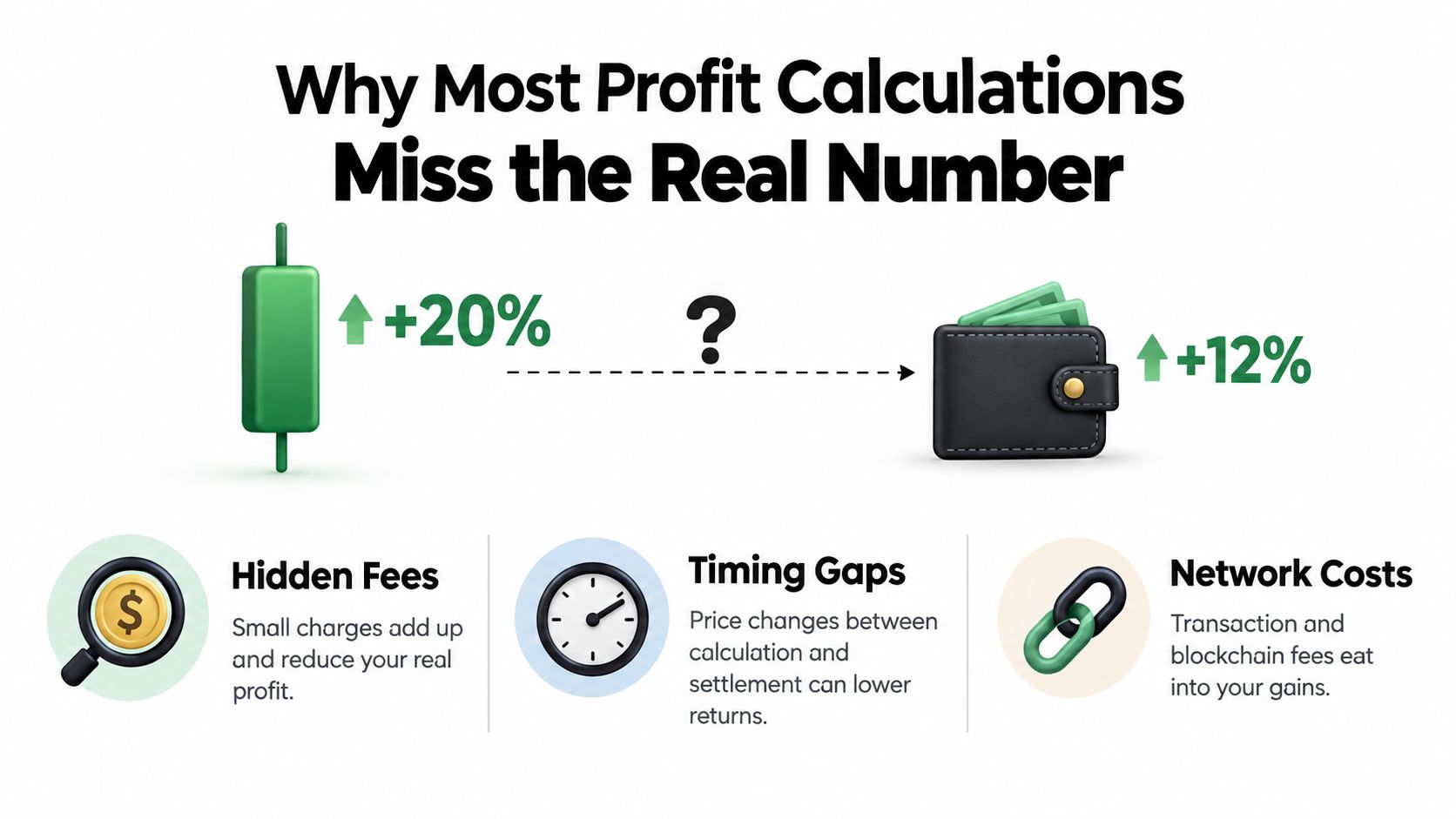
Why Most Profit Calculations Miss the Real Number
A chart shows a price. Your wallet records the outcome of a transaction. Treating those as interchangeable is the first mistake.
A price-only calculator assumes you bought and sold exactly where you intended. It may also assume that trading costs are negligible or that a single fee input covers everything. That's convenient for a rough estimate, but it's a weak foundation for a trading decision.
Execution-aware profit starts with a different question: what happens if the available route doesn't deliver the quoted outcome?
Calculator limitations include spreads, slippage, network costs, and transfer costs, which are useful prompts when checking a tool's inputs against your own trading workflow. See the crypto profit calculator methodology and limitations.
The illustration summarizes why a promising price move doesn't translate directly into wallet profit. Its displayed returns are illustrative, not a forecast.
Separate the assumptions before calculating
- Execution quality: Which route and available liquidity support the quoted proceeds?
- Trading friction: What will venue fees and an unfavorable fill subtract?
- Network spending: What does submitting the transaction cost?
- Unsuccessful attempts: What costs remain if the position doesn't fill?
Practical rule: Treat the displayed profit as an estimate until you can identify every deduction behind it.
For a Solana swap, keep the quote, execution assumptions, and transaction costs separate. That makes the result easier to audit. The worked arithmetic below uses explicit example inputs and public network-fee constants, rather than an unexplained final figure.
The Core Math Behind Any Crypto Profit Calculator
Start with the money going out and the money coming back. Don't begin with the percentage on the chart.
Gross profit = gross sale proceeds − acquisition cost
Net trading profit = gross profit − trading costs − execution adjustments − network costs
The concept map separates terms that calculators sometimes place beside each other without explanation.
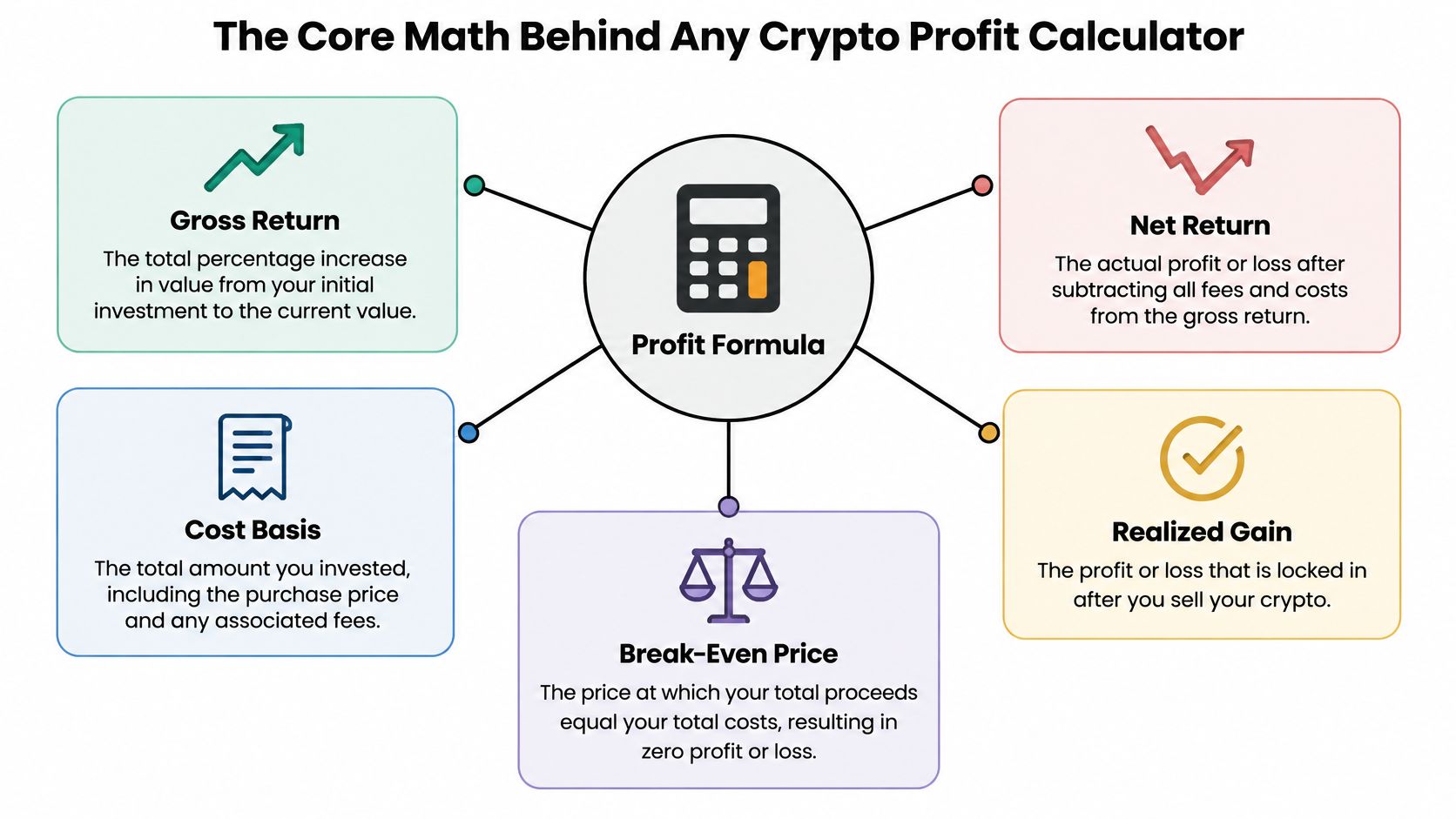
What each result means
| Term | Plain-language meaning |
|---|---|
| Gross return | The price-based result before deductions |
| Net return | The result after the costs included in your model |
| Cost basis | The acquisition value retained for gain calculations, with applicable adjustments |
| Realized gain | The gain associated with a completed disposal, rather than an open position |
| Break-even price | The exit price at which net proceeds match total outlay |
Dollar profit and percentage return answer different questions. Dollar profit tells you how much you made. Percentage return compares that profit with a stated capital amount.
For a net-return calculation, use:
Net return = net profit ÷ total capital committed
Keep that denominator consistent. A calculator using only the token purchase amount won't describe return on capital in quite the same way as one including entry costs.
Break-even also deserves care. If the exit venue charges a percentage fee, the amount deducted changes with sale proceeds. You can't always find break-even by adding a fixed fee to the entry price.
For a fixed token quantity and an exit fee charged on gross proceeds:
Break-even exit price = total recoverable outlay ÷ token quantity after applying the exit-fee factor
Use executed token quantities, not intended quantities. Otherwise, even correct algebra can produce the wrong answer.
For a companion walkthrough, use the video below alongside your own transaction records.
Every Cost Layer You Need to Subtract
Give each cost its own line. A single field labeled “fees” makes it difficult to see whether the calculator includes trading charges, network spending, or both.
Trading fees and execution adjustments
A venue fee is the amount a DEX or aggregator charges under its fee structure. Calculate entry and exit separately because they apply to different transaction values.
Venue fee = applicable trade value × venue fee rate
Slippage is an execution-price difference, not a fee paid to the network. An adverse fill can leave you with fewer tokens on entry or lower proceeds on exit. A slippage-tolerance setting is a boundary for execution, not proof that the entire allowance was spent.
For a practical exit check, compare the quoted proceeds with the proceeds received. Use that difference as the execution adjustment only if the other fee fields don't already include it.
Price impact should also remain visible. Ask whether the route quote already reflects the effect of your order size. Subtracting an adjustment already embedded in the quote would understate profit.
Solana network costs
Solana's base fee is 5,000 lamports per signature, equivalent to 0.000005 SOL, and its optional priority fee is ceil(compute-unit price × compute-unit limit / 1,000,000) lamports when the price is expressed in micro-lamports per compute unit, as described in the Solana transaction-fee documentation.
Cost layers and how each one is calculated
| Cost layer | Typical unit | Formula or constant |
|---|---|---|
| Venue fee | Percentage converted to currency | Trade value × applicable rate |
| Adverse slippage | Tokens or currency | Quoted result minus executed result |
| Base fee | Lamports | Signature count × base fee per signature |
| Priority fee | Lamports | Rounded-up compute-unit price × limit calculation |
| Failed-attempt cost | Lamports, then reporting currency | Sum of charged fees on unsuccessful attempts |
Priority fees are intended to improve scheduling likelihood, not guarantee a successful trade. An unnecessarily high compute-unit limit can increase the fee, while an insufficient limit can cause failure. Solana's fee-structure guidance also identifies getRecentPrioritizationFees as a basis for account-aware congestion estimates.
A failed swap can leave you without a position and still leave you with a network bill.
Before entry, model unsuccessful attempts as an expected cost. After execution, replace that estimate with the fees charged. Don't subtract both.
A serious calculator should expose entry and exit fees, quote assumptions, slippage adjustments, signature counts, compute-unit settings, network-currency conversion, and a retry budget.
A Worked Example With Real Solana Numbers
Consider a hypothetical token swap on Solana, not a live market quote. Keep the acquisition amount separate from the additional entry fee.
Follow the cash movement
The example buys $1,000 of a token at $0.10 and sells at $0.12, producing $1,200 in gross proceeds and a $200 gross gain; with a 0.25% venue fee on each leg, the entry charge is $2.50, the exit charge is $3.00, and combined trading fees are $5.50, following the example inputs associated with the Solana fee calculation reference.
| Calculation | Running result |
|---|---|
| Gross sale proceeds minus token acquisition amount | Gross profit |
| Gross profit minus entry venue fee | Profit after acquisition-side charges |
| Previous result minus exit venue fee | Profit after both venue charges |
| Previous result minus network costs in dollars | Net result under the stated execution assumptions |
The arithmetic is deliberately simple: subtract the purchase amount from sale proceeds, then subtract each trading charge. Don't deduct the purchase amount again when you calculate return.
Add network costs without inventing an exchange rate
The network-fee example uses two signatures, giving a 10,000-lamport base fee; a 200,000-compute-unit limit at 5 micro-lamports per unit adds 1,000 lamports, for 11,000 lamports in total, using the public constants cited in the preceding section.
That illustrates a transaction's fee construction. It isn't automatically the network bill for the entire round trip.
For the round-trip example, the stated network budget is 20,000 lamports, leaving $194.50 minus the dollar value of those lamports, using the worked inputs cited above. A dollar conversion requires an actual SOL valuation assumption, so don't insert an arbitrary exchange rate.
Then add execution-specific deductions:
- Adverse fill adjustment: Subtract the measured shortfall against the comparable quote.
- Congestion adjustment: Replace the network estimate with the fee implied by the submitted transaction settings.
- Failed-attempt spending: Add charged fees from unsuccessful submissions.
No slippage amount or retry charge has been supplied for this trade. The honest result therefore remains conditional, not a fabricated final net profit.
How CoinStats Can Help
A calculator and a portfolio tracker solve related but different problems. The calculator tests a proposed trade. The tracker helps you organize what happened across wallets and accounts.
For a starting estimate, the CoinStats crypto profit calculator offers a place to work through entry, exit, and fee assumptions. Its broader portfolio tools are relevant when manually assembling transaction history becomes the harder task.
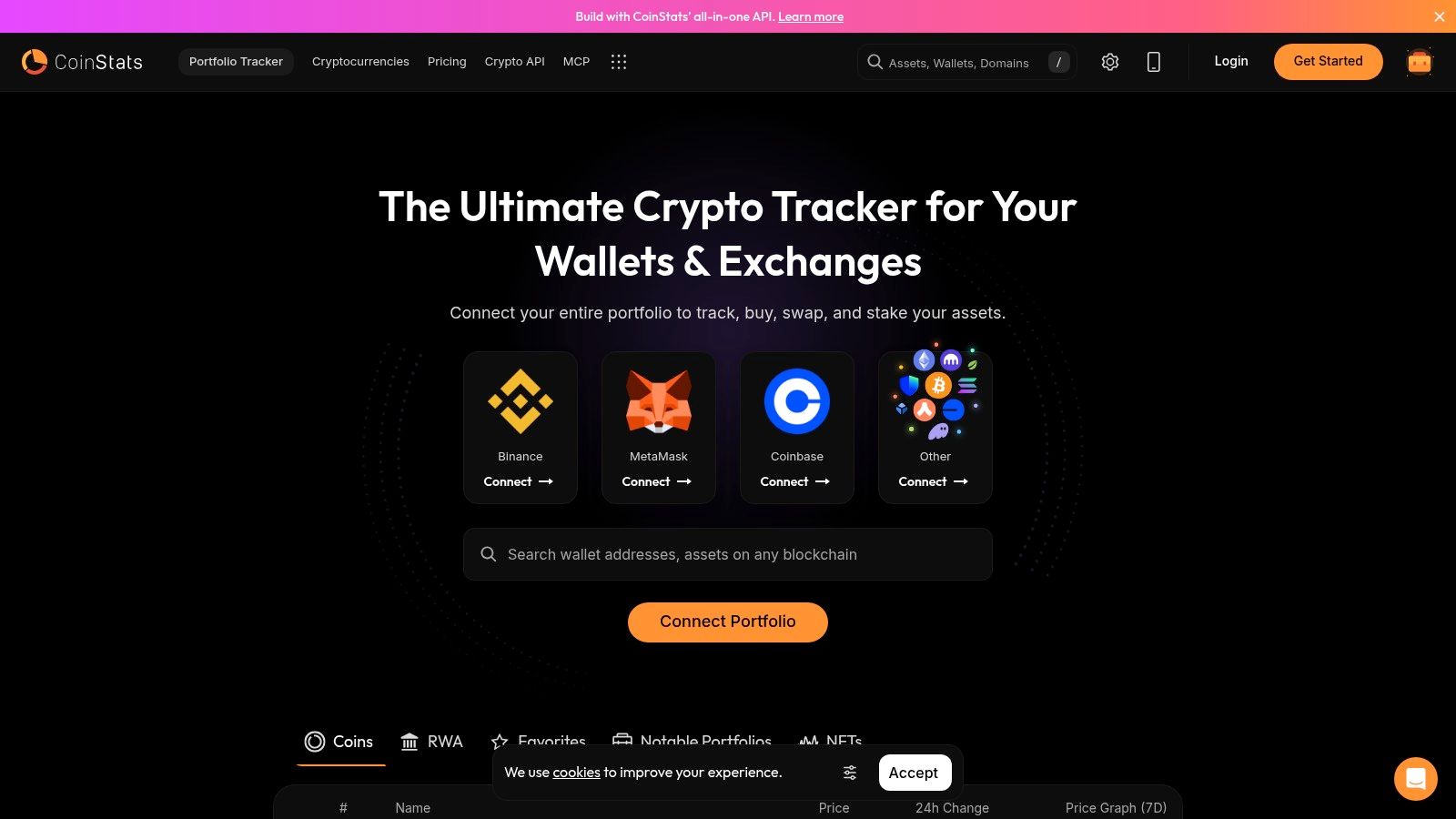
The screenshot shows the portfolio-oriented context around that calculation.
Choose by the problem you need to solve
CoinStats combines connected wallets and exchange accounts with balances, transaction records, portfolio performance, and holdings breakdowns. Its broader feature set includes price alerts, NFT tracking, market research, swaps, staking, calculators, widgets, and developer APIs. Premium features include deeper profit-and-loss analysis and expanded portfolio tracking.
Those capabilities make it worth considering when your main question is, “How do my crypto holdings and completed trades fit together?” They don't remove the need to inspect the assumptions behind a prospective swap.
| Approach | Useful for | What you should still verify |
|---|---|---|
| Calculator | Testing entry and exit assumptions | Which execution costs it includes |
| Portfolio tracker | Reviewing holdings and transaction history | Completeness of records and acquisition data |
| Execution-focused workflow | Comparing quotes and submission conditions | Final fills and charged transaction fees |
Solana Tracker is another option for Solana-specific wallet PnL tracking, including realized and unrealized results, cost basis, and token-level performance.
For the same proposed trade, keep separate best-fill, ordinary-fill, and congested-chain estimates outside the headline result unless the chosen tool explicitly models them. Portfolio visibility isn't the same thing as execution simulation. Choose CoinStats for a consolidated view, then verify swap-specific assumptions against the transaction and route data available to you.
Three Routing Scenarios for the Same Trade
Keep the acquisition and intended exit unchanged. Change only the execution assumptions. That isolates what routing and submission conditions can do to the result.
The illustration uses Bitcoin labels, but the comparison method also applies to a Solana swap. Its displayed price outcomes aren't inputs to the worked example.
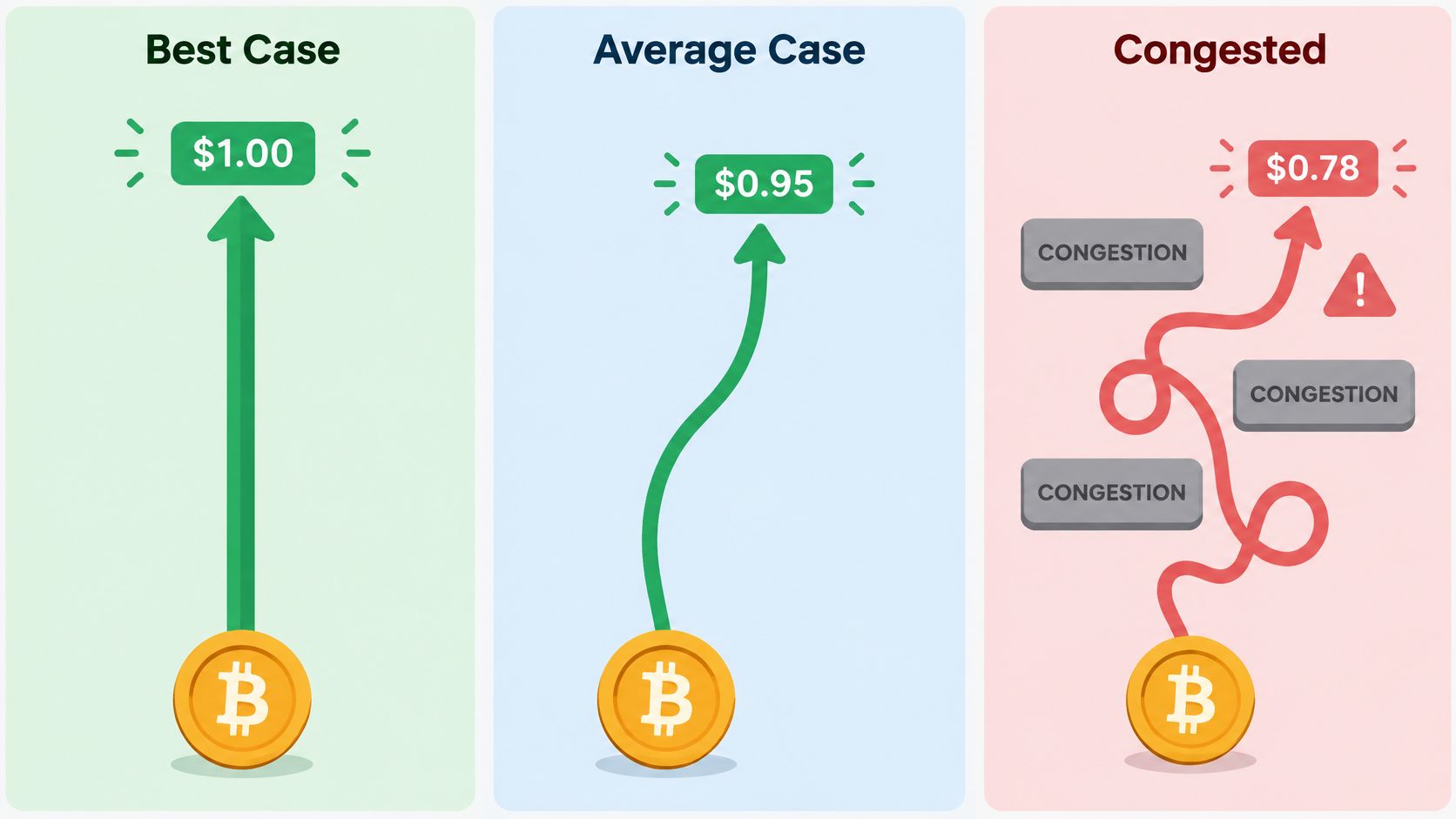
Compare outcomes without pretending to know their probabilities
| Scenario | Execution assumption | Calculator treatment |
|---|---|---|
| Best case | Fill matches the comparable quote | Deduct disclosed trading and network costs |
| Average-case planning scenario | Fill is somewhat worse than quoted | Add the adverse execution adjustment |
| Congested chain | Higher submission spending and an unsuccessful attempt before completion | Use revised network settings and include charged failed-attempt fees |
“Average case” is only a planning label here. Without historical observations, it isn't a measured average.
Likewise, a scenario table isn't a statistical probability distribution. To calculate expected profit, you need defensible probabilities for the modeled outcomes. Without those probabilities, show a range of conditional results instead.
Don't hide an uncomfortable execution scenario by averaging it with a favorable one.
The practical value is in the decision before entry. If a trade looks attractive only when the quote holds perfectly, you can reassess the size, route, or willingness to trade. That doesn't guarantee a better outcome, but it makes the assumption explicit.
Keep reporting assumptions constant across the comparison. Preserve the acquisition records, acquisition and disposal dates, and documented fees. Apply any jurisdiction-specific tax estimate only after calculating the scenario's trading result.
Don't label a scenario “after tax” merely because a generic percentage has been subtracted. The tax model needs its own inputs and qualifications.
Adding Cost Basis and a Simple Tax Estimate
A wallet balance change isn't a complete gain calculation. You also need the acquisition history behind the asset you disposed of.
For U.S. users, the IRS generally requires reporting gains or losses on digital-asset disposals and identifies asset type, transaction date and time, units, U.S.-dollar fair market value, and basis as relevant records. In its illustrative example, buying 2 SOL at $80 each creates a $160 basis; selling at $120 each produces $240 of proceeds and an $80 gain before fees, while $4 of documented fees leaves a $76 economic gain, subject to applicable reporting treatment, as outlined in the IRS digital-asset transaction guidance.
Economic profit isn't automatically taxable gain
The example's arithmetic is straightforward. The tax classification of each cost requires the applicable rules and supporting records.
A useful reporting layout keeps these fields separate:
- Gross proceeds: The value received before the relevant deductions.
- Acquisition basis: The retained purchase history and applicable adjustments.
- Documented fees: Costs linked to acquisition, disposal, and other activity.
- Realized result: The gain or loss calculated from those records.
- Illustrative tax estimate: A jurisdiction-specific estimate, not a universal rate.
For a developer-facing reporting workflow, the Solana wallet PnL history and currency API resource is relevant to organizing historical profit-and-loss information.
Challenge the shortcut
Don't substitute current portfolio value for proceeds, omit basis because assets arrived from another wallet, treat every economic expense identically for tax purposes, or apply a generic tax rate to every trade.
Keep acquisition and disposal timestamps so the applicable holding-period rules can be evaluated. If basis records or tax treatment are unresolved, show the trading result and leave the tax estimate qualified rather than manufacturing precision.
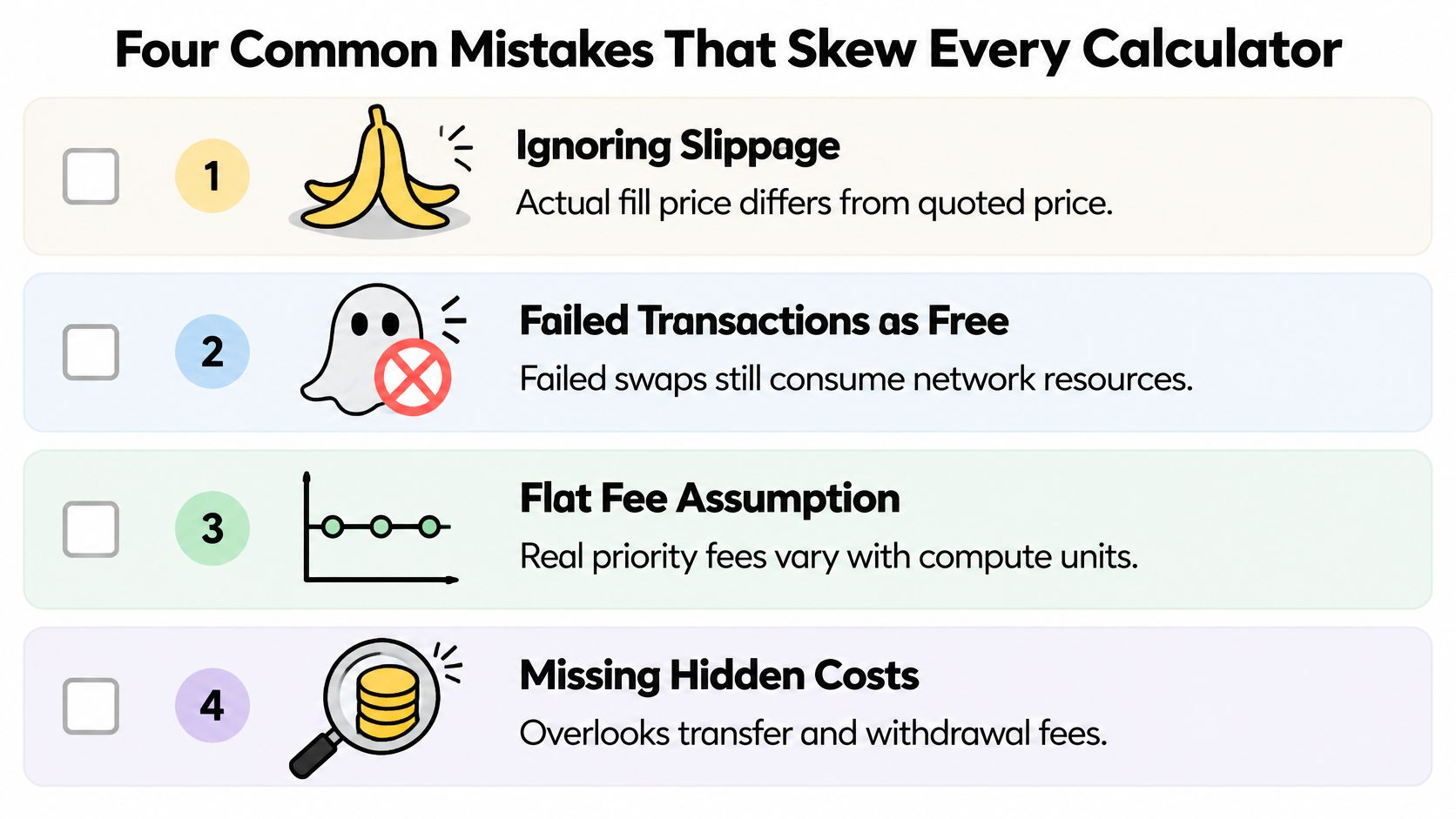
Four Common Mistakes That Skew Every Calculator
A calculator can perform arithmetic correctly while answering the wrong question. The problem is often an omitted input rather than a broken formula.
Use the graphic as an audit prompt, then inspect the calculation itself.
Check the substitution behind each error
| Mistake | Misleading calculation | Corrected approach |
|---|---|---|
| Ignoring slippage | Quoted proceeds minus acquisition spending | Use executed proceeds or a clearly labeled execution scenario |
| Treating failures as free | Count only successful-swap spending | Include charged unsuccessful-attempt fees |
| Assuming a flat network bill | Apply an unchanged fee allowance | Use transaction-specific signature and compute settings |
| Confusing price change with realized return | Present chart appreciation as wallet profit | Calculate net profit against a stated capital denominator |
The dollar gap for any omitted item is the dollar value of that item. If the actual fill, failed-attempt charge, or network conversion is missing, the gap is unknown, not negligible.
Audit deductions in both directions
Overstating costs is also possible. A calculator may subtract venue fees already reflected in proceeds, or deduct both estimated and actual retry spending.
- Check the quote definition: Determine which charges the displayed amount already includes.
- Check the records: Match each deduction to an estimate or an actual transaction.
- Check the labels: Separate forecasts, open-position valuations, and completed-sale results.
The earlier worked trade remains profitable under its stated inputs. There's no basis for claiming it becomes a loss without additional measured costs.
Treat the calculator output as a result to reconcile. A neat display doesn't establish that the inputs are complete.
A Closing Checklist Before You Trust Any Number
Before submitting a Solana swap, turn the profit estimate into a small decision record. Save the assumptions so you can compare them with the completed transaction later.
- Confirm entry and exit assumptions: Record the token quantity, acquisition spending, intended proceeds, and whether fees are already included.
- Set an execution band: Keep favorable and adverse fill assumptions separate. Don't confuse tolerance with expected spending.
- Estimate priority spending: Use recent account-relevant fee information and the intended compute settings.
- Choose a failed-attempt budget: Decide what unsuccessful submissions would cost and when you'd stop retrying.
- Calculate net return last: Convert network spending consistently, remove duplicate deductions, and use a clear capital denominator.
A crypto profit calculator is most useful when it exposes uncertainty instead of disguising it. A range tied to execution conditions is more actionable than a confident answer built on an untested quote.
After the swap, replace estimates with actual fills and charged fees. Reconcile the result with your wallet records before calling it realized profit.
Take your next proposed Solana trade and build the cost table before you submit it. Compare the quoted-fill and congested-chain outcomes, decide whether both fit your risk budget, and save the calculation so you can check what you kept.