Your bot bought at 2 a.m. The API answered with a success code, your dashboard drew a fresh position, and you went back to sleep. By morning the wallet balance hadn't changed and the price had moved without you.
Nothing in that response was technically a lie. The request was accepted. The trade never landed. That gap between an API that answers and an API that executes is where most crypto trading projects get hurt, so judge a crypto trading API on two things: whether trades land and whether the data feed stays intact.
What a Crypto Trading API Is
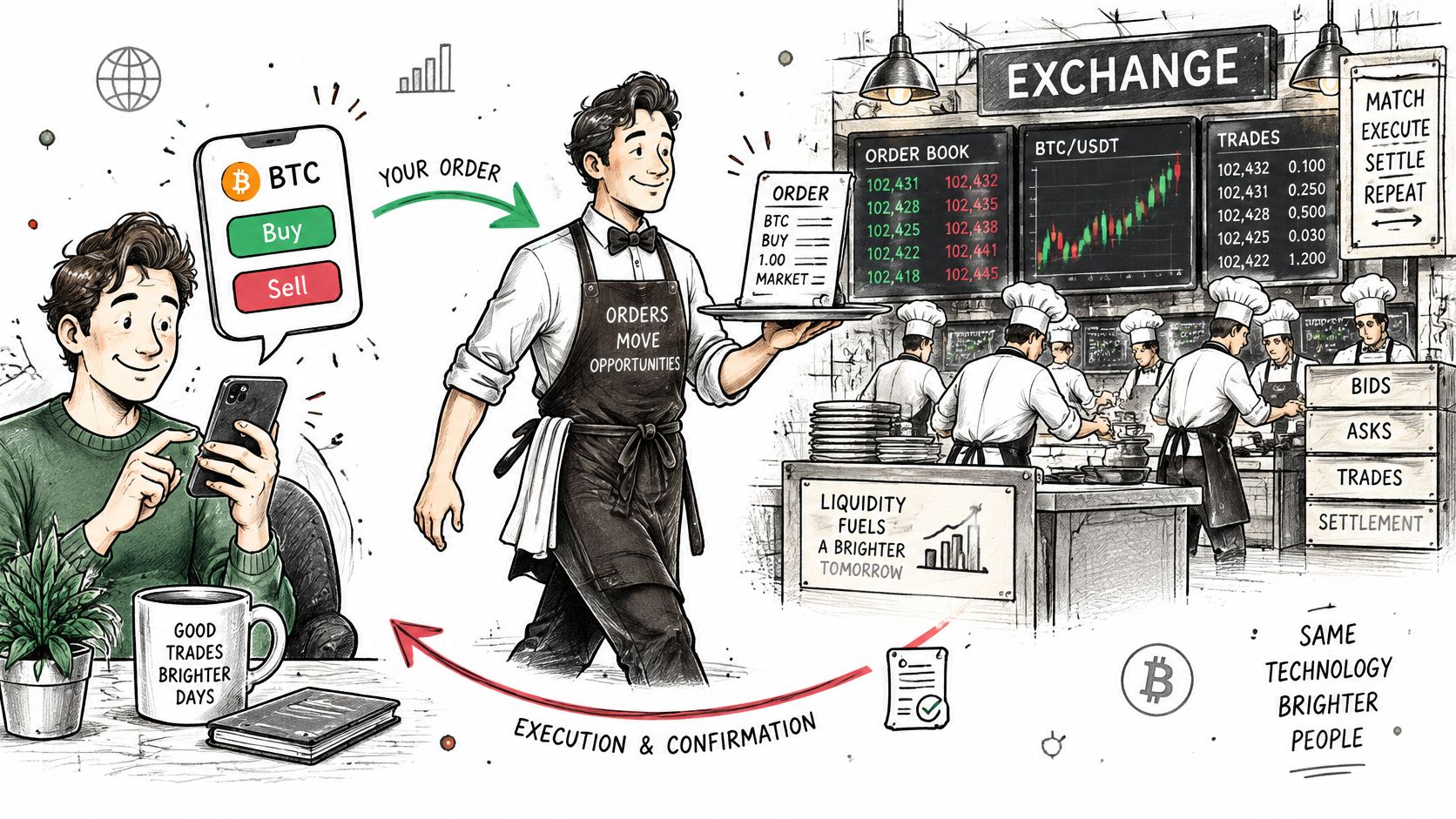
Think of an API as the waiter between your table and a busy kitchen. You don't walk into the kitchen, shout at the chef and grab the plate yourself. You give the order to the waiter, the waiter carries it back, and when something goes wrong in the kitchen, the waiter is the one who tells you.
A crypto trading API is a set of endpoints and live streams that let software read market data, place and cancel orders, and check balances without anyone clicking a screen. Your code sends the request, the API carries it to the exchange or the blockchain, and the result comes back as structured data.
Every trading flow passes through that same middle layer.
Three everyday examples show the range:
- A price bot: it checks the Bitcoin price every second and buys when the price crosses a level you set in advance.
- A wallet swap screen: it shows a quote for SOL to USDC, with the expected output and fee, before the user taps confirm.
- A market dashboard: it lists the last few hundred trades for one token so a trader can see where the volume is coming from.
Developers reach for an API for three reasons. Automation means the system acts while you sleep. Speed means milliseconds instead of a human reaction time. Breadth means one connection instead of the alternative: the CoinAPI market data product consolidates trades, quotes and order books across more than 400 spot and derivatives exchanges, work no small team wants to duplicate venue by venue.
There's one distinction that confuses people early. On a centralized exchange such as Coinbase or Kraken, the exchange matches your order inside its own system. On Solana, a swap runs on-chain through decentralized protocols, so the API builds a transaction, you sign it, and the network executes it. The API is the bridge between your code and the market, and on Solana that bridge includes the transaction itself.
REST, WebSocket and FIX Compared
A bot misses a fill because it polled a REST endpoint every five seconds while the price moved in two. That failure is a transport choice, not a code bug. Three interface styles appear in crypto documentation, and the fastest way to pick one is by the job it does, not by how modern it sounds.
| API style | Best for | How data arrives | Typical user |
|---|---|---|---|
| REST | Placing, canceling and querying orders; historical candles | On request, one response per call | Backend services and simple bots |
| WebSocket | Live prices, trades and order book updates | Pushed continuously over one open connection | Trading dashboards and market makers |
| FIX | Institutional order routing and execution | Session-based standard messages | Funds, brokers and institutional desks |
REST behaves like a question and an answer. You send one request and get one response: submit an order, cancel it, read a balance, or pull the last 200 one-minute candles. Every call stands alone, which makes it simple to debug and easy to retry.
WebSocket opens a single connection and keeps it open while the server pushes updates. This is the right tool when a price change needs to reach the screen the moment it happens, and polling would either be too slow or too wasteful. Polling every five seconds means your data is, on average, two and a half seconds stale. A stream removes that gap.
A naming detail catches people out. Coinbase's developer documentation warns that feed messages can be dropped or arrive out of order even over TCP, so a WebSocket consumer must check sequence numbers and resynchronize when continuity breaks. In practice that means keeping a book locally, fetching a REST snapshot when a gap appears, and replaying buffered messages against it. A live socket is not the same thing as a complete feed, and a bot that trades on a stale book will misprice its orders.
FIX is the older session-based protocol institutions use to route and confirm orders with brokers and venues. Most crypto apps never touch it directly, but you'll see it listed on institutional product pages, and it's the reason a fund can connect without rewriting its order management stack.
Rule of thumb: choose the transport by the task, not by what looks newest. Live market data belongs on a stream, and one-off actions belong on a request.
The pattern most bots settle into combines all of it: WebSocket for the price move that triggers the decision, REST for the order that follows. The test that matters is not the advertised latency of either channel. It is whether the order lands at the price the feed showed, and whether the feed stays intact while it does.
Core Features for Orders, Market Data and Routing
Three feature groups do most of the work in any trading integration.
Order execution covers placing market and limit orders, canceling or modifying them, and checking status. One detail saves real money: give every order a client order ID you generate yourself, so a retry after a timeout can be matched against the original instead of creating a second trade. Without it, a flaky network turns one intended buy into three.
Market data covers last price, order book depth, recent trades and OHLCV candles (open, high, low, close and volume for each interval). Depth matters because a book showing only the top bid and ask hides how far a large order will push the price. Historical candles matter for backtesting, where you test a strategy against past years before risking funds. Volume definitions matter too: Coinbase's trade volume documentation states that its 24-hour volume includes block trades and block RFQ trades while excluding position moves, so two venues can report very different numbers for the same asset.
Account data covers balances and open orders, and it's the state you reconcile against after every fill.
Then there's routing. Say you want to buy 1 SOL. Venue A quotes 150.20 USD and Venue B quotes 150.05 USD after its fee. A best-price router checks several venues or pools, compares the net result after fees and slippage, and sends your order to B. Hosted swap APIs handle that search for you; our Raptor Swap API routes across 71 Solana DEXes so a single call covers the comparison.
Set a slippage limit as well, such as 0.5%, which cancels the trade if the price moves past that band before it fills. Before trusting any of these features, test three things: the fill price you get, how a rejected order is reported, and how old the data is when it reaches you.
Latency and Reliability on Solana
Latency splits into two halves, and vendors usually quote only the first. The first half is the time from a market event to your app seeing it. The second is the time from your decision to the trade landing on-chain. A quote that returns in 50 milliseconds tells you nothing if the transaction behind it never confirms.
Solana imposes hard limits that shape every trading API built on it.
| Solana limit | Value | What it means for your API |
|---|---|---|
| Transaction size | 1,232 bytes | Large multi-hop swaps may need to be split or routed differently |
| Accounts per transaction | Normally up to 64 | Routes touching many pools can exceed it; address lookup tables help |
| Blockhash validity | 150 slots | Refresh the blockhash and submit before it expires |
| Default compute per instruction | 200,000 units | Simple actions often need no more than this |
| Maximum compute per transaction | 1.4 million units | Caps how complex one transaction can be |
Those caps come straight from Solana's transaction documentation, and a router that ignores them produces transactions that are rejected before they ever reach a validator.
Fees are the other half of the design. Every transaction pays a base fee of 5,000 lamports per signature, with half burned and half paid to the validator. The optional priority fee is calculated as ceil(compute-unit price × requested compute-unit limit ÷ 1,000,000) lamports and goes entirely to the validator, as Solana's fee structure guide explains. Because the fee uses the requested limit rather than actual consumption, a swap asking for 200,000 compute units at 10 micro-lamports adds 2,000 lamports, while the same swap asking for 1,000,000 units adds 10,000 lamports for identical work. Solana's fee guidance recommends setting the limit from an estimate of the transaction's needs, so estimate and add a small margin.
Congestion is the reliability problem you can't design away. An academic study of more than 1.5 billion failed Solana transactions found failure rates can exceed 75% during congestion, against roughly 1% to 3% on Ethereum, with some heavily used programs above 95%.
Ask this before you sign up: what share of submitted swaps actually land, what reason is attached to each failure, and does the service fail over to another RPC node when one degrades?
Diagnose a failed trade in order
Work through failure causes from cheapest to most expensive:
- Expired blockhash. The transaction missed the 150-slot window, so fetch a fresh blockhash and resubmit.
- Dropped with a valid blockhash. The priority fee was too low for current congestion, so re-estimate it.
- RPC error with no on-chain signature. The node is the problem, so fail over to a second endpoint.
Log three numbers yourself: quote-to-submit time, submit-to-land time, and failure reason. Those beat any headline latency claim. For the feed, compare message sequence numbers, replay missed events, and drop prices older than your staleness limit before acting. If you'd rather not share a public endpoint, dedicated nodes give you a private one.
Security and Rate-Limit Best Practices
Start with keys, because a leaked key is the one failure that loses funds instead of time.
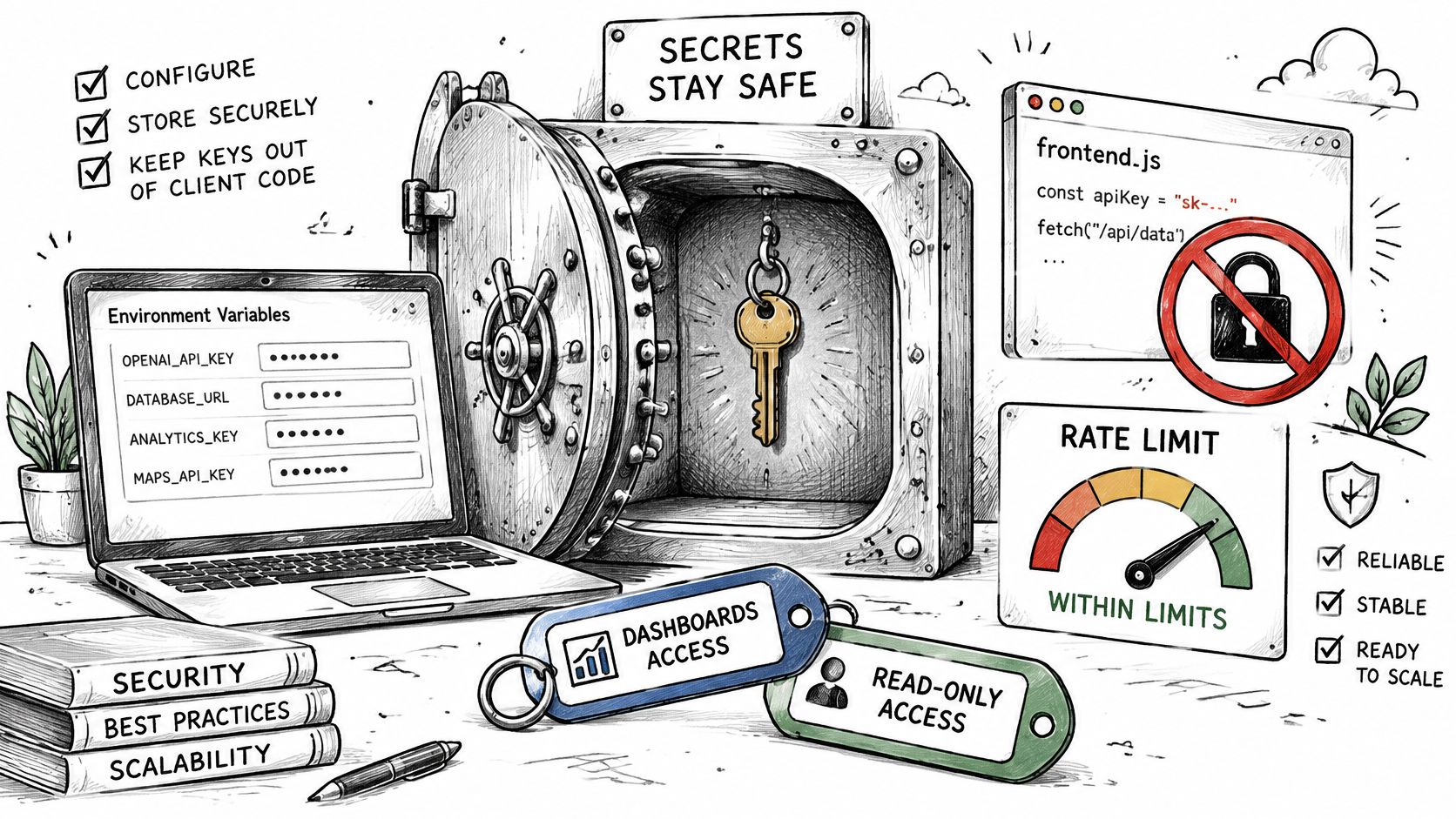
Store credentials in environment variables or a secrets manager, never in front-end code or a public repository. Give each application its own key so you can revoke one without breaking the rest. A dashboard gets a read-only key; only the bot that places orders gets a trade-enabled one. Turn off withdrawal rights on every trading key, and use an IP allowlist where the provider offers it. Rotate on a schedule, every 90 days is a reasonable default.
The point is blast radius. A bot that can only place orders and cannot withdraw means a stolen key costs you confusion, not your balance.
Rate limits are the other wall. Solana's official RPC guidance lists HTTP 429 when request limits are exceeded and HTTP 403 when traffic is blocked, which is exactly what a polling-heavy app runs into, and it recommends WebSocket subscriptions such as accountSubscribe or signatureSubscribe for balance changes instead of repeated calls, per the Solana RPC documentation. Coinbase publishes similarly concrete caps, including 750 WebSocket connection attempts per second per IP and 8 unauthenticated messages per second per IP on one Advanced Trade endpoint, as its WebSocket rate limit page states. Scale workers behind one NAT gateway and they all draw from the same allowance.
Practical rule: a dashboard key reads. A trading key writes. Nothing needs both.
When a 429 arrives, stop sending immediately, wait with exponential backoff (1, 2, then 4 seconds) plus a small random offset, retry a bounded number of times, then resume at a lower rate and log the event. Cache anything that doesn't change every second, such as token metadata or trading pair lists.
Integration Patterns and Example Workflows
Three patterns cover most of what teams build.
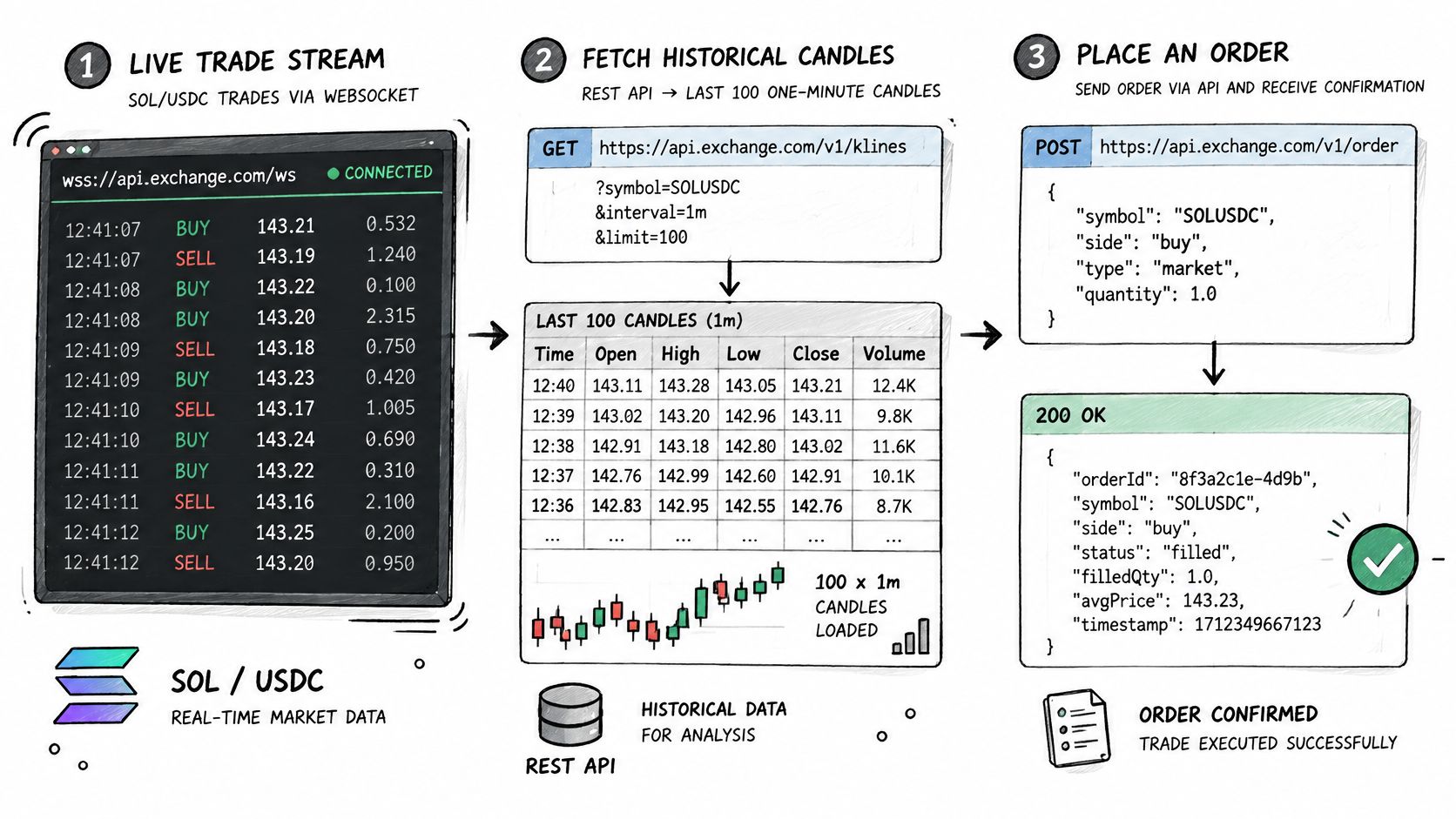
A price dashboard
A WebSocket subscription streams SOL/USDC trades to the screen as they print, while a single REST call loads the last 100 one-minute candles when the page opens. The chart draws instantly from history and then extends itself with live updates, with no refresh button anywhere.
A swap bot
The details matter most here. Using a hosted swap API such as Raptor Swap, the flow runs:
- Request a quote for the trade.
- Check price impact against your slippage limit.
- Build the transaction with a fresh blockhash.
- Sign it with a key that stays on your server.
- Submit it.
- Confirm the result through a signature subscription.
- Log the outcome, including the failure reason if there is one.
Keep one number in mind throughout. Buying 2 SOL at a quote of 150.00 USD with a 0.5% slippage limit means the trade must fill at or below 150.75 USD, or it gets rejected. If the book moves to 151.10 while your transaction is in flight, the rejection is the system working, not failing.
A wallet app
REST returns balances on login. A WebSocket feed then reports incoming transfers, so a deposit of 10 USDC appears within seconds without the user pulling down to refresh.
Use live streams for anything that changes often, and REST for anything you act on once.
Choose the Right Crypto Trading API Provider
A provider can quote low latency and still lose your trade. Score each option by whether orders land and whether the stream stays whole when the market gets busy.
| Criterion | What to check | Red flag |
|---|---|---|
| Market coverage | Which exchanges, DEXes and pairs you need | Only one venue for a multi-venue plan |
| Transport | REST plus WebSocket, with documented sequence numbers | WebSocket with no reconnect or gap guidance |
| Historical data | Years of history and candle granularity such as 1-minute | No history or only recent data |
| Reliability | Published uptime, failover RPC and an incident record | No status page or incident history |
| Rate limits | Published per-key and per-IP quotas | Undocumented or vague limits |
| Fees | Free tier, per-request cost and how priority fees are set | Hidden costs or unclear fee handling |
| Security | Key scopes, withdrawal controls and IP allowlists | One all-powerful key for everything |
The reliability row deserves more weight than the uptime badge. Galaxy's research on Solana's fourth quarter recorded the network's first full year without downtime, with slot times near 400 milliseconds through the Agave 3.0 rollout. Even a healthy chain can sit behind an unstable API, so ask how the provider behaved during congestion, how often clients reconnect, and whether missed messages are recoverable.
Then run the decision in six steps:
- Write down the task: dashboard, bot, wallet or exchange feature.
- Pick the transport that task needs.
- Shortlist two or three providers covering your chains and venues.
- Test each on small size or in a test environment for at least a week.
- Measure landing rate, data gaps and failed-order reasons.
- Choose the best measured results, not the best advertised numbers.
For Solana work, three Solana Tracker products map onto this list. The Data API exposes 70+ endpoints for tokens, wallets, trades, prices and risk scores, indexed and served in milliseconds. The Raptor Swap API is free and hosted across 71 Solana DEXes with JIT routing, and you can self-host the binary if you need to; swaps are executed on-chain through decentralized protocols, with Solana Tracker acting only as the interface. The Datastream carries real-time WebSocket feeds for prices, trades, launches, wallet activity and volume across 20+ room types with unlimited messages. If your strategy also depends on following large holders, combine on-chain wallet tracking with any disclosure feeds you trust, including resources that track whale activity and filings.
Start on the free tier and spend that first week measuring rather than reading marketing pages. You can test this on Solana today with Solana Tracker's Data API, Raptor Swap API and Datastream feeds, then judge the result by landed trades, gap handling and clear failure reasons. Start at Solana Tracker.