A market count ranking makes Polymarket alternatives look interchangeable. They are not. The split that matters is fiat brokerage versus self-custodial on-chain markets, because that choice decides which wallet you hold, how quickly you can exit, and what settlement records you keep.
Market count also hides what trades. The Congressional Research Service summary on prediction markets gives a broad overview of prediction markets. In practice, you may be comparing sports and current-event books on different rails, not political forecasting tools with the same funding path.
The friction is concrete. USDC on Base can move into a Limitless market after a wallet connection, spend approval, and share purchase. That is a short on-chain path. Moving the same dollars to a fiat venue adds a bank rail, an identity check, and a settlement window. If your position is wrong on a Sunday night, the difference is real.
Funding creates the next break. A stablecoin balance can reach a self-custodial market address directly, while a brokerage-style account may require a deposit from a named bank account and a withdrawal back to the same place. Liquidity can also sit in different books, so a price that looks attractive on one venue may be thin when you try to take the other side.
Resolution is another source of friction. One venue may settle through a brokerage process, another through an on-chain market mechanism, and a research platform may only score forecasts rather than hold tradable shares. That changes what you own after the headline resolves.
So this list is ordered by switching friction. Fiat venues and research tools come first, then on-chain markets on Base and BNB Chain, then play-money forecasters that cost nothing and show where probability estimates break. I would choose the venue around your existing wallet and exit route before choosing the market count.
1. CoinStats
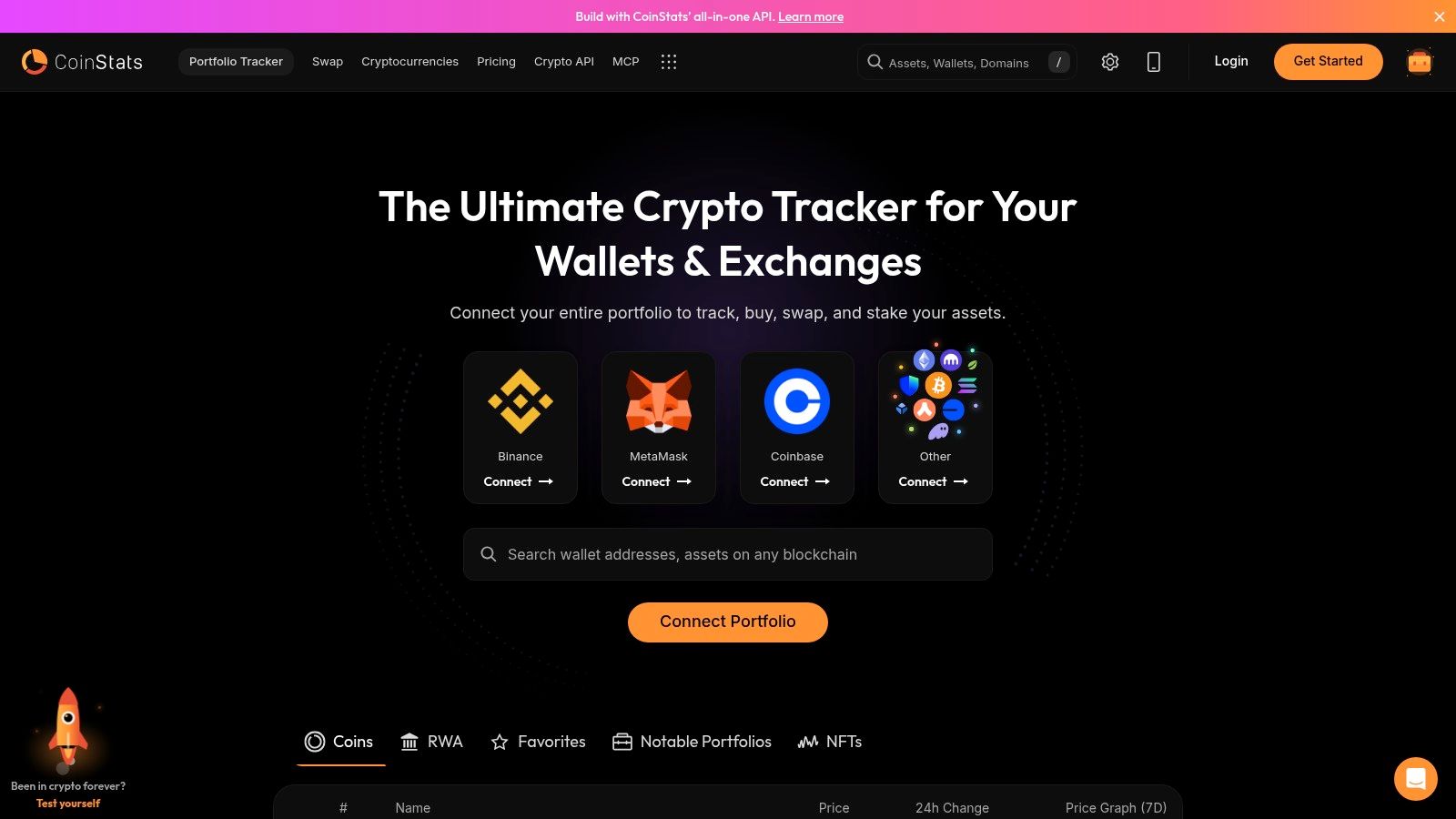
Say your book is spread across three places: SOL and a couple of SPL tokens in a Solana wallet, USDC on Base parked for a Limitless trade, and a small balance sitting in a dollar-based event account after a resolved contract. CoinStats is the layer that pulls those into one screen, so you're not reconciling P&L across five browser tabs on a Sunday.
That aggregation view is the entire point once event markets become a second income stream next to your spot crypto.
What it does well
- Portfolio aggregation: connect wallets and exchange accounts and see balances, transactions, and performance in one dashboard, including NFT holdings.
- P&L that survives multiple venues: cost basis and profit and loss per holding, which is what you need when half your edge came from a market you exited two weeks ago.
- Payout math built in: profit, return, and impermanent loss calculators, plus customisable price alerts for the moment a position turns against you.
CoinStats also keeps a Polymarket page inside its prediction-markets directory, which is the practical entry point when you want to check a venue's live prices against a position you already hold somewhere else.
Where it doesn't help
It won't execute an event trade for you. You still need Kalshi, Limitless, or whichever venue issues the contract. What it gives you is the accounting and alerting around those positions, plus an open API with EVM, Bitcoin xPub, and Solana wallet endpoints if you'd rather build your own view than click one.
Pick it when you're running multiple wallets across multiple chains and at least one event-market position you want in the same book as your spot crypto. Skip it if you want one screen and one chain.
2. Kalshi
Kalshi solves one problem: a regulated, dollar-settled event position without opening a wallet. Sports contracts turned it into a volume business. By February 2026, approximately 87% of Kalshi's $39.7 billion in trading volume over the preceding year came from sports-related contracts, according to the Congressional Research Service summary. That concentration tells you where the liquidity sits.
The growth curve is the part traders underestimate. An MSCI analysis of Kalshi and Polymarket reported monthly volume rising from about $226 million in December 2024 to $6.6 billion in December 2025, with active traders up from roughly 240,000 to 1.2 million. The size is real. The market mix is not crypto.
Where it breaks for a crypto book is the funding rail. Deposits move through a bank, so USDC sitting on Solana has to be sold to fiat before it buys a single contract. Depth runs heavy on sports and thin on niche crypto questions, and fees vary by market and contract, so run the arithmetic before you size a position.
Practical rule: pull the market data instead of bridging funds. Our Predictions feed shows Kalshi and Polymarket markets, so you can see how a contract is priced on both venues before deciding where to place the trade.
3. Robinhood Event Contracts
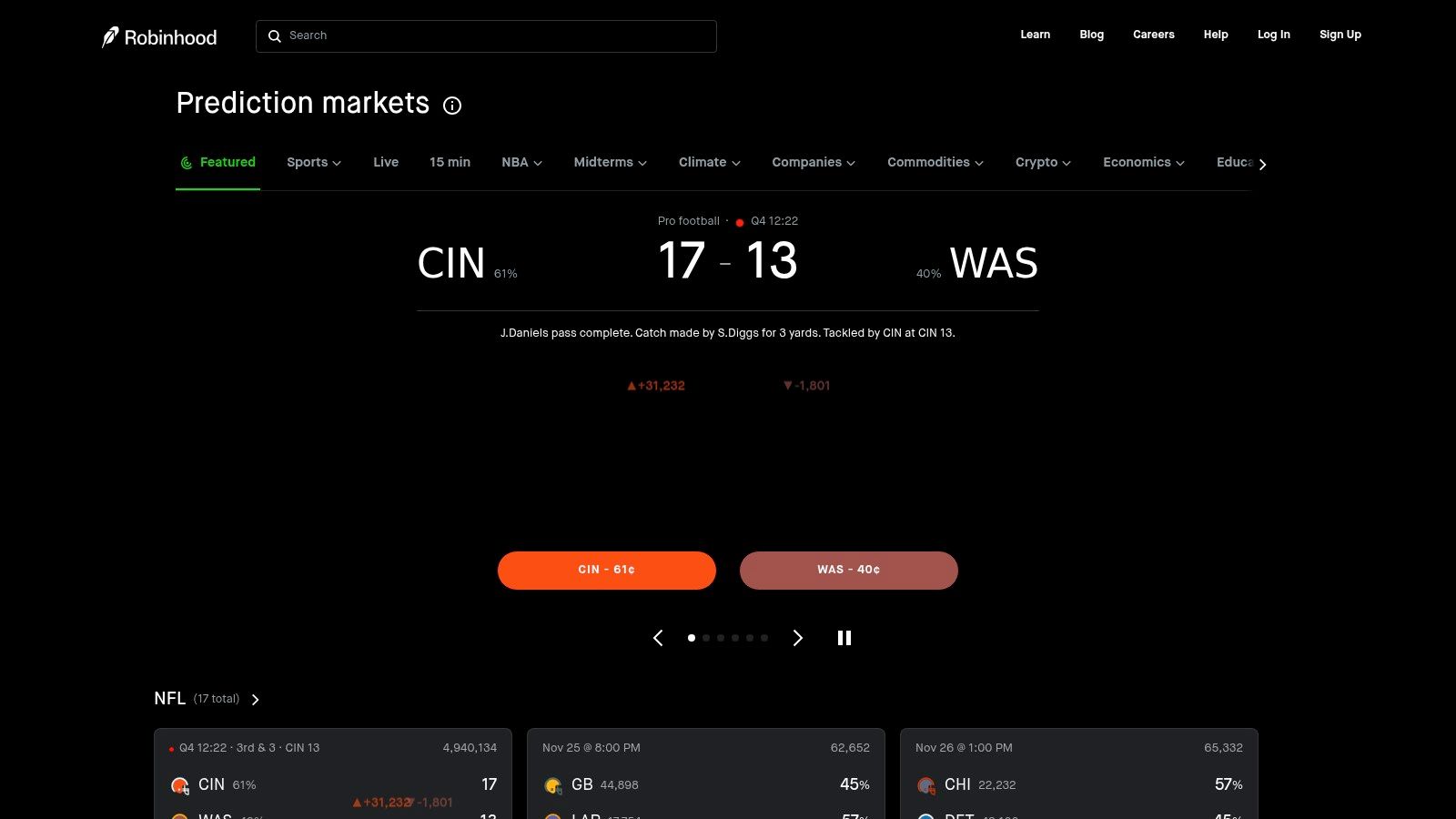
If your only contact with event markets is through a brokerage app you already use, Robinhood's contracts are the lowest-friction fiat route in this list. Robinhood's fourth-quarter 2025 shareholder letter reported that more than 12 billion event contracts were traded on the platform in 2025, making prediction markets one of its fastest-growing products.
The app is the sell, not the order book.
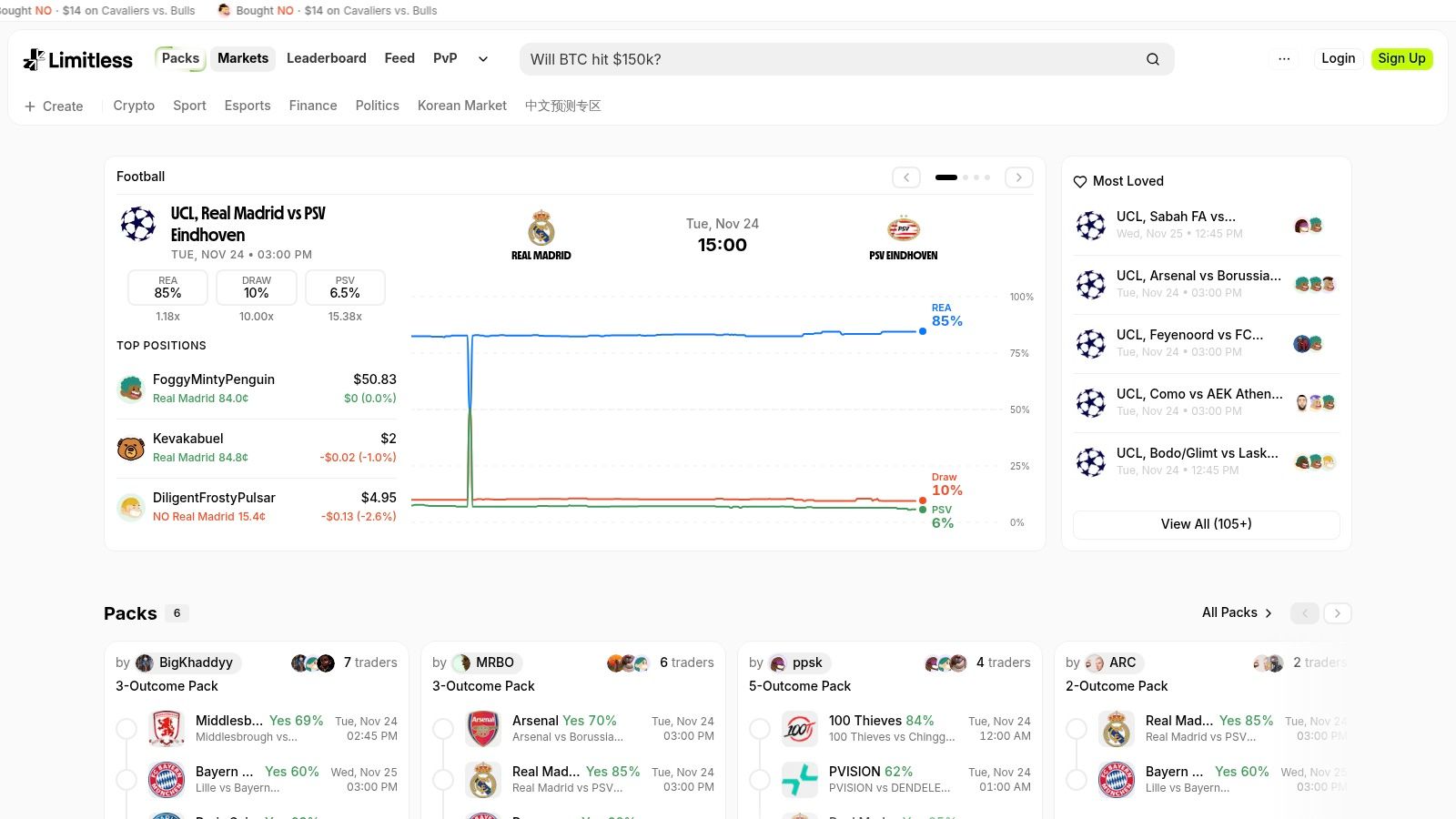
Contracts are binary YES/NO positions that settle at $1 or $0 against a defined outcome, and you can trade out before settlement. The friction is structural: U.S. residency, account approval, and state-level restrictions apply, and there's no crypto-native rail. You can't fund it from a Solana wallet, and you can't withdraw to one.
A dollar contract on a BTC price range is not the same instrument as a perp on the same idea. Different collateral, different settlement, different exit.
Where it fits: you already have a funded account, you want one binary position, and you'd rather not touch gas, bridges, or a seed phrase. Where it doesn't: anything requiring stablecoin collateral or a position you plan to hedge against on-chain exposure the same afternoon.
4. PredictIt
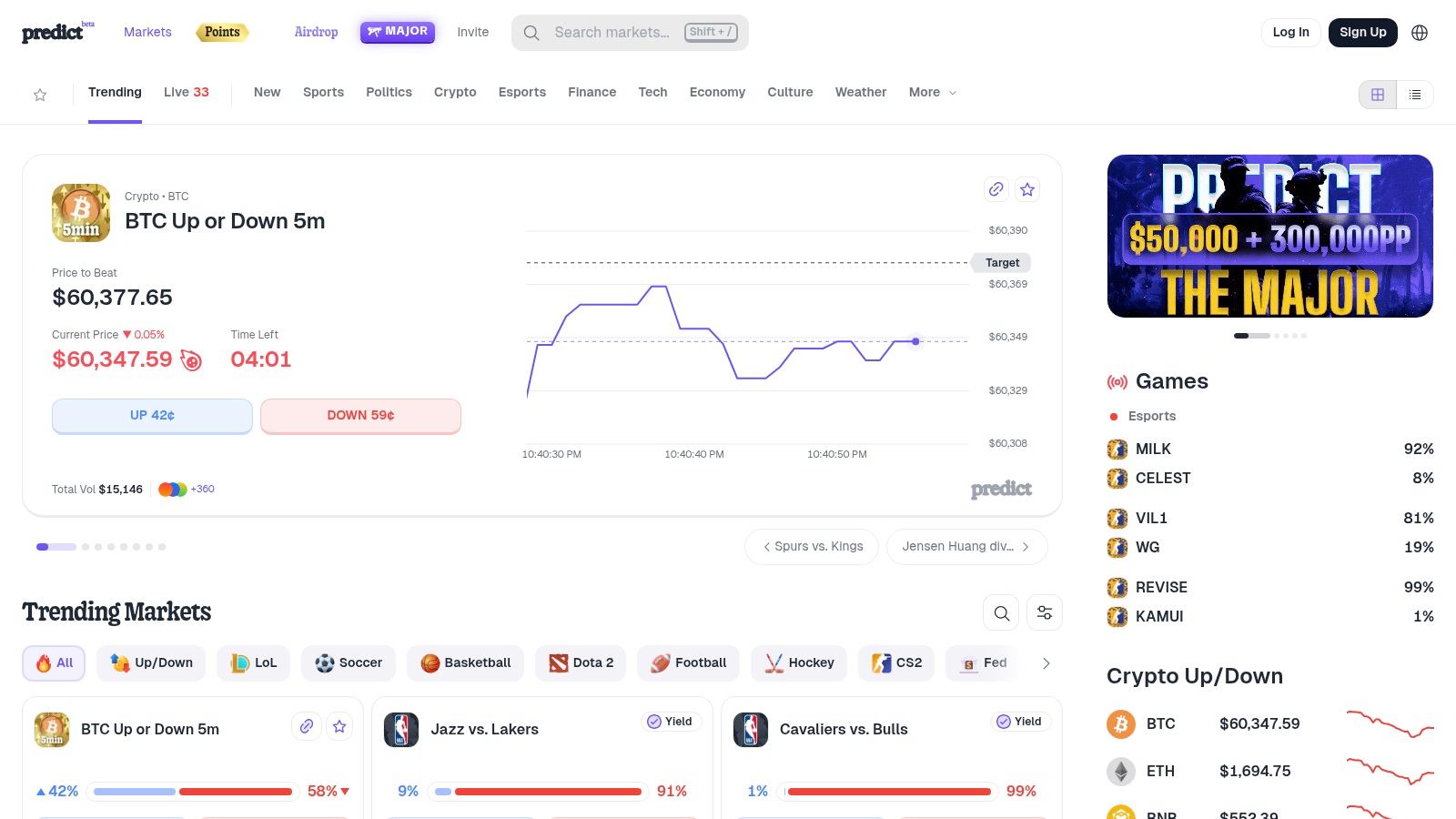
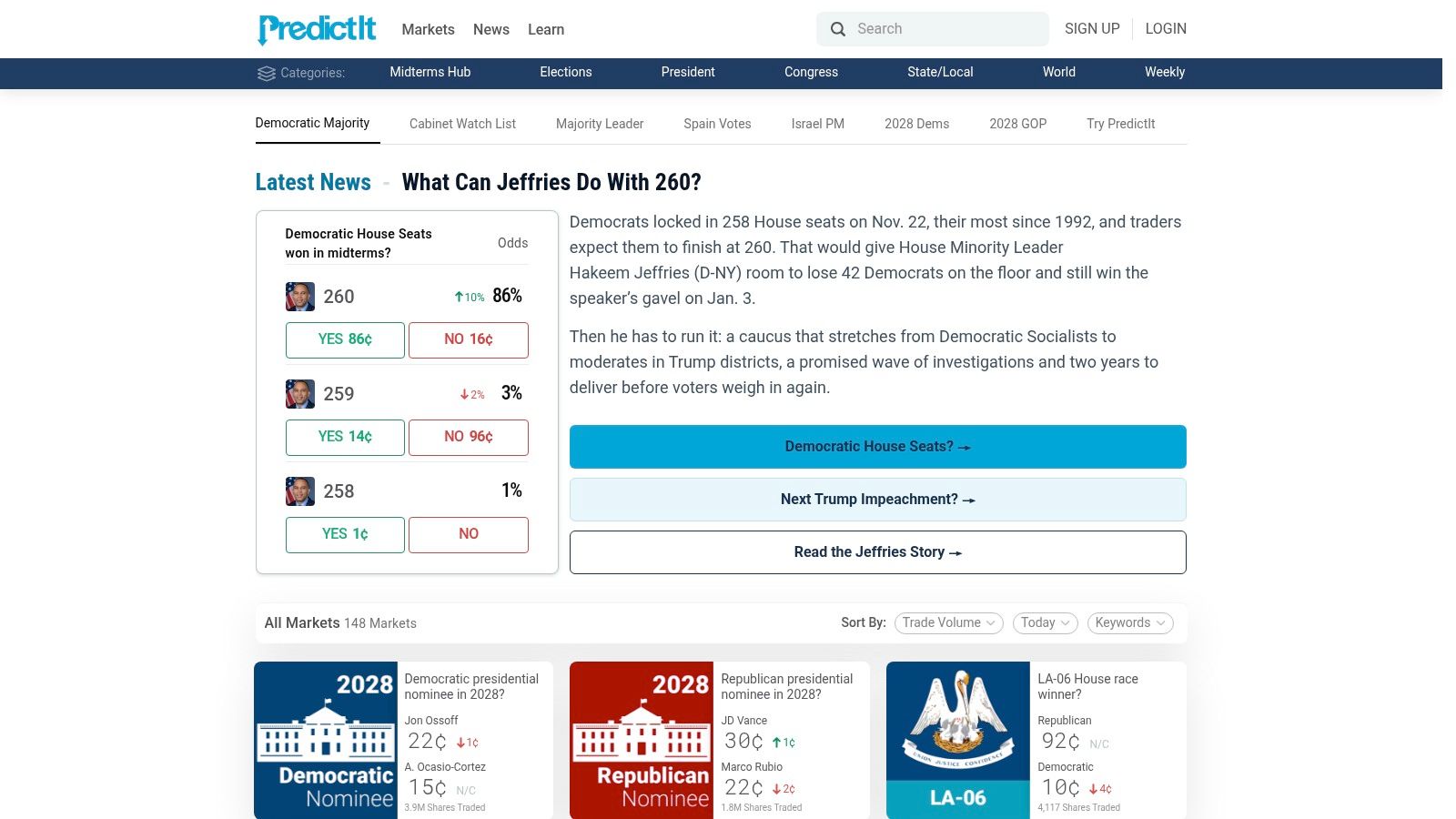
PredictIt is the venue to open when your questions are political and your money is in dollars. Shares trade between 1 and 99 cents and redeem at $1 on resolution, so the quoted price reads roughly as an implied probability.
Accuracy versus liquidity is the trade-off worth understanding before you fund anything. A comparative analysis of 2,500 political markets found that 93% of PredictIt markets correctly forecast outcomes better than chance, against 78% for Kalshi and 67% for Polymarket, per Rillor's prediction-market accuracy study. That's an outcome-direction measure rather than a calibration score, and thin books can still eat the edge it implies.
- Published rules: each market states its resolution criteria, so you can read the wording before you take a side.
- Early exit: positions can be sold before a market closes, which matters when a narrative shifts faster than the calendar.
- Narrow scope: no crypto price markets, no on-chain settlement, and market-specific limits and availability apply.
- Fee drag: on a 5-cent move, fees can take a visible bite out of the return.
For a crypto trader there's no stablecoin leg here at all. If a political outcome is going to move your SOL position, you're expressing the view from a bank-funded dollar account and hedging the crypto side somewhere else entirely.
5. Limitless
Limitless is the closest experience on this list to Polymarket without handing over your keys. It runs on Base, so your USDC stays in your wallet until you buy a share, and settlement happens on-chain rather than inside a broker's account.
The mechanics are the standard binary structure. As Bit.com's explainer on Polymarket mechanics sets out, a YES share and a NO share together represent $1 USDC, so buying YES at $0.35 risks 35 cents for a maximum 65 cents of gross profit. Seeing both the payout and the maximum loss before you click is the advantage over a sportsbook price.
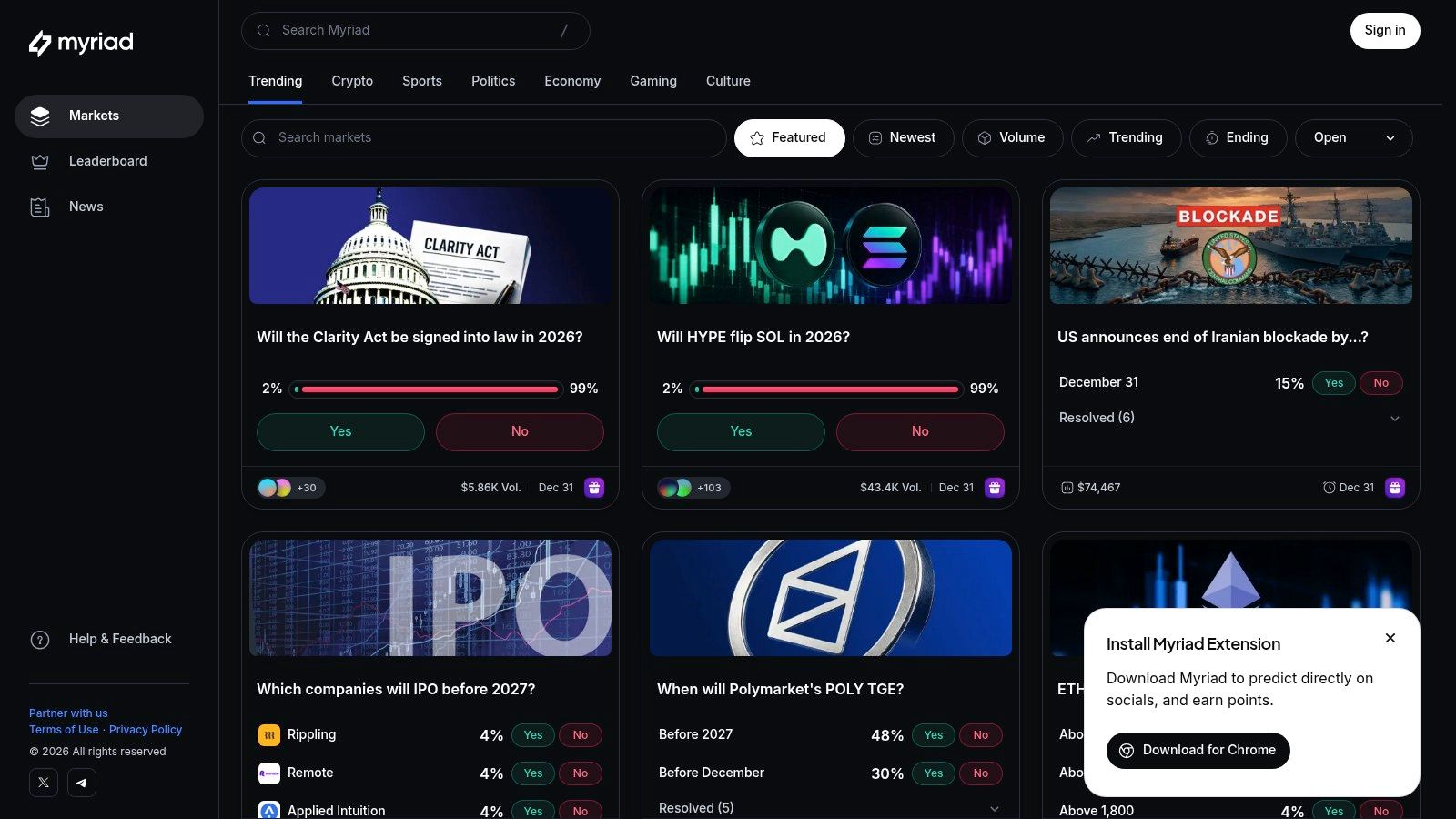
Market creation is the key differentiator. A community can list its own question, which means you sometimes find a market on a token vesting event or a protocol milestone before any large venue bothers to list it.
Where it breaks: it's Base, not Solana, so getting USDC from your Solana wallet to Base costs a bridge fee and a wait. Liquidity swings hard between markets, and the thin ones are where a Sunday night exit hurts. Check the book at your intended size before you assume the quote on screen is real.
6. Predict (Predict.fun)
Resolution is the first thing to check on Predict.fun, before markets, before fees. Outcomes settle through UMA's Optimistic Oracle, which means a dispute window sits between the event ending and your payout. You can be right on the result and still wait through the challenge period before your USDC shows up.
The venue runs on BNB Chain and covers politics, sports, crypto and current affairs, with YES/NO shares and multi-outcome contracts. If your bankroll sits in Solana USDC, sort out the route before the trade: bridge fee, a swapped or wrapped asset on arrival, and gas on a chain you may not already use.
Fees deserve the same scrutiny as the oracle. Prediction venues charge differently by category and by whether you take or rest an order, so assumptions carried over from another platform won't hold. Buying 1,000 shares at $0.50 commits $500, and even a taker charge priced in cents per contract moves your break-even before the market moves at all. Pull the venue's own fee schedule and run that math at your intended size, not at the top-line price.
Two features stand out for a crypto trader: some positions are yield-bearing while they sit, and Binance Wallet or smart-wallet flows can be simpler than a raw DeFi connect. The costs on the other side are BNB-native infrastructure, bridge friction from Solana, and liquidity that varies enormously between contracts. Check the book at your size on the ones you want to trade.
If a market's resolution depends on a news call rather than a price feed, read the dispute process before you size. Oracle windows are where profitable positions turn into waiting rooms.
7. Opinion
Opinion.trade is a BNB Chain prediction venue built for people who already live inside on-chain apps. It prices real-world event probabilities as tradeable markets through a web interface, so the first thing to test is depth, not design.
What works: crypto-native access with no broker approval, and a second on-chain book to compare against Polymarket when a question looks mispriced. What breaks: it isn't built on Solana, smart-contract and resolution risk sit on top of your market risk, and breadth should be verified market by market before you commit size.
Say one venue prices a crypto ETF approval question higher than another does. That gap is only worth trading if both books hold size at those prices, and usually one of them doesn't.
A quick check routine before any cross-venue trade:
- Size at the touch: confirm how many shares sit at the quoted price, not just the top line.
- Resolution source: two venues can resolve the same-sounding question differently.
- Withdrawal route: know which chain your winnings land on before you need them.
8. Myriad
Myriad mixes event markets with media. Markets cover crypto, sports, politics, finance, gaming, and culture, and the platform documents developer and automation tooling for teams that want to embed a market rather than just trade one.
That makes it a different product from a bare order book. Say you run a Telegram community around a Solana trading bot and want a market on whether a token hits a market cap target by Friday. A platform with an API and a content layer is faster to wire into your community than a venue where you'd be building the whole front end yourself.
The trade-offs are ordinary for a smaller venue: not Solana-native, liquidity and available assets vary, and settlement details differ market to market. Treat it as a distribution channel for markets as much as a place to take a position.
9. Futuur
Futuur runs an automated market maker rather than a pure order book, so you can buy or sell a position without waiting for a matching counterparty. In a quiet market, that's the difference between a fill and a stale quote you keep refreshing.
The AMM cuts both ways. On a busy question, the curve price can be worse than a maker's limit order next door. On an obscure one, it's the only fill in town, and paying the curve is better than holding a view you can't express.
You can start on play money, which is useful for testing a short-horizon crypto question like "BTC above a given level at 00:00 UTC on Friday" without committing USDC. Topics span crypto, finance, politics, science, entertainment, and sports, and questions range from same-week to multi-year.
Two things to verify before trading: whether your jurisdiction can access the money side, and how the resolution wording handles edge cases. AMM pricing removes the counterparty problem, not the settlement problem.
10. Manifold Markets
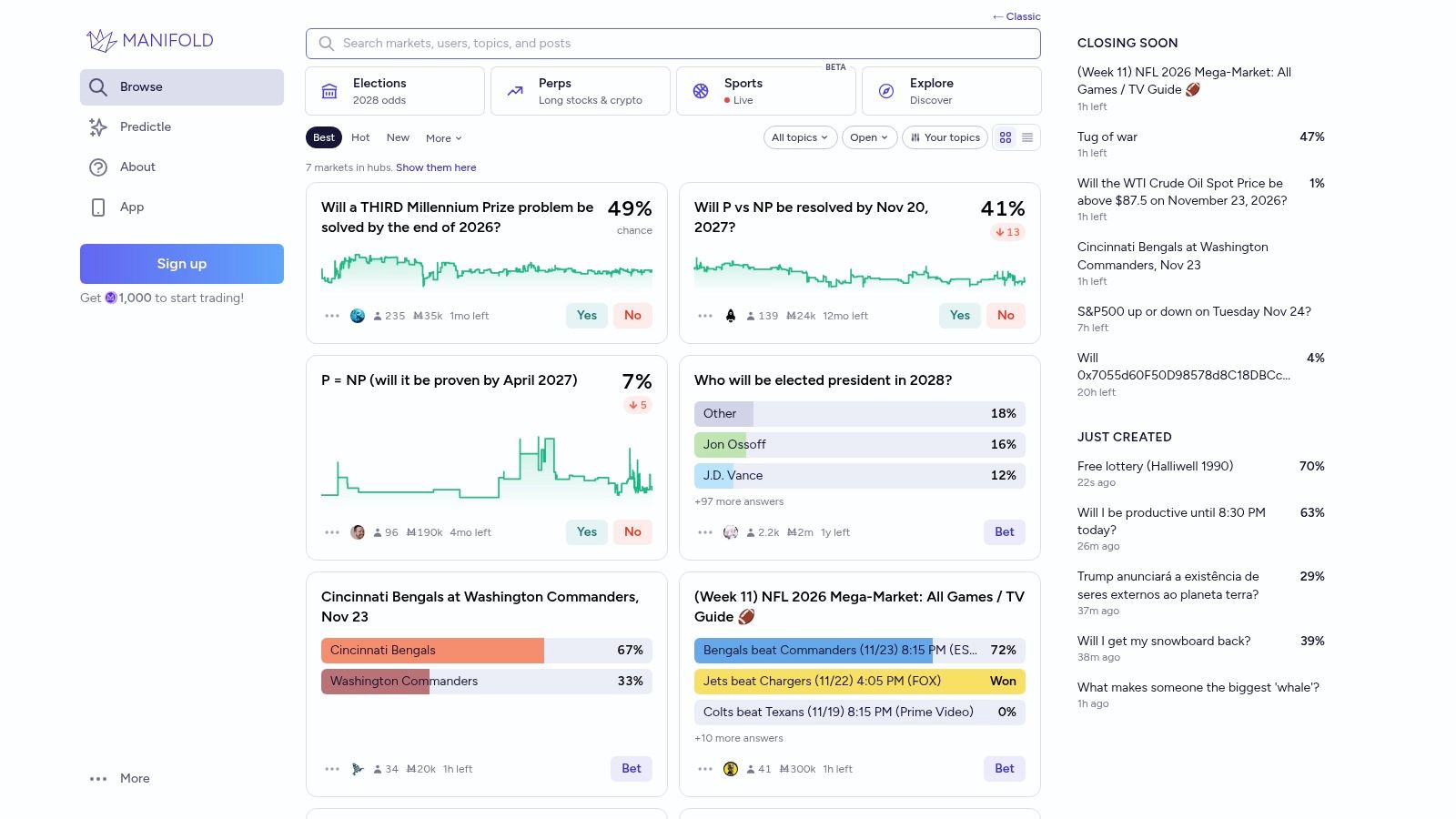
Manifold is where you go to get better at forecasting, not to get paid. Users create and trade markets in Mana, a play-money currency, so nothing on the platform converts to withdrawable crypto.
That isn't a flaw if you use it correctly. Laika Labs' comparison of Kalshi alternatives describes Manifold as sitting outside CFTC oversight with no real-money trading fees and community-driven markets, which makes it a low-risk place to test a BTC price strategy or learn how probability prices drift before you risk USDC on the same idea.
Market creation is flexible and the official API makes bot experiments easy, so it's a reasonable sandbox for a trading strategy you'd later point at a real book. The limit is structural: prices reflect social participation rather than capital at risk, and no one is obligated to buy your Mana.
Learn the mechanics here, then fund a venue where the losing side actually pays.
11. Metaculus
Metaculus isn't an exchange, and it doesn't pretend to be. Participants submit probabilities or full probability distributions on binary, multiple-choice, numeric, and date-range questions, and the platform aggregates them into a single view.
That aggregation is the useful part for a trader. Before you take the other side of a crypto question on a funded venue, a numeric forecast on something like BTC's closing range on a future date gives you a reference point that isn't shaped by one book's liquidity. Leaderboards and tournaments add a scoring signal you can weight.
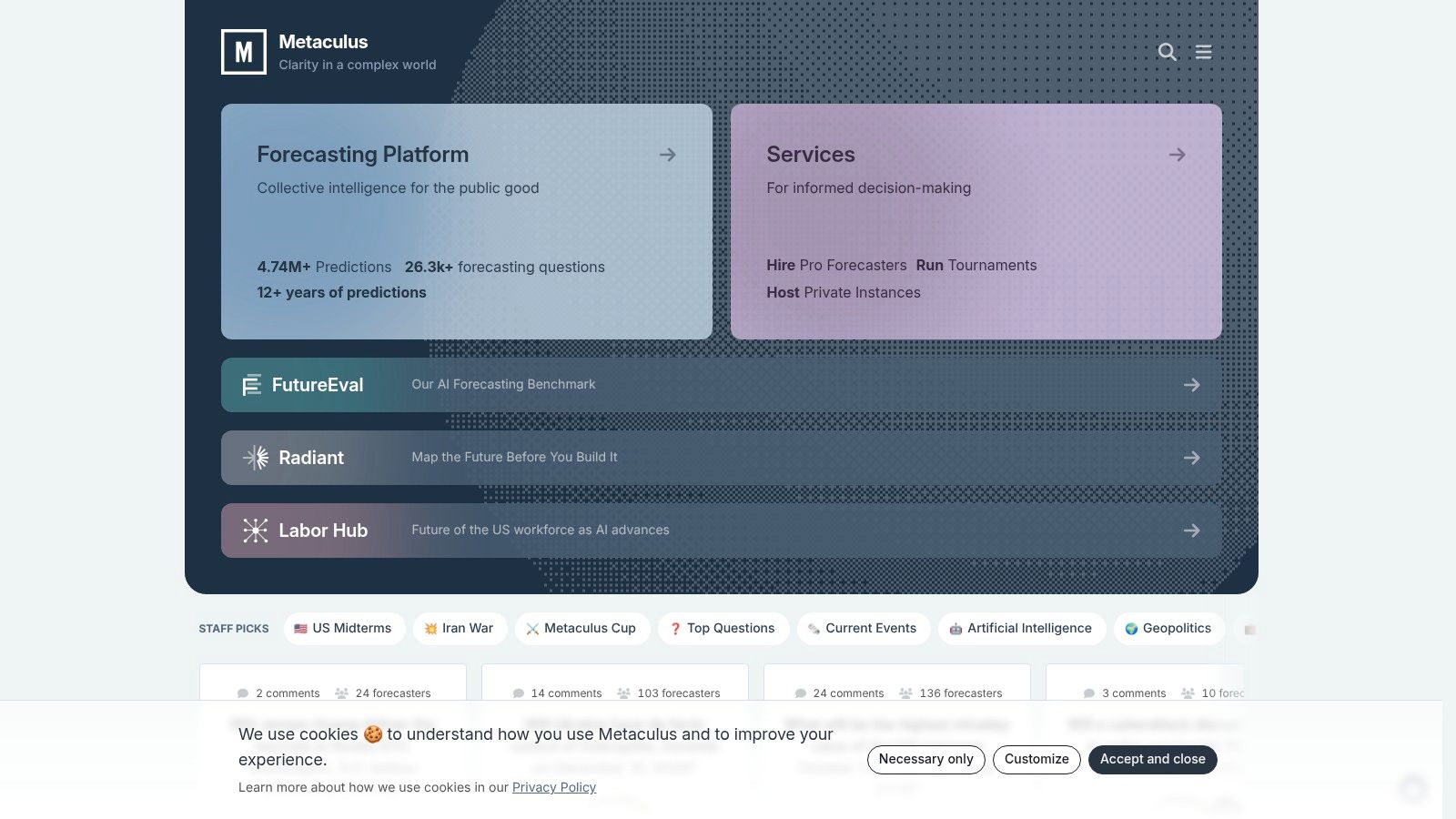
Questions carry specified resolution criteria, and a forecasting API and data access make it usable for research rather than just browsing. What you won't find is an order book, a cash position, or an exit. Question selection is also moderated, so coverage follows the community's interests rather than yours.
How the eleven alternatives compare on chain, funding, and fit
| Platform | Chain or Venue | Real Money | Best For | Main Trade-Off |
|---|---|---|---|---|
| CoinStats | Multi-chain portfolio tracker | Crypto swaps and staking; not an event-contract venue | Tracking crypto holdings, performance, and alerts across wallets and exchanges | Does not offer prediction-market trading |
| Kalshi | Regulated U.S. event-contract exchange | Yes, dollar-based contracts | Trading real-world events without a crypto wallet | U.S. eligibility, state restrictions, market availability, and published contract fees |
| Robinhood Event Contracts | Robinhood brokerage app | Yes, dollar-based contracts | Existing Robinhood customers seeking simple YES/NO positions | U.S. and state restrictions; published contract fees |
| PredictIt | Politics-focused prediction market | Yes, share-based trading | Political forecasting with published market rules | Narrower market selection; published limits and fees affect returns |
| Limitless | Base | Yes, crypto-native markets | Self-custodial event trading and creating markets | Requires a Base-compatible wallet and USDC onboarding; thinner size can move execution on smaller markets |
| Predict (Predict.fun) | BNB Chain | Yes, on-chain positions | Trading varied event markets with potential yield features | Requires BNB for gas; liquidity and resolution wording need review before sizing up |
| Opinion | BNB Chain | Yes, on-chain markets | Exploring crypto-native event probabilities | Requires BNB for gas; smart-contract exposure and thinner depth can affect entry and exit |
| Myriad | Multichain-oriented prediction platform | Yes, funded positions | Combining event forecasts with media and community content | Funding route depends on the supported chain; check settlement details before depositing |
| Futuur | Prediction-market platform | Play money and real-money access where offered | Exploring varied topics with an automated market maker | AMM pricing can differ from an order book, especially at the quote you actually get |
| Manifold Markets | Social forecasting platform | No; Mana is play money | Casual forecasting, community markets, and experimentation | Mana cannot be withdrawn as cash |
| Metaculus | Forecasting community and aggregation platform | No | Research, forecasting practice, and tracking expectations | No cash trading or real-money market prices |
The ranking here is about switching friction. A market count tells you what exists on paper. It does not tell you whether your wallet can fund the position, what chain the exit returns to, or how the contract settles when the headline is ambiguous.
Kalshi and Robinhood keep the asset leg simple. Dollars go in, YES or NO contracts are bought, and the wallet question disappears. The cost is eligibility. If your state or account profile blocks access, the best book in the room is irrelevant. PredictIt has the same practical filter in a different form: political focus, share-based trading, and limits that matter when a position works.
On-chain venues move the friction to funding and execution. Limitless asks for Base onboarding and USDC in the wallet you control. Predict.fun and Opinion put BNB gas in the path, so a small position can carry a meaningful fixed cost in friction even when the market view is right. Myriad adds a chain-routing question before you can size anything.
Futuur sits between a forecasting app and a venue because AMM pricing changes the feel of execution. A quote that looks fine on screen can fill differently from a central book, so check the size you want, not just the headline probability. CoinStats belongs in the table because it helps track holdings across wallets and exchanges, but it does not replace an event-contract venue.
Manifold and Metaculus serve a different job. Mana cannot be withdrawn as cash, and Metaculus has no order book or cash exit. I would use both for calibration before funding a venue where the settlement wording and withdrawal route decide whether the trade survives contact with reality.
Pick One Venue, Fund It Once, Then Test the Exit
Choose by the asset you already hold. Dollars in a bank account point to Kalshi or Robinhood. USDC on Base points to Limitless. BNB points to Predict or Opinion. Nothing funded yet points to Manifold or Metaculus for calibration work. Don't open four accounts in a week; you'll spread your attention and your capital across venues that each need monitoring.
Then run three checks that separate a plan on paper from a position you can hold:
- Resolution criteria: read the exact wording. "Above" and "at or above" settle differently, and so do "before" and "by".
- Liquidity at your price: check size at the quote you see, not the top-of-book number that vanishes when you click.
- Withdrawal path: know the route back to your wallet or bank before you deposit, including which chain the funds return on.
Rules also move under you. The Congressional Research Service's prediction-market overview notes that sports-related contracts expanded in January 2025 and that the CFTC later withdrew both a 2024 proposed rule and a September 2025 staff advisory in February 2026. Read that as a reason not to park serious size on one venue's promise of continuity, and as a reason to keep your own record of every open position.
Test the exit with real money and small size. Buy a position, sell half of it back to USDC at market, and time how long the funds take to land. Say you buy into one contract and then sell half back at market: the number you're measuring is minutes to withdrawable balance, not P&L. Do that once per venue and you'll know which ones you can trust on a Friday night.
Traders who hedge or research Polymarket-style event markets alongside Solana execution often keep both open in one place, because the useful signal is the relationship between a market price and what wallets are doing on-chain. Treat price, volume, and market-cap figures on any venue as estimates that can differ between sources, including our own.
Start with one market you already have a view on. Open the Predictions tab, pull the live price, order book, and recent trades for that Kalshi or Polymarket contract through the Data API or Datastream, and watch it for a session before you fund anything. Builders can wire the same endpoints into a dashboard with the TypeScript SDK, so a market-monitoring view that tracks resolution dates and disputes takes an afternoon rather than a sprint.
If I were funding one account this week, it would be the on-chain venue on the chain I already hold, not the dollar exchange. The reasoning is mechanical rather than ideological: my USDC is already sitting there, the exit is a wallet I control, and I can measure settlement without waiting in an approval queue. A fiat venue earns its place later, once a position gets big enough that a regulated counterparty is worth the paperwork and the bank rail.
Take the first step at a size that won't annoy you if it goes wrong. Open the Solana Tracker Predictions feed, pick a Kalshi or Polymarket contract resolving inside seven days, and watch its live price, order book, and recent trades for one full session before you move a dollar. Then fund the venue that matches the asset you already hold, buy the smallest position that still makes you care about the outcome, and sell half of it back the same day. What you're measuring is time to withdrawable balance, not profit. Do that once per venue and you'll never guess again about which one you can rely on when a position needs to close fast.