Your bot needs five things at once: a token price, a wallet's balances, an alert when a new pair launches, a connection that doesn't drop mid-transaction, and a deployed program to sign its own trades. Wire that from five vendors and you own five failure modes. Solana's builder base makes the choices worth getting right, since Electric Capital counted 7,625 new developers entering crypto through Solana in 2024, the largest single source out of 39,148 people who explored crypto development that year, as Business Insider reported.
Here are ten web3 development tools judged by the job each one does on Solana, not by its feature page. Some are data APIs, some are RPC and streaming providers, and one writes the on-chain program itself. Comparing an indexer to a framework wastes a week, so every entry starts with the build it suits: a wallet dashboard, a launch-alert bot, a market-making loop, a tokenized fund, a program deployment.
Prices and limits move. What follows is the trade-off I'd weigh before wiring a tool into a production repo, including the parts vendors leave off the pricing page.
1. Solana Tracker
A launch-alert bot has to identify new tokens, check risk, fetch prices and prepare a swap route. Solana Tracker brings data, streaming, trading and risk tools together for that Solana-specific build, though a multichain roadmap calls for another provider.
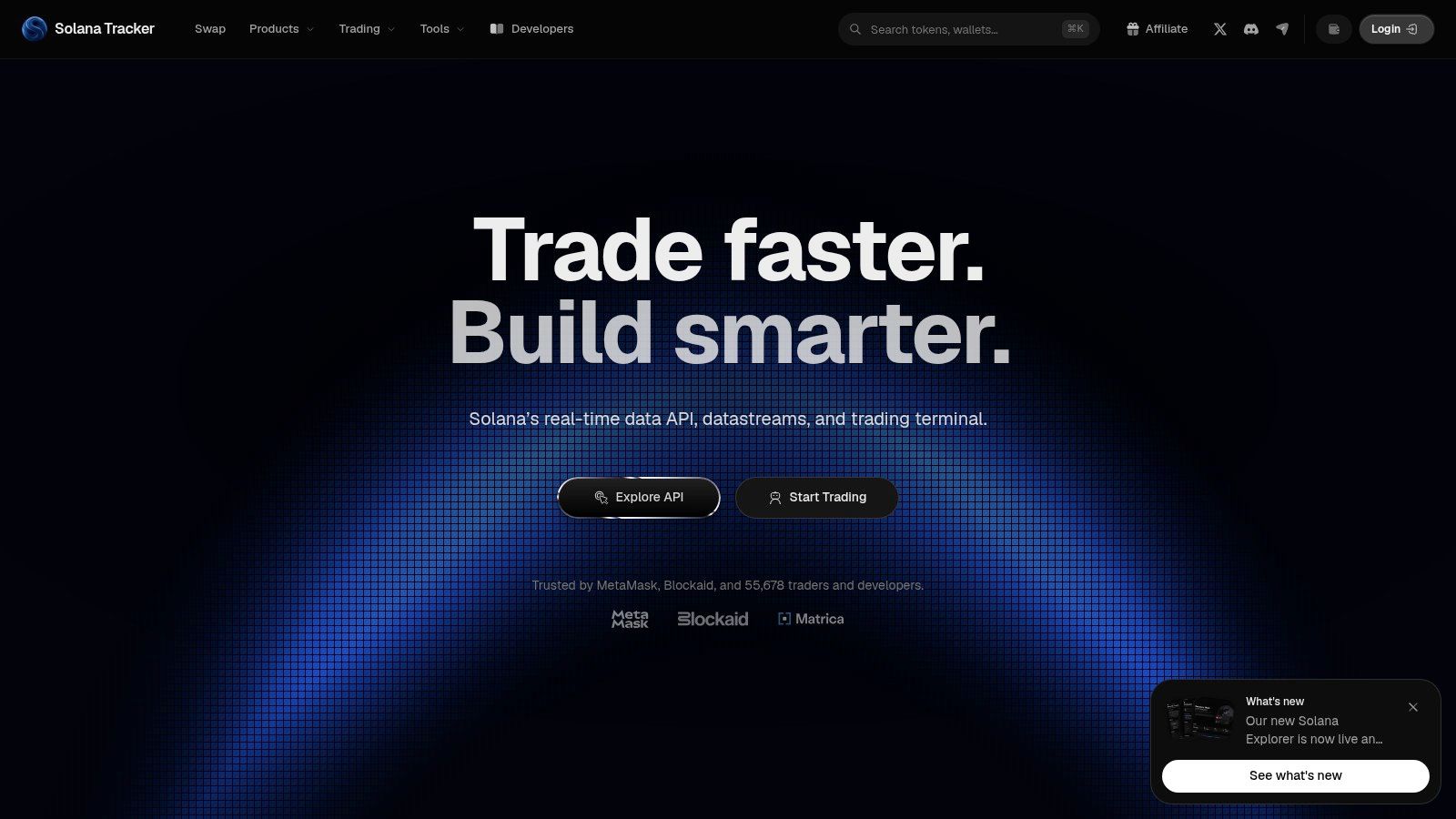
Routing needs attention early. Solana DEX activity covered more than 75 active DEX programs and 277,000 markets in one week, according to Solana Compass. Hard-coding a small set of venues can miss other routes. The Raptor Swap API routes across more than 20 Solana DEXes, with a hosted API and an optional self-hosted binary.
What it handles well
- Data and streams for different build needs. The Data API offers 70+ endpoints for tokens, wallets, trades, prices and risk scores. Datastream provides real-time WebSocket feeds across 20+ room types, including prices, trades, launches and wallet activity.
- Risk checks before a swap. Rugcheck scores tokens across 20+ risk factors and surfaces signals such as snipers, bundlers, insider wallets, and mint and freeze authority status. Treat those signals as inputs to a decision, not a guarantee against loss.
- RPC and deployment options. RidgeDB-backed V2 methods are designed to use about 90% fewer credits. Dedicated Nodes provide private RPC hardware without requiring a DevOps deployment.
The trade-off is scope: Solana Tracker is built for Solana, so a multichain application needs another provider. For a launch listener, compare polling with Datastream before choosing an approach, and size costs using the free tier's limits and actual traffic as the app grows.
Cost rule: estimate request volume per minute as well as total usage. A polling bot can generate repeated calls while waiting for a launch.
If RPC is the part you are sizing, this comparison of high-performance RPC node providers explains when dedicated hardware may suit the build better than a shared endpoint.
2. Helius
For a wallet dashboard, Helius is useful when users need parsed transaction history, not raw logs. It returns labelled data for token accounts, swaps and incoming transfers, reducing the need to decode every program the dashboard touches.
The Helius stack combines RPC, enhanced APIs, webhooks and WebSockets. LaserStream adds WebSocket and gRPC streaming on eligible plans, while transaction-sending infrastructure supports higher-throughput paths. For a Solana-only app, one provider can cover node access, parsing and live updates. The trade-off is less value for teams building across multiple chains, which may need a broader provider alongside it.
Budget by workload, not just by the entry plan. Credits can run down quickly when backfills share capacity with live requests, and streaming or higher-performance features depend on the plan. Estimate the cost of historical data jobs separately from ongoing traffic before choosing a tier.
Transaction fees are a separate cost. Solana's developer documentation gives the base fee as 5,000 lamports per signature, with an optional prioritization fee based on requested compute units multiplied by micro-lamports per unit. A swap with two signatures therefore starts at 10,000 lamports. Failed attempts that include a compute-budget instruction can also incur a prioritization fee.
For the RPC portion of the stack, compare high-performance RPC node providers against the throughput and streaming features your build really needs.
3. QuickNode
You ship a Solana wallet, then a customer asks for Base deposits. QuickNode handles that request with one dashboard, one billing account and endpoints on both chains.
Cross-chain work stopped being exotic. Electric Capital's 2024 developer report found about one in three crypto developers worked across multiple chains, up from less than 10% in 2015. RPC choice follows that behaviour, because nobody wants a second set of keys for a second network.
You get private Solana Mainnet and Devnet endpoints with HTTPS and WebSocket access, Streams and webhooks for app data pipelines, gRPC streaming on higher Solana plans, and a usage dashboard that makes an expensive loop visible before the invoice does.
What lets it down is depth on Solana-specific data. A general-purpose provider returns what the chain returns, so parsed DeFi positions or token risk scores still come from a second API. gRPC also isn't on every plan, which surprises teams who prototype on a free tier and then expect the same feature set in production.
Free access is fine for testing an integration. Budget for the tier that includes the streaming feature your production path depends on, and check that line before launch week rather than during it.
4. Triton One
A market-making bot reacting to large pool trades needs data quickly, not just tidy JSON. Triton One offers ShredStream for that kind of low-latency Solana workflow, where transaction arrival time can affect whether a bot responds within the current slot race.
In a comparison summarized by RPCFast, ShredStream transactions arrived first in 99.9% of comparisons. The test matched shred-derived streams against replay-based Yellowstone data with identical account filters over a three-minute sample. Median local receive time was 4.82 milliseconds for ShredStream and 16.04 milliseconds for replay data.
Treat those feeds as serving different jobs. Shreds support fast reactions, while replay data provides confirmed results for logs, balances and post-execution state. A trading loop that needs both should account for the separate streams and their costs.
What to weigh
- Prepaid model. Prepaid billing asks you to fund usage in advance, which can be a poor fit for a small side project with uncertain traffic.
- Metered extras. Shred Streaming and specialized services bill separately from unary gRPC and RPC. Check which services your bot needs before estimating spend.
- Isolation. Dedicated nodes suit teams that need their own hardware instead of a shared pool.
For a launch-alert bot or trading system, use early data to react and replay data to confirm what happened.
5. Alchemy
An EVM team adding a Solana tab has a problem Solana-native teams don't: two dashboards, two billing relationships, two sets of keys. Alchemy exists to collapse that into one account.
Solana support covers RPC and archival access, gRPC streaming for real-time workflows, and the usual app management tools, with usage-based pricing rather than a fixed subscription at the entry level. For a team already on Ethereum, the operational saving is less about features and more about one place to look when something breaks.
Habit is the core argument. Alchemy's own 2023 Web3 development report counted 26.8 million downloads of Ethereum-oriented libraries and frameworks in Q3 2022, a 37% year-over-year rise during a brutal market, which says infrastructure choices outlive price cycles and switching costs are genuine.
The invoice is where it bites. Compute-unit pricing means request count alone won't predict cost, because a heavy account scan and a balance read are not the same animal. Solana gRPC is priced separately and throughput depends on the plan, so model a week of real traffic before committing.
6. Chainstack
Chainstack suits the team that wants managed access today and a migration path tomorrow. Start on a shared Solana endpoint, move to a dedicated node when the workload justifies it, and keep the door open to self-hosting.
The pricing page lists managed RPC nodes including Solana Mainnet, WebSockets and archive data on eligible plans, dedicated-node and self-hosting options, and Yellowstone gRPC as a separate Solana add-on. A free Developer plan exists and asks for no credit card, which makes it one of the easier endpoints to test against a real client.
Budgeting is what trips people up. Request units vary by method, so a month of small reads can look cheap while an indexer scanning accounts hits limits early. Some Solana methods and add-ons sit behind paid plans, and Yellowstone gRPC isn't part of the basic Developer tier at all.
A practical routine: log your method mix for one week, count the expensive calls, then pick a plan against that mix. Guessing from request totals alone usually ends in an upgrade at an inconvenient moment.
7. Shyft
Shyft is for Solana data consumers who care where the servers sit. A dashboard serving traders in Asia has a different latency profile from one serving Chicago, and regional streaming infrastructure matters more there than a longer feature list.
The Shyft platform combines Solana RPC and WebSocket access, Yellowstone gRPC streaming with regional infrastructure, parsed transaction and DeFi APIs, callbacks, SuperIndexer GraphQL, and dedicated RPC nodes for heavier requirements.
Parsed APIs are the practical draw. Build a trading journal that lists a wallet's swaps with token names, amounts and timestamps, and paying for parsing beats writing a decoder you maintain every time a program ships a new instruction layout.
Two things to check before committing. The free tier doesn't include gRPC access, and streaming plus higher throughput require paid plans. The pricing pages also list newer and legacy plans side by side, so confirm which set applies to a new account rather than budgeting from a search result.
8. Solana Developer Platform
Most entries here serve developers shipping a dApp. This one serves a company shipping a financial product, which changes the questions: compliance, partner integrations, and an approval process instead of a sign-up form.
The Solana Developer Platform is API-first, with modules for asset issuance, payments and trading, selected partner services behind a unified interface, a dashboard and REST API, and a devnet sandbox for testing documented mainnet workflows.
The market behind it is growing quickly. Dataintelo estimated the global Web3 developer platform market at USD 3.2 billion in 2024 with a projected 28.5% compound annual growth rate, and institutional issuance is the segment with the longest sales cycle and the highest bar for documentation.
It isn't a swap for Anchor or a standalone RPC provider. Mainnet provider availability depends on the service and the approval process, and the documentation describes the platform as under active development, so APIs can move. Treat it as the layer above your infrastructure, not the infrastructure itself.
9. Anchor
A points system that credits wallets for holding a token needs on-chain rules for eligibility, balances, and claims. Anchor is the program-writing framework for that job, while RPC and data tools handle access to the chain.
The Anchor framework provides a Rust CLI for creating and deploying programs, declarative account validation, IDL generation, local testing, and client workflows. The IDL describes the program interface and gives client developers a defined contract to build against. Keep it versioned as the program changes.
Framework choices also have distinct ecosystems. The Solidity Developer Survey for 2025 reports Foundry as the primary framework for 57% of respondents, with Hardhat at 33% combined usage. These figures describe Solidity tooling, not Anchor adoption on Solana.
Where Anchor stops
Anchor requires Rust knowledge and does not provide RPC, indexing, or hosted data. Its conventions also cannot guarantee that program logic is safe: a mistake in vault accounting can still put funds at risk. A 2025 analysis of blockchain-engineering job postings in the ACM Digital Library found security-related competencies in roughly one quarter of postings, including deployment, infrastructure automation, and observability. Those remain separate responsibilities when you use a framework.
Ship rule: Treat the IDL as a public interface. Version it to avoid breaking clients on a later deployment.
10. The Graph
The Graph answers a narrower question than the rest: how do you query your own app's history without running a database and a cron job?
A trading game with a leaderboard is the clean example. Define a subgraph that indexes positions, settlements and payouts from your program, then query it with GraphQL for the season standings. Reusable schemas mean the frontend asks for the shape it wants instead of paginating through raw transactions.
That structure pays off when the alternative is a bespoke indexer someone has to babysit. It's also the honest reason to skip it: you're now designing, deploying and maintaining a subgraph, which is a second codebase with its own release cycle.
Timing is the other trade-off. Indexing adds delay compared with a direct chain feed, so a launch-alert bot or a market-making loop should never sit behind one. Confirm current Solana network and feature support before you commit a Solana-first project, since support varies by deployment.
How the 10 Web3 development tools compare on free access, streaming, focus, and Solana fit
For a wallet dashboard, prioritize parsed and indexed data. For a launch-alert bot, compare live feeds and their access terms. For program deployment, choose a framework rather than treating it as another data provider. The table separates those build needs across the ten tools.
| Item | Free access | Streaming options | Best for | Solana focus |
|---|---|---|---|---|
| Solana Tracker | Free tier for testing | WebSocket feeds; Raptor Swap API routes across 20+ Solana DEXes | Solana trading, on-chain data, and developer infrastructure | Solana-focused platform |
| Helius | Free plan for experimentation | Webhooks, WebSockets, and plan-dependent LaserStream | Solana apps needing RPC, parsed data, and streaming | Solana-focused |
| QuickNode | Free access for testing | WebSockets, Streams, webhooks, and plan-dependent gRPC | Managed multichain infrastructure with upgrade options | Solana endpoints within a multichain platform |
| Triton One | Pay-as-you-go; listed minimum deposit applies | Unary gRPC and Triton Shred Streaming | Demanding Solana data or transaction workloads | Solana-focused infrastructure |
| Alchemy | Free tier for development and testing | gRPC streaming; availability and cost depend on plan | Teams building across several chains | Solana support within a multichain platform |
| Chainstack | Free Developer plan; no card required | WebSockets; Yellowstone gRPC as a separate add-on | Multichain teams seeking managed or dedicated nodes | Solana RPC and optional Solana gRPC |
| Shyft | Free access for initial testing | WebSockets; paid-tier Yellowstone gRPC and regional streaming | Solana apps or trading systems needing parsed data | Solana-focused |
| Solana Developer Platform | Devnet sandbox available | Devnet sandbox for testing | Institutional financial products using supported workflows | Solana-specific platform |
| Anchor | Open-source and free to use | No hosted streaming; local testing tools | Building and testing Solana on-chain programs | Solana-specific framework |
| The Graph | Subgraph development and deployment | Indexed data queries; not a real-time feed | Applications needing structured, queryable datasets | Solana subgraph support varies by deployment |
The categories matter as much as the access terms. Solana Tracker, Helius, and Shyft suit builds that need Solana data services; QuickNode, Alchemy, and Chainstack serve teams working across chains. Anchor handles on-chain program development, while The Graph is for querying indexed application data. Its indexing delay makes it a poor fit for launch alerts that need live updates.
Build a Smaller Stack Before Adding Another Tool
Choose tools from the build task. A wallet page opened on demand can use getWallet for enriched holdings. A poller that checks many wallets but needs only balances and prices should use getWalletBasic to avoid requesting data it will not use. The right endpoint depends on the work each request must do.
Credentials affect how you wire the client. REST wallet calls require a Data API key, while the Datastream key is optional and enables live mode. Keep those credentials separate in the integration, and add streaming only when the application needs updates between polls.
Test free access against the workload you intend to run. A launch-alert bot listening to several rooms puts different demands on a service than a single test request. Check rate limits and subscription behavior before relying on the bot during a launch.
Start with one data provider, one RPC source, and one program framework. Add another tool only when a test identifies a specific gap.
Feed quality also depends on your test setup. Solana's June 2025 network health report describes Surfpool as a local mainnet simulation environment for realistic testing without high-performance hardware. Use a local simulation to check confirmation logic before relying on it in production.
Risk checks need specific signals. An arXiv analysis of Solana rug pulls manually verified community-reported incidents and assembled a benchmark of confirmed rug-pull tokens. It identifies freeze-authority abuse as a distinct pattern: an issuer retaining the SPL Token freeze authority can freeze a holder's account, allowing a buy while preventing a later sell. Check mint and freeze authority before entry rather than relying on a general risk label.
Build for ordinary operating conditions, not just launch day. Avoid paying for overlapping data sources without a clear need, keep an RPC fallback for outages, and make errors visible in the dashboard. Solana Tracker puts a unified data API, low-latency WebSocket streams, RPC and DEX routing on one platform, which can suit a launch bot or wallet dashboard that would otherwise combine several vendors. Its tools include Rugcheck and wallet tracking. Choose services and credentials to match the workload, then add components only when the build requires them.