Your Solana protocol needs a Rust engineer who understands DEX routing and real-time data feeds. The recruiter sends a backend developer who owns crypto, follows memecoin launches, and has never debugged a transaction failure. You've gained another interview, not another qualified candidate.
The best tech recruiting agencies differ less by size than by how they assess technical depth. A recruiter should distinguish a memecoin trader from a protocol engineer, recognize the difference between building an exchange interface and operating its execution infrastructure, and explain why a candidate fits your actual workload.
Make that workload concrete. Tell the agency that someone will consume Solana Tracker's Datastream feeds, integrate risk signals from Rugcheck, or investigate stale quotes during swap execution. Then ask how they'd screen for reconnect handling, backpressure, transaction confirmation, and production incident ownership.
Practical rule: Crypto familiarity isn't engineering evidence. Ask what the candidate built, what failed, and how they verified the fix.
The firms below serve different hiring needs, from hands-on software recruitment to retained executive search. None should get a pass on protocol-specific screening because it has recognizable clients or an AI-powered sourcing platform. TekRecruiter appears through two distinct hiring use cases: broader team-building support and practical assessment for production-facing engineers.
1. TekRecruiter

Best for crypto teams hiring across engineering, infrastructure, and technical commercial roles.
TekRecruiter earns consideration among the best tech recruiting agencies for its engineering-led approach and range of engagement models. Founder Ron Smith is a Computer Science graduate and former founding software engineer who built startup data systems before moving into recruiting. That background is relevant when your hiring problem requires understanding systems, not just recognizing stack keywords.
The Miami-headquartered, minority-owned Certified Diversity, Equity & Inclusion Supplier serves startups through enterprises, with relationships in New York and offices spanning other U.S. markets and São Paulo. Its coverage includes software engineering, AI, DevOps, SRE, cloud, cybersecurity, data, quantitative development, product, technical sales, and engineering leadership.
Where the approach fits crypto hiring
TekRecruiter describes an AI-native recruiting operating system for sourcing, pipelining, screening, and matching, with recruiters retaining responsibility for conversations and judgment. Its candidate discussions examine what someone built, why they built it, and what it accomplished for the business. It also screens for HEART: High agency, Execution, Accountability, Resourcefulness, and Transparency.
For a crypto startup, that could mean recruiting a data engineer who can explain trade-ingestion failures and a technical account executive who can discuss RPC integration without handing every question to engineering.
Its engagement choices include:
- Direct hire and executive search: Permanent engineers, technical leaders, and senior executives.
- Contract-to-hire and staff augmentation: Engineers working under your leadership, with flexibility around conversion and engagement duration.
- Nearshore hiring: Vetted, English-speaking Latin American engineers, including candidates in Brazil.
- Supplier search: MSPs, outsourcing firms, development companies, AI engineering providers, and fractional leaders when a company is more appropriate than an employee.
The trade-off: Broad technical coverage doesn't establish Solana expertise. Its enterprise-platform specializations, including AWS, Azure, Salesforce, and Stripe billing, won't substitute for evidence of Rust or trading-system screening.
Ask these verification questions:
- Technical depth: Who evaluates Rust ownership, Anchor account constraints, and transaction execution?
- Relevant evidence: Can you show an anonymized assessment for a distributed-systems or trading-infrastructure hire?
- Commercial clarity: Which engagement fits this role, and what are the written fees, conversion provisions, and replacement terms?
2. TekRecruiter

Best use case: assessing engineers who'll own production-facing crypto features.
Consider TekRecruiter separately for a narrower assignment: finding someone who can ship a wallet analytics feature, rather than helping assemble an entire team. Its emphasis on software candidates have built is useful here, provided your engineering lead helps define what counts as convincing evidence.
Say you're building a dashboard inspired by our wallet-performance leaderboard. A qualified candidate should discuss transaction ingestion, wallet attribution, realized versus unrealized performance, and how incomplete records affect displayed results. Being an active trader doesn't demonstrate any of those engineering abilities.
Test practical building experience
Give the recruiter an example project and an assessment rubric before sourcing starts. Ask candidates to explain their architecture, identify a failure mode, and describe the tests they'd use to catch it.
Web3Vacancy's Solana job guidance identifies Rust, Anchor, TypeScript, program-derived addresses, compute budgets, and account architecture as relevant screening areas. Match those requirements to the position rather than demanding every skill from an off-chain analytics engineer.
The benefit is a project-centered conversation that can expose actual delivery experience. The limitation is that a proprietary AI system doesn't establish the assigned recruiter's technical judgment, and standard pricing isn't publicly listed.
Before engaging, ask:
- Assessment ownership: Who reviews the candidate's code or architecture explanation?
- Stack calibration: How would your screen differ for an Anchor engineer and a TypeScript indexing engineer?
- Deliverables: Will every submission include project evidence, ownership boundaries, and unresolved technical concerns?
I'd use this approach when the role has a concrete deliverable and your team can calibrate the recruiter's screen.
3. Candidate Labs
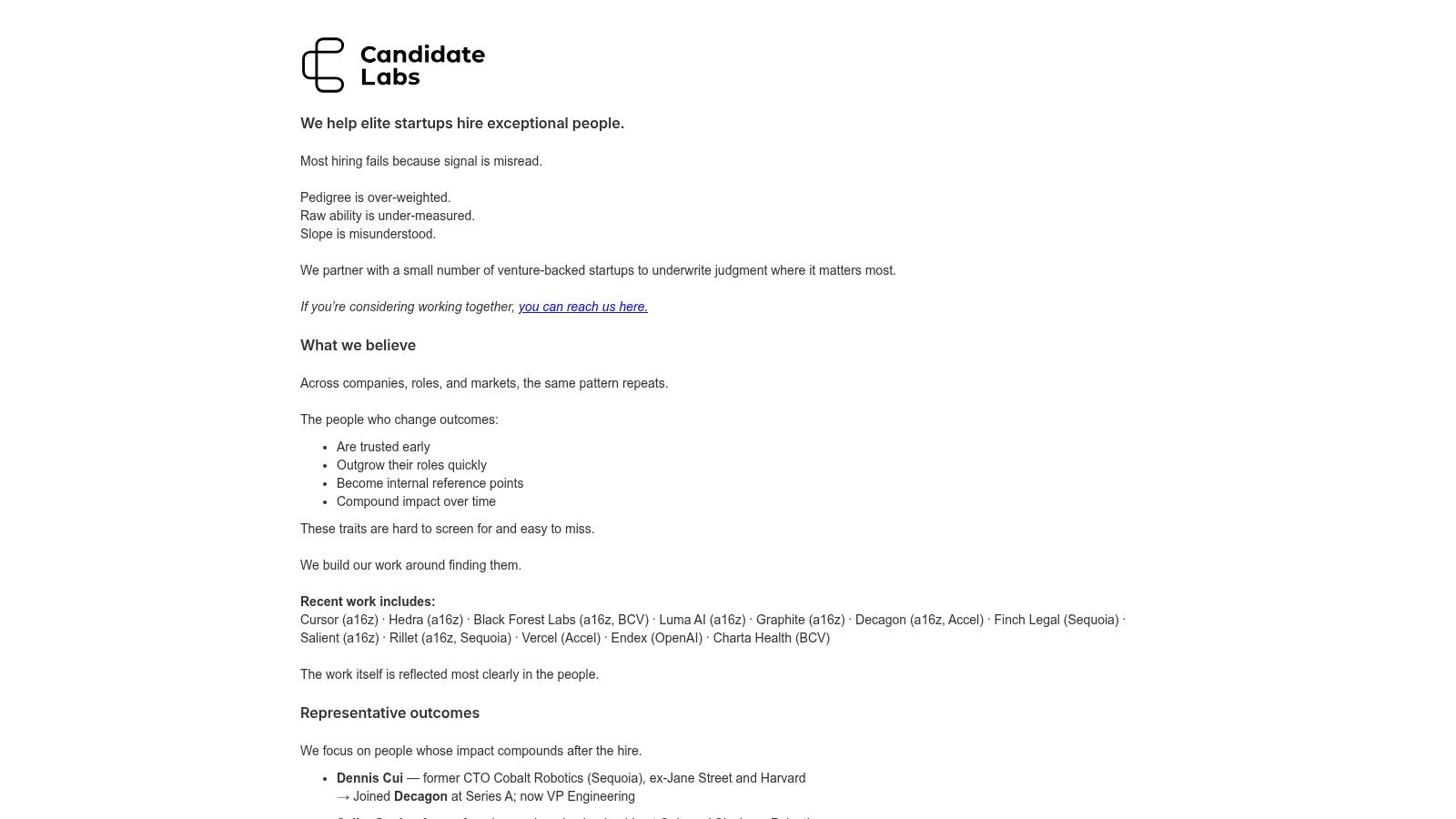
A crypto startup's hardest hire may be the engineer who can turn an unclear trading workflow into a usable product. Candidate Labs is worth considering for that startup-shaped problem, rather than assuming you need a blockchain-only recruiter.
The firm serves a selective group of venture-backed companies and recruits across engineering, product, design, go-to-market, finance, and operations. Its website lists work with Vercel, Cursor, Luma AI, Decagon, and Black Forest Labs, and emphasizes judgment and growth potential alongside credentials.
That orientation may fit a wallet startup hiring a product-minded engineer who'll work directly with founders. It doesn't prove access to Solana protocol developers or exchange-infrastructure specialists.
A strong startup engineer can learn a product domain. Don't assume they can safely learn custody, execution, or protocol security without appropriate supervision.
Best fit and limitations
Candidate Labs is most interesting when you need ownership across functional boundaries. For example, a developer-tooling startup might need an engineer who can debug SDK integrations, talk to customers, and prioritize fixes without waiting for a detailed specification.
Its selectivity may be less suitable for a large batch of similar vacancies. Pricing and engagement terms aren't publicly listed, so define the scope before deciding whether its model fits your hiring plan.
Ask:
- Comparable searches: Which completed searches involved developer infrastructure, fintech, or production trading systems?
- Judgment assessment: How do you distinguish adaptable engineers from candidates who interview confidently but need extensive direction?
- Domain boundaries: Which crypto skills will you assess yourselves, and which require our engineering team?
Use Candidate Labs for startup adaptability and cross-functional hiring. Require separate proof before assigning a security-sensitive protocol search.
4. Riviera Partners

A CTO search isn't a senior-engineer search with a larger compensation package. An exchange CTO must make decisions about architecture, security ownership, incident response, hiring, and delivery while understanding where trading failures become business risks.
Riviera Partners specializes in senior technology leadership across software engineering, product, AI/ML and data, security, and design. It works with companies from seed stage through public-company scale and describes a proprietary platform supporting its search process.
That makes it a more natural option for a CTO, VP of Engineering, or senior security leader than for routine individual-contributor hiring. Its potential value is helping define the leadership mandate and evaluating candidates against it.
Brief the mandate before the title
Say your exchange has unreliable market-data ingestion and unclear incident ownership. The right brief isn't just CTO with crypto experience. It's a leader who can establish service ownership, assess execution dependencies, recruit infrastructure engineers, and communicate operational risk to founders.
Ask Riviera Partners:
- Leadership evidence: How will you verify that candidates personally improved reliability and engineering accountability?
- Crypto relevance: Which search team members understand exchange architecture, wallet security, or blockchain infrastructure?
- Search boundaries: Which candidate populations, deliverables, and exclusions will the engagement cover?
The trade-off is scope. Executive-search specialization may be excessive for a mid-level Rust engineer, and fees and engagement terms aren't publicly listed. Confirm relevant crypto experience rather than treating senior technology placement as sufficient.
I'd shortlist Riviera Partners when the missing capability is leadership across teams, not another developer on the sprint board. Keep technical interviewers involved so an impressive executive narrative doesn't replace architectural scrutiny.
5. Franklin Fitch
Your swap application works, but WebSocket consumers disconnect under load, observability is patchy, and nobody owns the deployment pipeline. That's an infrastructure hiring problem, even though the product happens to trade crypto.
Franklin Fitch covers U.S. software and application engineering, infrastructure, cloud, security, data, ML, AI, and go-to-market roles. Its stated specializations include platform engineering, DevOps, cloud architecture, and security, with permanent and contract recruiting available.
Those job families make it a sensible candidate for the infrastructure surrounding Solana applications. They don't establish expertise in on-chain Rust programs, so keep those searches distinct.
A useful crypto assignment
For an RPC-backed trading service, brief an SRE role around reconnect storms, queue growth, deployment rollback, secret management, and on-call ownership. Require evidence that candidates operated services, not merely configured cloud resources.
Contract hiring may fit a defined observability or deployment project. A permanent hire is more appropriate when you need enduring ownership of reliability practices and incident response.
Before selecting the firm, ask:
- Recruiter specialization: Who will run the search, and what platform-engineering or SRE roles do they personally cover?
- Production screening: How will you assess backpressure, recovery after feed interruption, and operational troubleshooting?
- Engagement fit: What are the written contract, permanent-placement, and potential conversion terms?
The main advantage is coverage across application software and supporting infrastructure. The main risk is accepting broad cloud expertise as proof of low-latency trading competence.
Have your infrastructure lead review an example screening summary before approving candidate outreach. Pricing isn't publicly listed, and the assigned recruiter's niche experience matters more than the breadth of the firm's service menu.
6. Everforth Apex

Consider Everforth Apex when your crypto hiring plan contains recurring requisitions and mixed employment models. It offers direct placement, contract-to-hire, and contract work, which suits an exchange expanding several supporting teams at once.
A realistic assignment bundles backend API engineers, QA automation specialists, and cloud engineers during a wallet integration rollout. That is where a large staffing operation earns its fee: parallel pipelines, steady submission volume, and coverage across job families that share interviewers. Keep the protocol-security hire on a separate, tightly calibrated search. One intake call cannot serve both.
Scale and specialist fit are different things. Staffing Industry Analysts ranked Everforth among the largest U.S. IT staffing firms, reporting $1.17 billion in 2025 U.S. IT staffing revenue. That establishes staffing volume. It says little about reaching Rust engineers who have shipped Solana programs.
Make the workforce arrangements explicit
Contract flexibility only helps when responsibilities are written down. Before signing, confirm who employs the consultant, who runs payroll, who owns performance management, and who approves conversion to a permanent hire. For employers, request a proposal tied to your actual roles and requisition count rather than assuming a standard arrangement.
Three questions worth putting in writing:
- Delivery team: Will dedicated recruiters handle backend, infrastructure, and security searches, or does one generalist cover everything?
- Qualification evidence: What technical screening accompanies each submission for our trading-stack roles?
- Employment terms: Who is the employer of record, how does conversion pricing work, and what happens if the project ends early?
The upside is coordinating several hiring tracks through one larger operation. The trade-off is a less boutique experience, and sustained community sourcing for scarce Rust talent is where large generalist firms most often thin out.
Protect interview capacity with role-specific acceptance criteria: a take-home aligned to your API stack, or a screening rubric your engineers sign off on before outreach begins. A fast flow of broadly relevant résumés should not consume your senior team's calendar.
7. Parker Remick

Partner involvement is the reason to evaluate Parker Remick, not a reason to skip checking the search team. The executive-search boutique focuses on engineering, product, and related technical leadership, including AI.
The firm works with technology companies across venture-backed, private-equity-backed, and public-company settings. Senior partners lead searches with support from researchers and coordinators, a structure that may appeal when founders want direct senior involvement in a sensitive leadership appointment.
For a crypto infrastructure company, consider a Head of Engineering search after the founding team can no longer manage delivery, hiring, and incident escalation themselves. The candidate needs to develop managers and engineering practices without losing credibility with the people operating RPC and data services.
Leadership test: Ask what the candidate stopped doing personally, what they delegated, and how they knew the new owner was succeeding.
Where the boutique model makes sense
Parker Remick is most relevant when the job requires organizational judgment as well as technical credibility. It's not aimed at general high-volume recruiting or most individual-contributor vacancies.
Ask the firm:
- Partner accountability: Which partner will lead the search, and which candidate conversations will they personally conduct?
- Technical context: How will you evaluate leadership of distributed systems, security-sensitive products, or trading infrastructure?
- Reference depth: How do references distinguish leaders who built effective teams from leaders who inherited them?
Fees and engagement terms aren't publicly listed. Confirm the mandate, search process, and commercial obligations before committing.
I'd consider Parker Remick for a consequential leadership hire where founder alignment and careful assessment matter more than filling a routine vacancy. Don't use an executive-search engagement merely because an individual-contributor role has become difficult to fill.
8. True Search
True Search offers retained executive search through a dedicated Product, Data & Technology practice. It also offers SearchEssentials, a technology-enabled service intended for companies seeking a different level of search support.
The relevant choice isn't traditional versus modern recruiting. It's how much help you need defining the role, mapping candidates, assessing leadership, and managing the process.
For example, a crypto analytics startup might need a Head of Data who can own token-risk pipelines, wallet attribution, data quality, and customer-facing methodology. That role requires more than managing analysts or building dashboards. The leader must explain where the underlying evidence is incomplete and prevent product teams from presenting uncertain signals as established facts.
Compare the support, not just the service names
True Search may fit senior product, engineering, and data appointments where the hire will shape company direction. Ordinary engineering vacancies generally don't need retained executive-search support.
Ask:
- Service scope: What assessment, candidate mapping, and founder support are included in each service?
- Relevant leadership: Can the assigned team demonstrate experience with developer platforms, financial infrastructure, or security-sensitive data products?
- Success definition: How will you test whether candidates can explain uncertainty, prioritize reliability, and build the required team?
The advantage is an explicit technology and data leadership practice with different service options. The limitation is that neither the practice name nor a technology-enabled workflow establishes crypto expertise.
Pricing and specific engagement terms aren't publicly listed. Request a written comparison of responsibilities and deliverables so you can identify what your founders and engineering leaders must still handle internally.
Choose it for a leadership mandate, not as a substitute for defining one.
Best Tech Recruiting Agencies at a Glance
Read “Crypto Relevance” as a screening question, not a credential. If a firm cannot describe comparable Solana, exchange, developer-infrastructure, or trading-system searches, treat crypto depth as unproven until the first candidate slate shows otherwise.
| Agency | Best For | Role Level | Contract Options | Crypto Relevance |
|---|---|---|---|---|
| TekRecruiter | Crypto teams hiring across engineering, infrastructure, and technical commercial roles | Individual contributors through executive leaders | Direct hire, contract-to-hire, nearshore, executive search | Crypto-team focus is stated; ask for comparable Solana, exchange, or trading-infrastructure searches |
| TekRecruiter | Practical screening for production-facing engineers | Engineering and software roles; seniority depends on the role | Tailored engagement; specific contract options not stated | Crypto expertise is not established; probe how they screen for production Solana systems |
| Candidate Labs | Recruiting across functions for venture-backed, high-growth startups | Multiple levels across engineering, product, design, go-to-market, finance, and operations | Engagement terms not publicly listed | Crypto or blockchain expertise not established |
| Riviera Partners | Senior technology leadership searches | Executive and senior leadership | Executive search; terms not publicly listed | Crypto or blockchain experience should be confirmed |
| Franklin Fitch | U.S. hiring across software, cloud, infrastructure, security, data, and AI | Technical roles across listed specialties; levels not specified | Permanent and contract recruiting | Blockchain or Solana expertise not established |
| Everforth Apex | Multiple or recurring technology staffing needs | Technology roles; specific levels not stated | Direct placement, contract-to-hire, and contract | Blockchain expertise not established |
| Parker Remick | Executive searches in engineering, product, and related technical fields | Senior technical and product leadership | Executive search; terms not publicly listed | Crypto-specific experience not stated |
| True Search | Senior product, engineering, and data leadership hiring | Executive and leadership roles | Retained search and SearchEssentials; terms not publicly listed | Crypto or blockchain experience should be confirmed |
How to Choose and Brief Your Recruiting Partner
Match the agency to the work before comparing proposals. A boutique engineering recruiter may suit a hands-on Solana developer. Riviera Partners, Parker Remick, and True Search are more natural candidates for senior leadership mandates, while broader staffing arrangements may fit recurring infrastructure and application vacancies.
Then replace blockchain developer with a description someone can screen against. For example: an engineer who'll consume Solana Tracker's Datastream WebSocket feeds and Raptor Swap API, handle reconnects and duplicate events, and investigate execution failures. Our Raptor Swap API is a free hosted swap API across 71 Solana DEXes, with JIT routing and an optional self-hostable binary.
Use an action checklist before signing
- Define ownership: Separate on-chain programs, off-chain indexing, trading execution, frontend integration, and operational responsibility.
- Demand screening evidence: Request an anonymized candidate assessment showing project ownership, technical strengths, and unresolved concerns.
- Ask the verification questions: Use the technical-depth, comparable-search, and commercial questions attached to each firm above.
- Calibrate with a real exercise: Give the recruiter a sample candidate profile and a practical screener. Ask them to explain what they'd accept, reject, and escalate.
- Agree on useful reporting: Track qualified submissions, technical-screen outcomes, interview conversion, offer acceptance, and retention rather than résumé volume.
- Confirm commercial terms: Put fees, payment triggers, exclusivity, candidate ownership, replacement conditions, and contract conversion provisions in writing.
For the screener, ask a candidate to outline a TypeScript consumer that recovers after a WebSocket disconnect without losing or double-counting trades. A useful answer should address reconnection, deduplication, recovery boundaries, monitoring, and what the feed can guarantee.
For a protocol role, use a different exercise: review Anchor account constraints, explain compute-budget trade-offs, and identify unsafe assumptions. Don't screen both jobs with the same generic coding test.
Measure the agency as a hiring funnel. SDLC Infotech's agency-selection guide suggests mainstream IT benchmarks including first qualified submissions within 3–7 business days and a submission-to-interview ratio of at least 50%. Treat those as discussion benchmarks, not promised timelines for scarce protocol specialists.
Finally, protect candidate trust. Ask how recruiters communicate timelines, disclose automated screening, and give applicants meaningful updates. An agency represents your company before your engineers ever join the conversation.
Choose a concrete workflow from Solana Tracker, write the engineering ownership and failure cases around it, and send that brief to the firms that fit your role level. Request a sample assessment and written terms before authorizing outreach. You'll learn more from how a recruiter handles that brief than from another list of client logos.