A token launches on a Solana launchpad. Early buyers inspect its wallets and liquidity while you're still opening the chart. By the time you find it, the price has moved, the transaction feed is busy, and buying feels urgent.
Finding new crypto coins early is only half the job. You also need to know who controls the supply, whether liquidity can disappear, and whether you can sell. A trending badge or rising chart won't answer those questions.
The scale makes filtering essential. Chainalysis recorded 2,063,519 token launches during 2024, with transaction patterns consistent with suspected pump-and-dump schemes in 74,037 of them. That's a reason to build a screening routine, not chase a faster feed.
These seven tools serve different parts of that routine: find the token, inspect its risks, and monitor what changes. Start with the discovery interface that suits your trading style, then use authority checks, liquidity analysis, and alerts before committing capital.
1. Solana Tracker
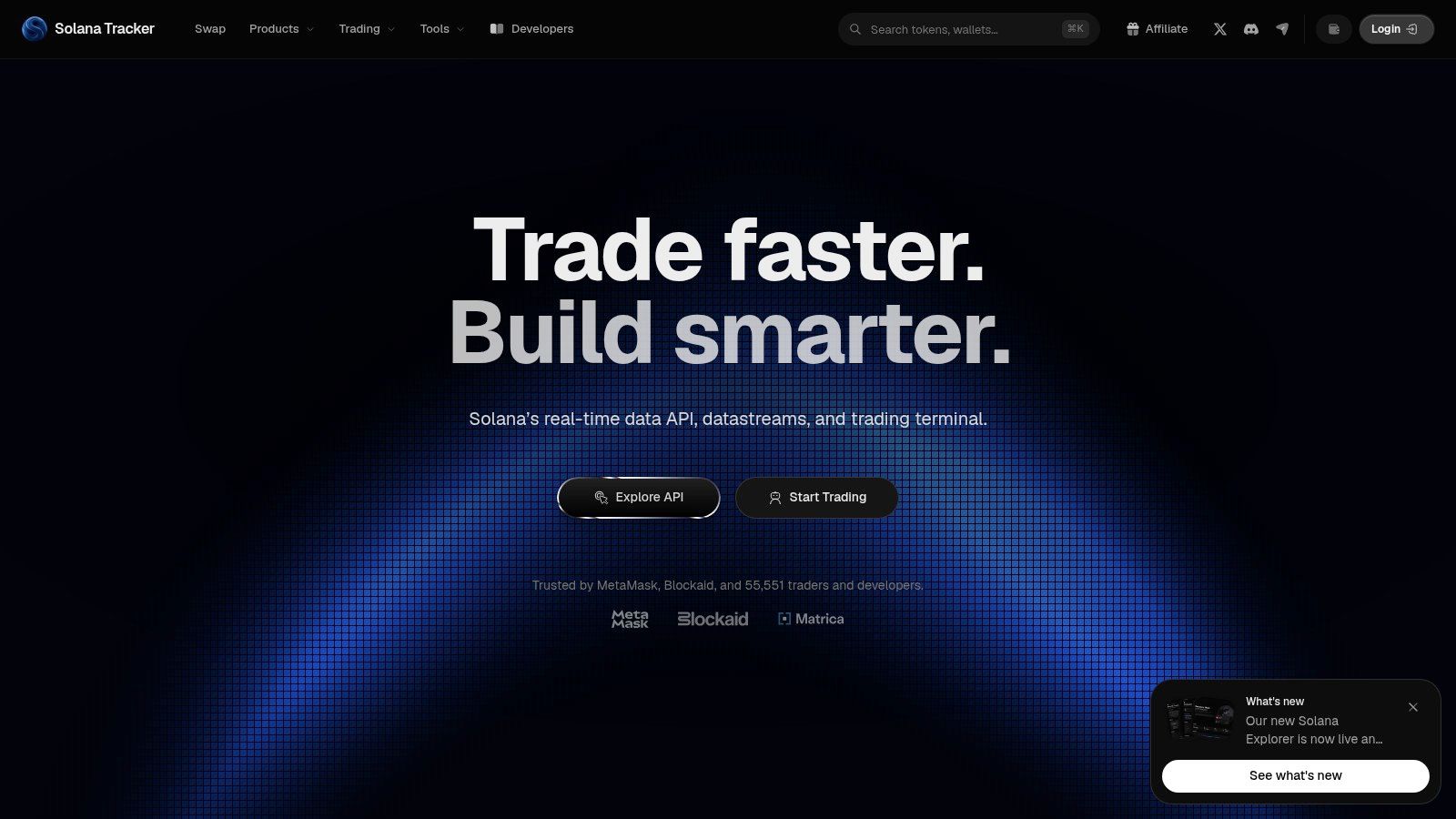
Best for Solana traders and developers who want discovery, risk analysis, and execution together. Solana Tracker combines live charts, one-click swaps, portfolio tracking, wallet analysis, and developer infrastructure rather than stopping at a new-token list.
Start with the trending Solana tokens feed, or use Memescope for live launchpad discovery. Treat either feed as a research queue. A token attracting attention still needs an independent assessment of liquidity, distribution, and trading behavior.
Read the flags before the chart
Our Rugcheck scores tokens from 0 to 10 across more than 20 risk factors, including snipers, bundlers, insider wallets, and authority status. Read the underlying flags rather than making an entry decision from the headline score alone.
Say a newly launched memecoin has a rising chart but concentrated insider ownership. Inspect those wallets, check whether they're selling, and compare their activity with changes in liquidity. You may miss an early price move by waiting, but you avoid treating coordinated buying as independent demand.
- For traders: Keep the chart, wallet behavior, risk signals, and execution in the same workflow.
- For developers: The Data API offers 70+ endpoints covering tokens, wallets, trades, prices, and risk scores. WebSocket streams and the TypeScript SDK support automated monitoring.
- For execution teams: Raptor provides hosted swap infrastructure and a self-hostable option, allowing different deployment approaches.
The RPC infrastructure also includes Shredstream and RidgeDB-powered methods for teams building beyond a browser terminal. That breadth is useful when your screening process becomes an application, but it's more infrastructure than a casual watchlist requires.
Practical rule: A risk score tells you where to investigate. It doesn't guarantee that a token is safe or that your exit will succeed.
The main limitation is scope: this is a Solana-focused platform, not a universal cross-chain terminal. Paid costs also need evaluation against your actual usage.
2. DEX Screener
Open DEX Screener's Solana new-pairs feed when you want a direct view of newly trading DEX pairs. Pair age, transactions, volume, liquidity, and charts make it useful for quickly narrowing a crowded launch feed.
Best for fast pair discovery across networks. Its strength is showing trading activity without requiring you to begin with a known token name. The web scanner is available without a paid subscription, making it a practical starting point for manual research.
For example, compare two new Solana pairs with similarly rising charts. If one has thin liquidity and a handful of repeated trades while the other has more varied participation, they deserve different treatment. Neither is automatically safe, but the comparison tells you which questions to ask next.
- Find: Select the chain and inspect newly created pairs.
- Vet: Compare liquidity with reported volume, then inspect the transaction feed for repetitive wallet behavior.
- Monitor: Record the mint and pool addresses so later checks refer to the same assets.
The trade-off is speed versus context. A fresh pair can appear before there's enough activity to distinguish genuine interest from temporary launch noise. A token appearing in the feed isn't an endorsement.
Don't compare tokens by ticker alone. If several coins use the same meme name, copy the mint address into your risk tool and confirm the pool's quote asset before considering a swap.
3. Birdeye
A token approaching migration needs a different review from one already trading in an established pool. Birdeye helps organize that distinction through its Solana new-listings interface and launch-stage filters, including New, Final Curve, and Migrated.
Best for organizing discovery around a token's launch stage. Birdeye combines those filters with charts, token market data, trading-oriented research tools, and developer APIs. That's useful when you want to follow a candidate through its launch process rather than inspect a single chart snapshot.
Compare like with like
Say you're watching a Pump.fun token near the end of its bonding curve. Compare it with other candidates at that stage, not only with tokens already trading in AMM pools. After migration, inspect the resulting pool's liquidity and trading activity again.
Graduation itself isn't evidence of durable demand. A Pump.fun preprint examining 655,770 tokens created during September–October 2025 found that only 4,338 reached graduation. That finding describes the study's sample and platform milestone, not a guarantee about any graduating token.
Migration changes the trading venue. It doesn't establish that buyers will keep participating.
Birdeye's filters make a watchlist easier to organize, but they don't replace authority, holder, or liquidity checks. A migrated token can still have concentrated ownership or deteriorating market depth.
For developers, API access can move this workflow into an application. The trade-off is that data access and usage depend on plan limits and costs, so validate the fields you need before building your screening logic around them.
4. GeckoTerminal
Start with the pool, not the coin name. GeckoTerminal's new Solana pools view is useful when you care about where a token trades and how much liquidity supports that market.
It shows recently added pools alongside liquidity, volume, transaction activity, and pool age. Its documented API also supports programmatic new-pool research, making it relevant to both manual screening and developer pipelines.
Suppose the same Solana token appears in several pools. One has a rising quoted price but little liquidity; another has more depth and continuing two-way activity. Inspect the pool you'd use, because a price displayed elsewhere may not represent an executable exit for your position.
- Verify identity: Match the token mint, pool address, and quote asset.
- Inspect depth: Request a quote for your intended trade size and review price impact.
- Track continuity: Watch whether liquidity remains available after the initial launch activity.
Best for pool-level comparisons, especially when a token trades across multiple venues. The limitation is that a new pool doesn't necessarily contain a newly created token. Existing projects can add markets, and duplicate tickers can confuse a name-based search.
Very early pool activity can also be economically insignificant. Don't promote a candidate because it has transactions; inspect their size and wallet participation.
Public API limits are another trade-off for automated screening. Design a queue that prioritizes promising pools rather than repeatedly requesting every newly discovered market.
5. DEXTools
A Solana token starts trending, and the chart looks clean. The next move is to verify the pair, then watch it without refreshing the screen all day. DEXTools combines new-pair discovery with pair exploration, charts, favorites, desktop alerts, and trading utilities. It works as a discovery-to-watchlist step in a repeatable vetting workflow: find the token, read the risk signals, then set up monitoring.
Best for traders who want discovery followed by watchlist monitoring. Core new-pair functionality is available among its free features, while some enhanced alerts and analytics require paid access or a DEXT-token-based tier.
For a practical routine, save a Solana pair only after checking its mint and reviewing its risks. If three similar tickers appear, match the mint first, then compare the pool you would trade. Set alerts around events that justify another look. A price move should trigger inspection of liquidity and transactions, not an automatic purchase.
Monitor exit conditions too
A profitable-looking chart isn't enough. A peer-reviewed study of newly created DEX tokens warned that some apparent winners had displayed value but effectively no realizable value.
That distinction matters when you're watching a speculative token:
- Price alert: Recheck the pool rather than assuming momentum is genuine.
- Liquidity change: Request a fresh exit quote and inspect what changed.
- Trading interruption: Review whether sells still execute and whether restrictions apply.
DEXTools covers broader chains than a Solana-only platform, which suits traders moving between ecosystems. The trade-off is interface complexity and feature gating. A Solana-only workflow may be faster when you only need one chain, while DEXTools is more useful when the same screening routine carries across markets.
Before paying, identify the monitoring task you need. If your routine only requires saving a pair and checking its chart occasionally, advanced analytics may add cost without improving your decision.
6. CoinGecko
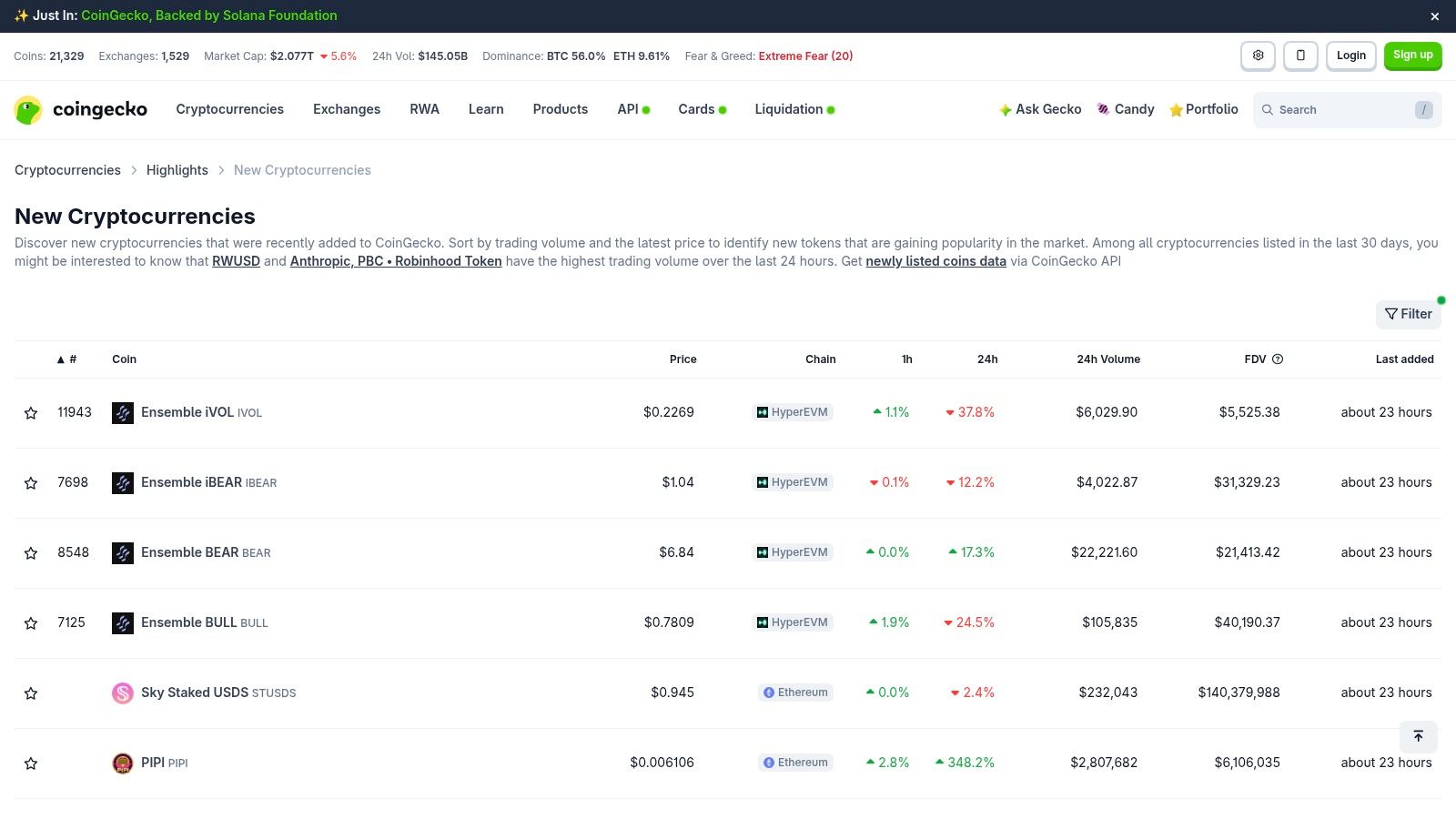
CoinGecko is better for broader comparison than launch-second discovery. Its recently added cryptocurrencies page helps you review newly tracked coins across networks using consistent fields such as chain, price, volume, and fully diluted valuation.
The key distinction is date added versus launch date. A token newly tracked by CoinGecko may already have traded elsewhere. Use the listing as a research lead, then verify the mint and inspect its existing markets.
Say a Solana coin appears with an impressive fully diluted valuation but limited trading activity. Open its market information and inspect the available pools. A supply-based valuation doesn't tell you how much capital can exit without moving the price.
A major tracking-site listing improves visibility. It isn't a liquidity guarantee or a safety certificate.
CoinGecko's historical coverage also encourages a longer view. CoinGecko's analysis found that 53.2% of cryptocurrencies in its five-year GeckoTerminal dataset had failed under its trading-activity criteria. That's a dataset-level result, not the failure probability of a coin on today's new-listings page.
Best for cross-chain research and consistent comparisons. The trade-off is freshness: it isn't designed to surface every brand-new DEX pool immediately.
For monitoring, record the actual trading venues alongside the listing. If activity disappears from those markets, an accessible coin page shouldn't keep the token on your active trading watchlist.
7. CoinMarketCap
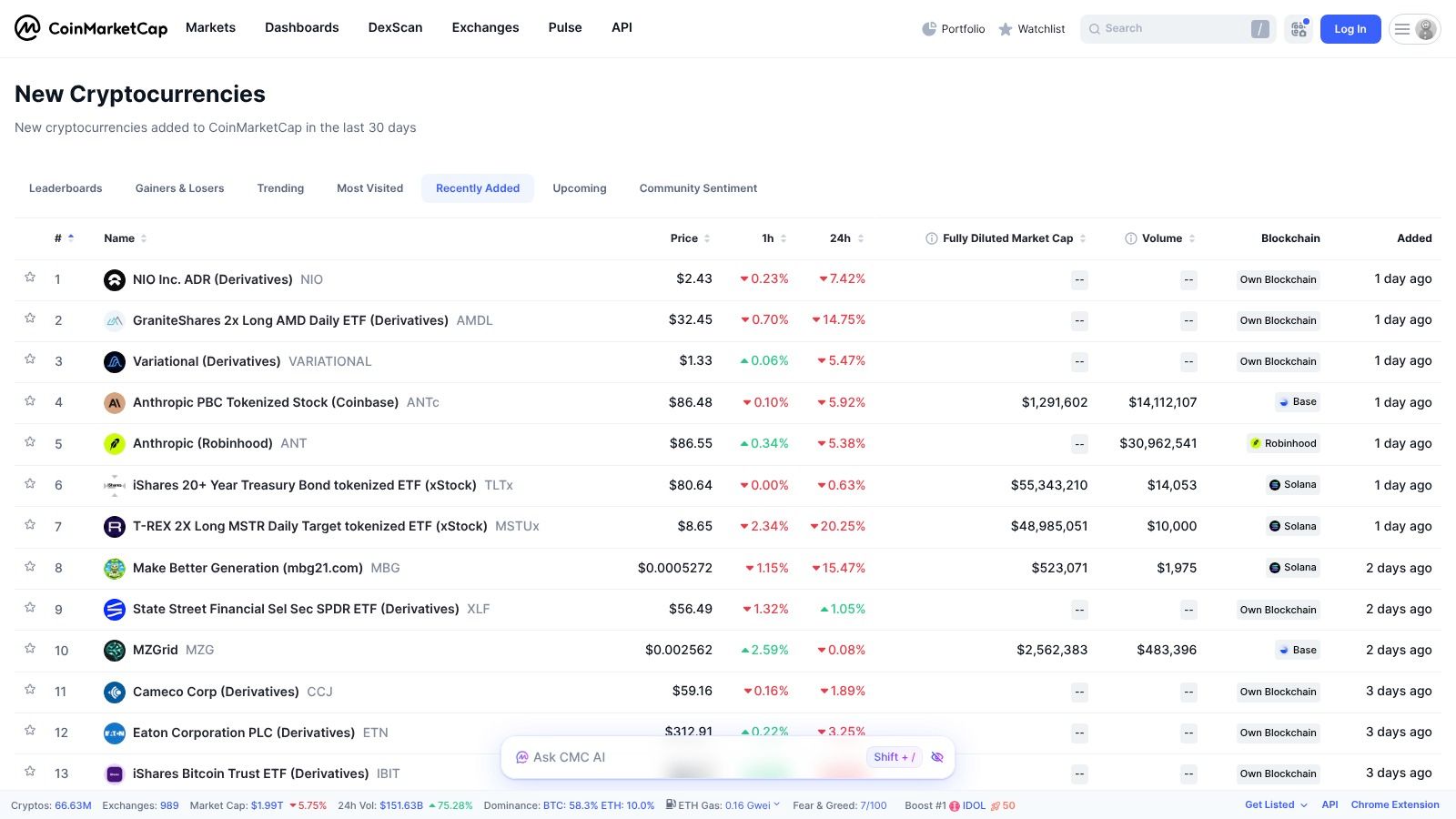
Use CoinMarketCap's New Cryptocurrencies page as a broad-market reference for recently added assets. It displays fields including blockchain, price, volume, fully diluted market capitalization, and date added, with sorting and pagination for browsing.
Best for checking newly tracked assets across chains. Like CoinGecko, it answers a different question from a launchpad feed: what has entered the tracking platform, rather than what was minted moments ago.
For example, you might find a Solana token on the new-listings page after discovering it elsewhere. Confirm the contract address, inspect its markets, and compare the listed information with the pool you intend to trade. Matching the name and logo isn't sufficient.
Use listing events as research triggers
For developers, the Listings New API endpoint supports automated listing research, but it requires an eligible paid API plan. That makes it useful for a listing-enrichment workflow, not a substitute for direct on-chain discovery.
- Find: Browse recently added assets or ingest eligible API results.
- Vet: Match the blockchain and contract address, then inspect liquidity and permissions separately.
- Monitor: Track the actual markets rather than relying on the listing's continued presence.
The practical advantage is consistent, recognizable market-reference information. The limitation is timing: listing can lag launch, so this isn't the strongest choice for discovering unlisted DEX tokens at their earliest stage.
For an exchange or wallet team, keep listing status and risk approval as separate fields. A newly tracked token should enter your review queue, not automatically become eligible for integration or trading.
How Each Tool Fits Into Finding New Crypto Coins
| Tool | Best for | Speed of new listings | Chain coverage | Free access |
|---|---|---|---|---|
| Solana Tracker | Solana trading, APIs, and token risk signals | Real-time data and feeds | Solana | Free tier available |
| DEX Screener | Scanning new DEX pairs and market activity | Fast new-pair feed | Solana and multiple chains | Web scanner available without a paid subscription |
| Birdeye | Solana token discovery and launch-stage research | New-listings feed | Solana-focused | Discovery available; some data and API access has plan limits or costs |
| GeckoTerminal | Exploring newly added DEX pools and liquidity | Recently added pools feed | Solana pools and other DEX pools | Public access; API rate limits apply |
| DEXTools | New-pair discovery and trading-oriented monitoring | Live new-pair feed | Multiple chains | Core new-pair features are free; some tools require paid access or DEXT |
| CoinGecko | Researching recently tracked coins across networks | Recently added listings; may lag token launches | Multiple networks | Public recently added coins page |
| CoinMarketCap | Checking recently added, broadly tracked assets | Recently added listings; may lag token launches | Multiple blockchains | Public browsing; Listings New API requires an eligible paid plan |
A practical workflow assigns each tool a job. Use Solana Tracker when the token is already on Solana and you need trading data, APIs, and risk signals in the same pass. Its Trading menu covers Swap, Latest Tokens, Trending, Top Gainers, Memescope, Whale Watch, KOL Tracker, Predictions and Solana Price. Memescope gives you live feeds of new launchpad tokens, so it fits the find step. The trade-off is scope: this is a Solana workflow, so it is less useful when the candidate starts on another chain.
Use DEX Screener or GeckoTerminal to find pairs and pools that are just appearing on a DEX. DEX Screener works well for scanning new-pair activity across Solana and multiple chains. GeckoTerminal is more useful when the question is where liquidity has been added, including Solana pools and other DEX pools. For example, a new Solana pair can be checked against the pool shown by GeckoTerminal before you decide whether the market is usable. The trade-off is that a pool feed is not the same as a launch feed.
Birdeye, DEXTools, CoinGecko and CoinMarketCap fit later stages. Birdeye is useful for Solana discovery and launch-stage research, though some data and API access has plan limits or costs. DEXTools suits live new-pair monitoring across multiple chains, with some tools requiring paid access or DEXT. CoinGecko and CoinMarketCap are better for confirming that an asset has entered broader tracking systems. Their recently added listings can lag token launches, so they are safer for research triggers than for earliest discovery.
The risk step should happen before the monitor step. Rugcheck scores every token from 0 to 10 across 20+ risk factors, including snipers, bundlers, insider wallets and authority status. Solana Tracker also supports Wallet Tracker and KOL Tracker, with KOL Tracker showing live trades from tracked KOL wallets. That gives a concrete routine: find the token, read the risk flags, then watch the wallets and market behavior. The trade-off is that a fast feed can put weak tokens in front of you, so speed needs a filter.
Putting It Together With a Simple Daily Workflow for New Coins
You don't need every discovery site open at once. Choose one primary feed, one risk-review process, and a monitoring method that tells you when a candidate needs attention.
For manual Solana screening, start with a launch or pair feed. For broader research, use a recently added listings page. Developers can automate discovery, but the same distinction applies: a token-creation event, pool-creation event, and tracking-site listing are different events.
A repeatable action sequence
- Pick one discovery feed: Save the mint address, pool address, launch stage, and reason the token caught your attention.
- Run a Rugcheck-style assessment before entry: Inspect mint and freeze authorities, insider concentration, bundlers, and other underlying flags. Don't rely on the summary score alone.
- Check liquidity and holder behavior: Review creator activity, large-wallet selling, and whether liquidity supports your intended position. Request an exit quote as well as an entry quote.
- Set watchlist monitoring: Use available alerts or WebSocket streams for price, trades, liquidity, and relevant wallet activity instead of refreshing charts all day.
- Define rejection conditions: Remove candidates when you can't explain permissions, identify usable liquidity, or verify the correct mint.
Say a watched memecoin rises while a concentrated holder starts selling and liquidity declines. That's a reason to reassess execution and exposure, not celebrate the chart.
For Solana-focused readers, Solana Tracker combines the terminal, Rugcheck scoring, wallet tracking, and real-time data APIs in one place. Risk scores remain indicators, not guarantees, and neither an alert nor a successful small sell guarantees a later exit.
The useful outcome is a smaller, better-documented watchlist. You're looking for new crypto coins you can evaluate and monitor, not collecting every launch that appears.
Solana Tracker brings token discovery, Rugcheck signals, wallet tracking, and real-time market data into a Solana-focused workflow. Visit Solana Tracker to build a watchlist, inspect the underlying risks, and monitor shortlisted tokens before deciding whether to trade.