You open your Solana wallet to swap a memecoin into USDC. A tempting number flashes on the screen, you click confirm, and a few seconds later fewer USDC arrive than you expected. That gap between the quote and what lands in your wallet is where most traders lose money without ever noticing why.
A DEX aggregator checks many decentralized exchanges at once and routes your trade through the path that returns the most tokens after costs. Routing volume through these services has grown enormous across decentralized crypto markets, which means the quality of a route now shapes real outcomes for everyday swaps, not just whale-sized orders.
The catch is that the headline quote is only the starting point. What you receive depends on pool depth, price impact, priority fees, and how your transaction gets ordered on-chain. Think of the quote as a menu price before tax and service charges: the number that matters is the one on the final receipt. Understanding what happens between quote and settlement is the difference between chasing a flashy rate and protecting your net payout.
What a DEX Aggregator Does in Plain Terms
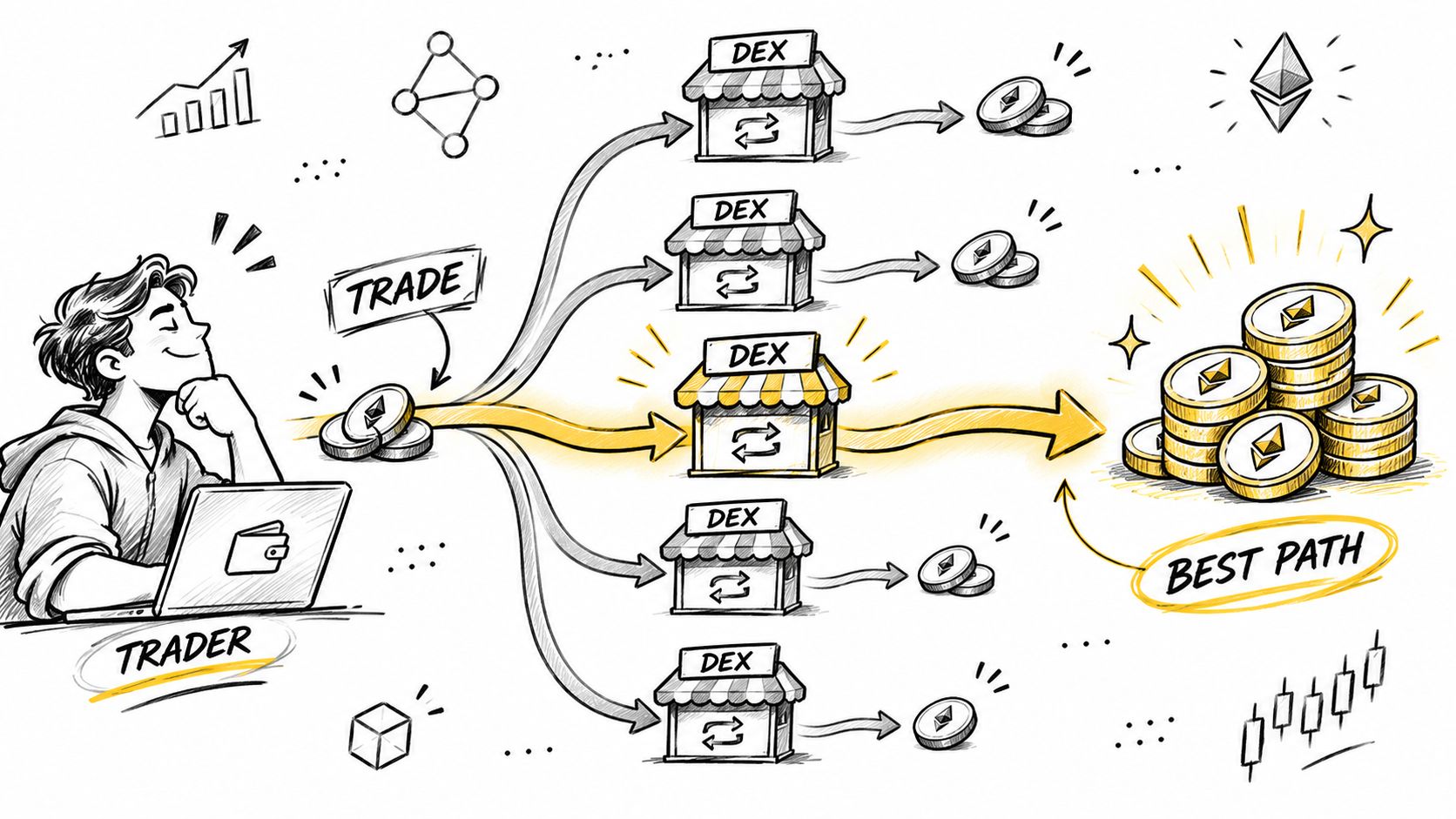
A DEX aggregator is a routing service that scans multiple decentralized exchanges at once and sends your swap along the path that delivers the most tokens. Think of a shopper who checks five stores before buying a pair of headphones instead of paying full price at the nearest shop. On Solana, that nearest shop is a single decentralized exchange or one isolated pool, while the aggregator is the shopper checking every other counter before handing over cash.
This model began in 2019 when the 1inch team built an early aggregator during a hackathon to display and interact with prices across several decentralized exchanges, expanding by early 2021 to 49 Ethereum-based exchanges and 12 exchanges on Binance Smart Chain according to a Software Engineering Daily interview with 1inch co-founder Anton Bukov. Rather than forcing traders to open ten browser tabs and compare pools by hand, the aggregator acts as a single layer sitting between your wallet and fragmented crypto markets.
Look at a simple illustrative swap on Solana (not a live market quote). Say you want to sell 1 SOL for USDC. Pool A quotes 150 USDC, while Pool B on another exchange quotes 151.2 USDC for that same 1 SOL. Instead of checking both exchanges manually, the aggregator spots that price gap and routes your order straight to Pool B.
Here is how that comparison happens behind the scenes when you request a swap.
Three Terms You See on Every Swap Screen
Every routing screen relies on three basic building blocks, and knowing them makes any Solana swap easier to read:
- Liquidity: The pile of crypto tokens sitting inside trading pools so buyers and sellers can swap without waiting for a human counterparty.
- Venues: The individual decentralized exchanges and automated market makers that hold those pools, each with its own reserves and fee tier.
- Router: The software engine that reads live pool balances across venues, compares expected payouts, and selects the path for your transaction.
From your side of the screen, the workflow stays simple. You get one combined quote, click approve once in your wallet, and let the router move your trade across the chosen venues automatically.
How the Router Chooses a Path and Splits It
When a router searches Solana, it rarely assumes the direct pool between two tokens is the best deal. Depending on your order size and available reserves, it chooses among three core path types.
| Route type | How it works | Example |
|---|---|---|
| Direct swap | One pool trades the two tokens directly | BONK to USDC in a single BONK-USDC pool |
| Multi-hop | The trade passes through an intermediate token | BONK to SOL, then SOL to USDC |
| Split route | One order is divided across several pools | A 10,000 USDC swap divided between two pools to limit price impact |
Each row solves a different liquidity problem. A direct swap works well for small trades in a deep pair, because one pool handles the entire exchange with minimal overhead. When the direct pair is thin, multi-hop routing bridges through a liquid base asset instead. As documented in a DevRels technical breakdown of Solana routing, a BONK-to-USDC trade may route from BONK to SOL and then from SOL to USDC when those two pools yield more combined tokens than the direct BONK-USDC pool, and a 10,000 USDC swap can be split across two pools when a single pool would push the price too far.
How Route Scoring Picks a Winner
Choosing between a direct pool, a multi-hop chain, and a split order comes down to math calculated against a live graph of automated market makers. The router scores candidate paths in three clear steps:
- Estimate gross output on every leg. The engine checks current token reserves in each pool along the candidate path to calculate how many tokens each hop would produce.
- Subtract pool fees and transaction costs. Every swap leg takes a pool fee, and adding extra hops or venues increases network execution overhead.
- Select the highest final amount. The router compares net totals across all candidates and returns the route that leaves you with the most tokens after fees, not just the highest spot exchange rate.
A longer route with a prettier headline exchange rate can still pay less than a simpler route once pool fees and extra execution hops are deducted.
A Worked 60/40 Split on a Mid-Cap Token
Solana's scale makes this scoring necessary. A Galaxy Research report on Solana market structure describes the network as having more than 10,000 liquidity pools, with separate decentralized exchanges and proprietary automated market makers quoting different prices, and notes that routers can divide large trades into discrete portions such as 60% through one pool and 40% through another to cut price impact and improve net output.
Walk through an illustrative example (using hypothetical figures, not live quotes). Say a trader wants to sell 50,000 USDC worth of a mid-cap Solana token. The deepest single pool only absorbs around 30,000 USDC before its reserve ratio bends sharply against the seller, so dumping the entire 50,000 USDC into that first visible pool would sacrifice a painful chunk of value.
Here is how the router handles that 50,000 USDC exit in five steps:
- Compare available pools. It scans active venues holding the token and measures how much depth sits near the current price in each one.
- Estimate output per leg after fees. Rather than stopping at the biggest pool, it calculates net returns across partial fills on two or more venues.
- Divide the order. It sends 60% (30,000 USDC) through the deepest pool and 40% (20,000 USDC) through a second pool so neither reserve gets drained too aggressively.
- Set a minimum output. Before signing, the swap attaches a floor representing the lowest token payout the trader will accept.
- Execute only if the market stays above that floor. The combined split runs on-chain as one coordinated attempt, aborting if reserves shift below the protected minimum.
Before clicking confirm on any sizable trade, take two seconds to inspect the displayed route breakdown alongside the expected net output. Checking whether your order is hitting one thin pool or splitting cleanly across deeper venues prevents avoidable losses.
Quoted Price, Price Impact and Slippage Explained
Most beginners get tripped up when they see a warning about a steep price drop on a swap even though they set a tight slippage limit. They assume the aggregator ignored their setting. In reality, two separate forces are at work, and confusing them leads to bad trades on thin Solana pairs.
Price impact is the market movement caused by your own trade size across the chosen route. When you buy or sell a large chunk of tokens from a shallow pool, the automated market maker's formula shifts the exchange rate against you immediately. That drop is baked into the quote before you even click confirm.
Slippage tolerance, by contrast, is the maximum gap you agree to accept between the quoted output and the final executed output if the market moves while your transaction is traveling to the blockchain. As explained in Solana Volume Bot's guide to aggregation, if a quote estimates 100 SOL for a token sale and you set 50 basis points of slippage tolerance, the transaction should generally reject execution below approximately 99.5 SOL, subject to the protocol's exact calculation.
This diagram shows how large trade sizes move pool prices and separate quoted figures from realized fills.
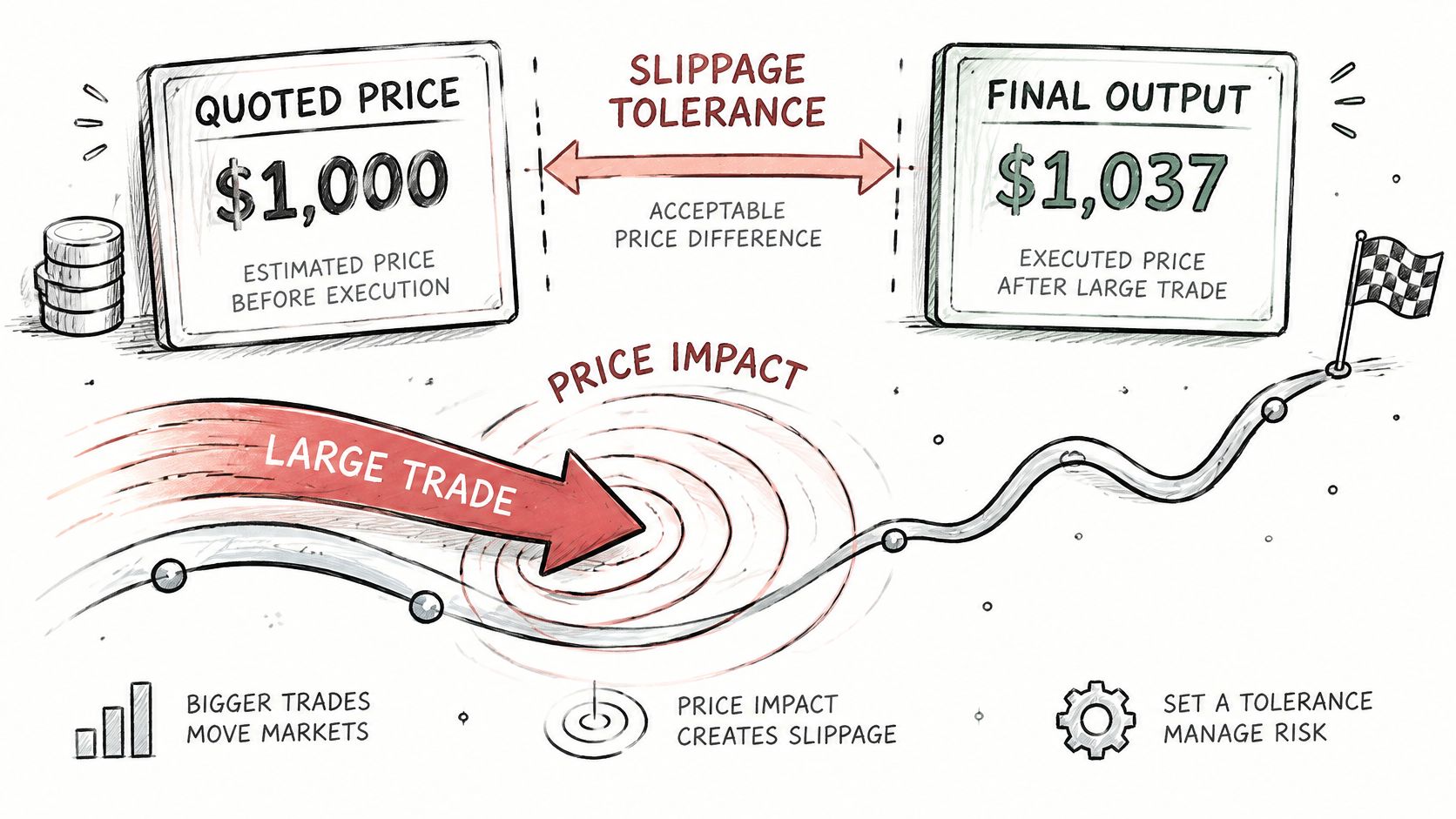
On low-liquidity Solana tokens, this distinction matters every single day. You can set a tight slippage limit and still suffer substantial price impact because your order is too big for the pool's reserves. Tightening slippage won't fix a massive price impact, because slippage only guards against changes that happen after the quote is calculated.
The opposite mistake is just as costly. Raising your slippage tolerance far too high so a volatile memecoin swap "just goes through" hands the market permission to fill your order at a far worse rate if prices swing or liquidity pulls away mid-transaction.
Practical rule: Price impact tells you whether your order is too big for the pool right now. Slippage tolerance tells the network how much worse a fill you'll tolerate if the pool moves before confirmation.
Three Practical Habits Before You Confirm
Keep these three checks in mind whenever you trade smaller Solana pairs:
- Check price impact before signing: Read the impact percentage shown on the quote screen every time, because a narrow slippage limit won't protect you from an oversized trade. If a modest buy already shows heavy price impact, the quote is telling you the pool is too shallow.
- Keep slippage tight on thin tokens: Use a conservative tolerance when liquidity is light so sudden reserve shifts trigger a clean revert instead of a terrible fill. A failed transaction costs a tiny network fee, whereas a wide slippage fill can erase a real percentage of your stack.
- Reduce trade size when impact spikes: If a single order moves the price more than you're comfortable giving up, cut it into smaller clips spaced a few minutes apart. Smaller pieces let arbitrageurs rebalance the pool between fills instead of forcing you to absorb the entire curve at once.
How Large DEX Aggregation Has Grown
A busy highway can carry thousands of cars while one exit remains jammed. DEX volume works similarly. The headline number shows total activity, while your route still depends on pool depth, reserve size, and the path chosen at execution time. Recent market figures show that aggregators now move a substantial slice of decentralized crypto trading, with Solana sitting near the center of that flow.
| Metric | Reported figure | Source context |
|---|---|---|
| Global DEX aggregator volume (2024) | $781 billion | Ethereum Reports 2022-2026 DEX market report (published 2026) |
| Global DEX aggregator volume (2025) | ~$1.62 trillion | Ethereum Reports 2022-2026 DEX market report |
| Aggregator share of DEX volume | ~23% | Industry research report cited in 1inch's 2020 review |
| Solana share of total DEX volume | ~48% | OKX 2025 DEX report via CryptoRank |
| Solana Q4 2025 DEX volume | $364 billion | Galaxy data cited in the CryptoRank OKX report |
| Jupiter 30-day routed volume (2026) | $14.79 billion | Blockonomi's 2026 DEX statistics report |
Those numbers matter because routing has become part of the trade itself. Annual aggregator volume roughly doubled from $781 billion in 2024 to about $1.62 trillion in 2025, and Solana accounts for nearly half of total DEX volume. In a market that large, a small improvement in pool selection or split paths can affect the tokens that finally reach your wallet.
That is the net execution angle. A quote may advertise better pricing, but the useful question is what survives after price impact, pool depth, MEV, and priority fees. Imagine two routes offering the same headline quote. Route A sends the full order into one shallow pool. Route B splits it across deeper pools. Route B may preserve more of the quoted improvement because each piece moves the market less.
Why High Network Volume Does Not Guarantee Pool Depth
Large ecosystem totals can hide thin reserves. The OKX 2025 market analysis says Solana liquidity can be unstable because many pools do not retain total value locked in the same way pools in other ecosystems do. The same CryptoRank report notes that memecoins predominantly trade inside shallow-liquidity AMMs, where slippage and transaction costs escalate quickly.
Say a trending token prints heavy daily volume across Solana DEXes. That figure might come from automated bots trading back and forth inside a pool holding little in actual reserves. High network volume proves activity, not depth. A router can find paths through that activity, but it cannot manufacture liquidity that is not there.
For traders, the practical lesson is simple. Treat volume as a map of where trading happens, then check whether the chosen route can absorb your order. A quote is the starting point. Net execution is the final result after the market has moved.
Risks Beyond the Best Price
A trader approves a swap expecting the exact quote on screen, then receives noticeably less token than promised. That gap between the displayed quote and the settled result is where aggregators stop being simple price-comparison tools and start being a lesson in execution risk. A quote is only a snapshot of pool reserves at one millisecond, and plenty can change between requesting a route and landing on-chain.
Why a Quote Can Slip Before Landing
A quote works like a fare estimate on a ride-hailing app: accurate the moment you see it, but only valid if road conditions hold still until pickup. On Solana, the "traffic" is other traders hitting the same pools. By the time you approve the wallet prompt and your transaction reaches a validator, someone else's swap can alter pool reserves and shift your final payout.
Routers and wallets do give you one lever here. Solana swaps can attach optional priority fees to improve scheduling priority during volatile launches or network congestion. Think of the priority fee as paying for a faster lane: it raises the odds of landing early, but it cannot freeze the price for you, because the pool itself keeps moving.
A concrete example makes the trade-off clear. Suppose a trading app requests a route to buy a fresh Solana token, sets a strict minimum-output limit, and adds a priority fee to beat the crowd. If three whales buy first and push the price past that threshold before confirmation, the minimum-output check forces the transaction to fail rather than fill outside your limit. You lose the network fee, but you avoid overpaying for the token. That is the honest bargain of on-chain execution: protection against a bad fill costs you the occasional failed transaction.
MEV, Sandwiching and Access Costs
Splitting a trade across multiple venues also creates risks a static quote never shows. When a swap travels through observable routes, automated searchers can spot the pending intent and sandwich or back-run it, buying ahead of your trade to inflate the price and selling right after you fill. The route looked optimal when quoted; the ordering of the block decided otherwise.
An empirical audit of millions of WETH-USDC swaps measured an average realized shortfall of 2.02 basis points against optimized benchmarks, totaling roughly $24 million across the observed sample. On a $1,000 swap, 2.02 basis points is only about twenty cents, but scaled across millions of trades it becomes a serious tax on execution quality. The same audit's gas-aware benchmark highlights a direct engineering trade-off: adding more pools can improve the gross exchange rate, yet extra transaction overhead eats back the gain, a balance that shows up on Solana through compute limits and priority fees.
Companion research on that same large Ethereum swap dataset found that sandwiching accounted for a significant share of the inefficiency and emphasized that MEV defenses like private routing, request-for-quote systems, batching, or validator-aware submission aren't binary cures. Even with protections enabled, toxic-flow repricing, stale quotes, and failed legs still occur. Broader research on fragmented market routing adds a second layer: reaching liquidity carries transaction-dependent costs shaped by the underlying blockchain, so a router that treats every pool as equally reachable can pick a path that looks cheaper on paper yet turns uneconomic after access costs.
Stop asking which aggregator displays the highest quote on screen. Ask how much of that quoted improvement actually survives fees, reserve changes, and transaction ordering.
Warning Signs on Thin Pools
Displayed liquidity is not always executable liquidity, and trading volume alone never proves a pool is safe. Watch for three specific red flags before sending a swap:
- A shallow pool relative to your order: Say a pool displays a slightly better price than competitors but holds very little depth relative to your order size. One liquidity provider pulling reserves before your transaction lands can collapse your fill.
- A brand-new token launch: Freshly deployed pairs often carry temporary liquidity seeded during launch windows that evaporates within minutes once early buyers exit. The pool you saw when quoting may not be the pool you trade against.
- A quote that sits far above every competing venue: Because stale quotes occur even on protected routes, a price that looks unusually generous can mean the reserve data behind it is already outdated. What looks like a gift is often just lag.
Two quick checks go a long way. Compare the quoted rate across more than one pool or venue before committing, and size your order against visible depth rather than headline volume. Neither step guarantees a clean fill, but both shrink the gap between what the router promises and what you receive.
Keep the division of responsibility clear, too. Swaps are executed on-chain through decentralized protocols, and Solana Tracker acts only as an interface, which means market movement, liquidity shocks, and underlying protocol risks always stay with you.
Token Risk Checks and the Decision to Swap
A clean route can still end badly if the token carries permissions that let the creator change the rules after you buy. A router reads reserves, fees, and paths. It does not judge whether mint or freeze authority is active, or whether launch wallets were positioned before the crowd arrived.
Use a simple mental model. Routing answers, “How do I get the most tokens for this order right now?” Token risk checks answer, “Can I trust that those tokens remain sellable under fair conditions?” A quote works like a delivery estimate. The route may be efficient, while the address you are delivering to sits on unstable ground.
Before approving a swap on an unfamiliar Solana token, check four token-level signals that a price quote can't measure: holder concentration among top wallets, whether mint or freeze authority remains active, sniper and bundler activity during launch, and insider wallets controlling a large share of supply. These matter because net execution is the final result you care about, not just the headline rate on the screen. A route that saves tokens on paper loses its value if selling later is blocked or the supply picture changes.
Risk checks fit naturally beside routing. Our Raptor Swap API is a free hosted swap API spanning 71 Solana DEXes with just-in-time routing and an optional self-hostable binary. The Solana Tracker Rugcheck tool scores every token from 0 to 10 across 20+ risk factors, including snipers, bundlers, insider wallets, and authority status. One tool maps the path. The other shows whether the destination deserves your order.
Here is a concrete read. Suppose a newly launched token shows a crisp multi-hop route with a strong net output after pool fees and price impact. Then Rugcheck returns a low score and flags an active freeze authority. That flag is enough reason to skip the trade. The best net execution on screen means little if you're blocked from selling later.
For developers and analysts who enjoy digging into these exact problems professionally, from modeling split-route efficiency to quantifying MEV and pool risk, quantitative teams actively recruit for on-chain execution talent, and you can apply for this DeFi quant role through Blockchain Jobs.
A Four-Step Take-or-Skip Checklist
Use one consistent decision rule before signing any Solana swap:
- Compare net output against the headline rate. Confirm that the expected tokens after pool fees and priority fees still beat simpler alternatives.
- Verify pool depth for your order size. Look at the route's chosen pools and price impact to make sure reserves can absorb your trade.
- Read the token score and authority status. Check for active mint or freeze permissions, heavy insider concentration, and bundled launch wallets.
- Take or skip the swap. If both the net execution math and the token safety checks pass, sign with a sensible slippage limit; if either fails, walk away.
Every trade settles directly on-chain through decentralized protocols while the aggregator only serves as your interface. That means market movement, liquidity shocks, and protocol risks stay with you. Skipping a bad quote or a risky token is the protection you control.