SOL tags 200 USDC at 2am, exactly the price on the sell order you placed last week. You open your wallet expecting 1,000 USDC from 5 SOL and find less, or a fill you can't explain, or nothing at all. Nothing failed. A limit price is a condition you set, not a promise the market keeps. Between typing the number and seeing the balance move, a keeper decides to act, a validator orders the transaction, a pool absorbs the trade, and a liquidity provider eats the difference. Learning how DEX limit orders work means following that chain instead of staring at the number you typed.
Three Designs Behind Every DEX Limit Order
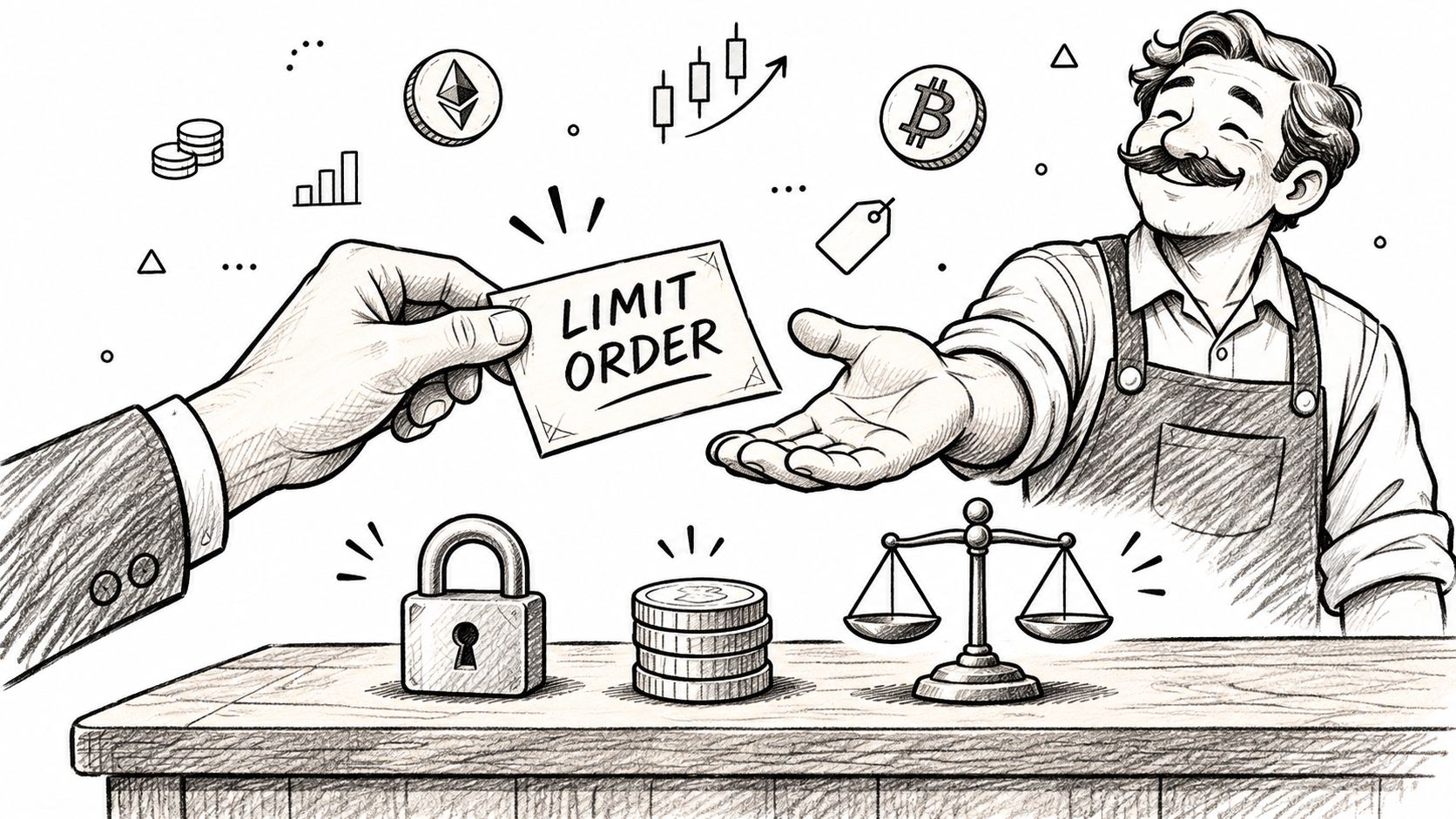
A DEX limit order runs on one of three designs. Each holds your money in a different place, fills under different rules and bills you in a different currency, so one phrase covers three quite different machines. Think of a limit order as a note you leave with a shopkeeper: buy at this price, or sell at that, and wait. The design decides who holds the note, who holds your cash while you wait, and who gets to say yes.
The shopkeeper picture is close to how it works in practice.
Design one is the on-chain order book. Academic research on decentralized exchange design describes Serum, a Solana-based DEX launched in 2020, as a fully on-chain central limit order book with a matching engine that uses price-time priority. Your order rests in a public book, and collateral gets locked the moment you place it. The same paper notes that limit-order submissions and cancellations represented 95% of message traffic on a Canadian exchange, which shows why writing every order and every cancel to a blockchain gets expensive fast.
Design two is the signed off-chain order. You sign a message naming the token you're selling, the token you want, a minimum amount and an expiry. Nothing touches the chain until a filler matches it, so your funds stay in your wallet.
Design three is the concentrated liquidity range. A position placed above or below the market behaves like a sell or buy limit, turning into the other asset as price crosses your range while it collects fees.
| Design | Where the order lives | Funds at placement | Fill rule | Main cost |
|---|---|---|---|---|
| On-chain order book (Serum style) | A resting order in a public on-chain book | Locked in escrow | Price-time priority | Transaction fees and order management |
| Signed off-chain order | A signed message held off-chain | Stay in the trader's wallet | A filler matches when the price meets your minimum | Filler gas and possible spread |
| Concentrated liquidity range (Uniswap v3 style) | Liquidity placed in a price range | Deposited in the pool | Fills as the price crosses the range | Divergence loss and rebalancing |
Two questions sort any interface you meet. Where do my funds sit while the order waits, and who decides when it fills? If the first answer is an escrow account, your capital is locked until cancellation or expiry. If the second answer is a keeper you've never met, your fill depends on that keeper's incentives and its priority-fee budget.
How a Solana Limit Order Moves From Placement to Fill
Every design runs through the same six stages. The differences sit in the middle.
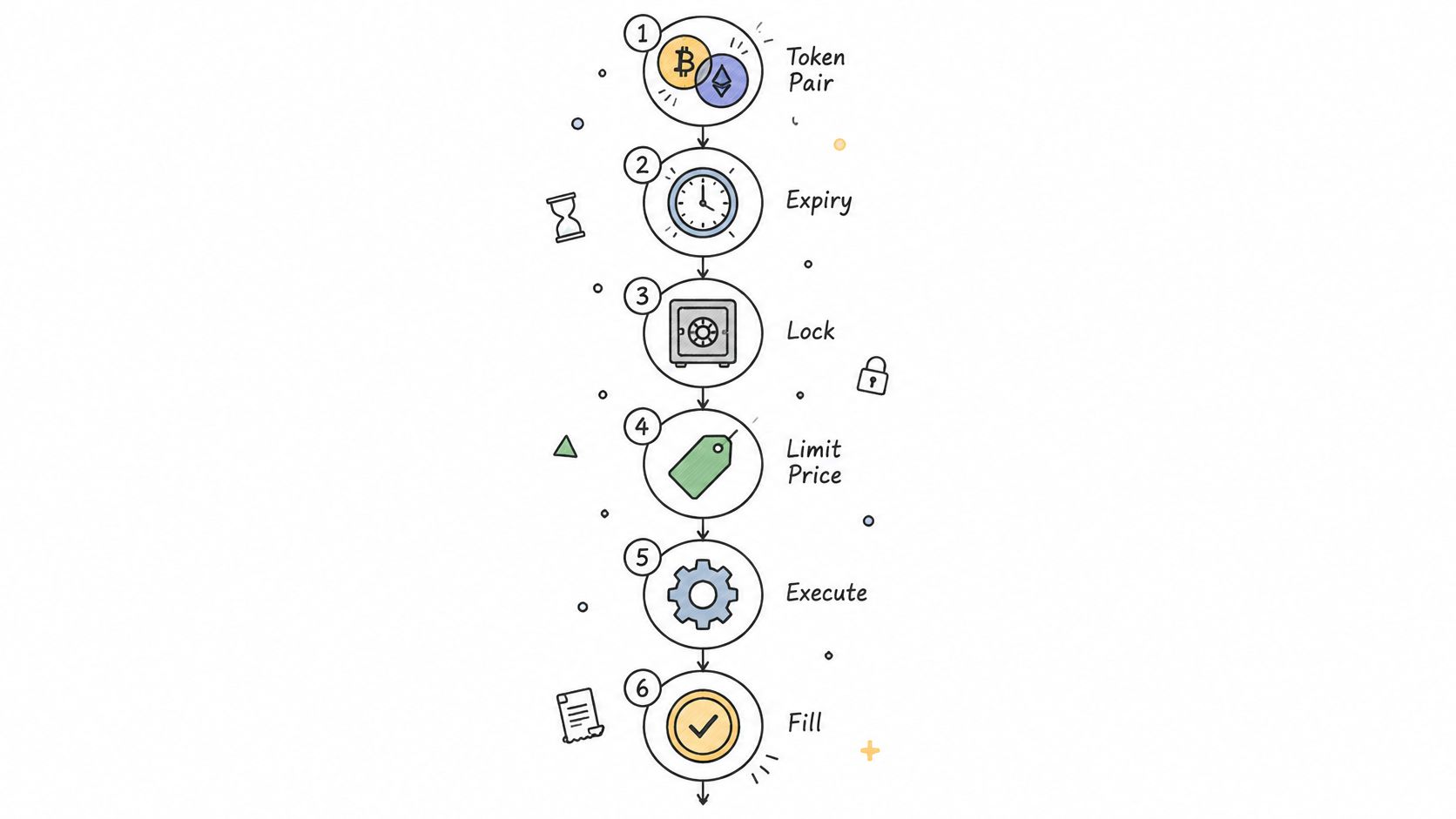
Set the pair, size, limit price and expiry. A DEX limit order sets the minimum price you'll accept on a sale or the maximum you'll pay on a purchase, and execution is never guaranteed, as this glossary entry on limit orders explains with a sell order for 5 ETH that only triggers at 4,000 USDC. Common slip: copying the last traded price exactly, so your order sits one tick away from the market forever.
Sign or submit the order. An order book writes it to an on-chain account; a signed-order design keeps it as a message until a filler picks it up. This choice is the whole reason funds move or don't move. Common slip: signing without reading the minimum receive amount.
A keeper, solver or market maker watches your price. Someone has to pay to poke the chain when your condition is met, and that someone expects to profit from doing it. Common slip: assuming the fill is automatic. It's a business decision made by a third party.
The fill transaction is submitted. Priority fee decides how fast it lands relative to everyone else competing for the same block. Common slip: leaving the fee at a default during a busy hour, then watching the quote move before inclusion.
Settlement lands, sometimes partially. A large order against a thin book fills in pieces. Common slip: reading a partial fill as a complete exit and closing your notes on the position.
Any remainder is cancelled or expires. This is your safety valve. Common slip: setting an expiry so short that the market never gets a chance to reach your price.
Practical rule: an order isn't finished until you know how much filled, at what price, and what's still open. Three numbers, every time.
Where Your Funds Sit Until the Order Fills
Custody is the difference newcomers feel first. In an escrow order book, the program takes your money at placement. The Solana order book reference implementation lays out the arithmetic plainly: a buy for 10 tokens at 2 USDC each locks 20 USDC up front. If that order fills at a better maker price of 1.90 USDC, the trade costs 19 USDC and the unused 1 USDC is tracked and refunded after full settlement. Partial fills and cancellation use the same machinery.
In a signed-order model, nothing leaves your wallet until a filler matches you. The signed instruction names the token you're selling, the token you want, a minimum amount to receive and an expiry, and the filler normally pays the transaction gas, as this guide to signed limit orders and DCA describes. You keep custody the entire time.
Both are honest designs. They just fail differently. Escrowed funds are locked while the order waits, so a limit that never gets hit ties up capital you may want elsewhere. Signed-order funds stay liquid, but the order only exists because someone else chooses to fill it.
Before you sign, confirm four things.
- Minimum receive amount. This is the number that protects you, not the headline price.
- Expiry. Short for volatile pairs, longer for a patient entry.
- Cancellation path. Know the button, and know whether cancelling costs a transaction.
- Who pays the fee. On signed orders it's usually the filler. On escrowed orders it's usually you.
Execution Risks Behind a Filled Price
The surprise most traders hit first is a fill that costs more than the price they wrote down. That's not a bug. Research on public blockchain trading identifies frontrunning and inefficient blockspace allocation as structural features of public chains, and notes that traders who can update or cancel orders quickly avoid adverse selection better than those who can't. Your limit price is a condition. Other people decide how it gets met.
The four things that can happen
Your order can sit unfilled because the market never reached your price. It can fill partially because liquidity at your level was thin. It can fill below your quoted price because the market moved between trigger and inclusion. Or the transaction can fail outright under congestion.
Adverse selection is the one nobody warns you about. A fill sometimes happens because someone faster saw that your quote had gone stale and took it before you could reprice. You got filled. You also got picked off.
Faster infrastructure isn't automatically better for you. It helps you cancel and reprice, but it also sharpens the race for priority, and slower orders lose that race.
| Symptom | Likely cause | What to do |
|---|---|---|
| Order never fills | Price never reached the limit or liquidity is missing | Lower the limit, extend the expiry or check pool depth first |
| Only part of the order fills | Thin liquidity at your price | Accept the partial fill or split the order into smaller sizes |
| Fill comes in below the quoted price | Market moved before inclusion | Use a shorter expiry and a tighter limit |
| Transaction fails | Network congestion or a low priority fee | Raise the priority fee and resubmit with a fresh quote |
Thin, volatile tokens are where this bites hardest. The quoted price looks generous while the executable size disappears. Check depth before you set a tight limit on a new launch.
Who Pays the Hidden Costs of a Fill
A filled limit order can still be a poor trade. The trader may pay for priority, the liquidity provider may lose value to arbitrage, and infrastructure participants may collect fees for ordering and settling transactions. The limit price shows the target, not who bears the costs along the way.
The trader pays priority fees to improve the chance of timely transaction inclusion. Paying more may help a transaction compete for space, but it does not guarantee a better fill.
The liquidity provider faces divergence and arbitrage losses as prices move. A pool can offer a quoted price that looks attractive, while the value received by the provider changes as traders trade against it.
The infrastructure layer earns fees for transaction ordering and settlement. Those fees are part of execution costs, alongside any price impact borne by traders or liquidity providers.
Before placing a limit order on a thin or fast-moving pair, consider who might take the other side and what costs each party bears. A successful fill confirms execution, not that the price was the best available.
Worked Examples With Real Solana Numbers
Three scenarios, three designs. Watch the numbers, not the labels.
Example one, resting limit order. You sell 5 SOL at a limit of 200 USDC each. If SOL reaches 200, a filler sells your SOL for 1,000 USDC. If it never gets there before expiry, the order expires and your SOL is untouched.
Example two, signed order. You sign an order to sell 100 USDC for at least 0.5 SOL. Your USDC stays in your wallet until a filler matches at 0.52 SOL. You receive 0.52 SOL, above your minimum, and the filler pays the gas.
Example three, concentrated range. You place a range for SOL between 150 and 170 USDC while the price sits at 140. The position holds only SOL. Once SOL rises through 150 it converts toward USDC and earns fees along the way, and once SOL passes 170 the position is entirely USDC and stops earning. Uniswap's write-up of v3 concentrated liquidity sets out that trade-off directly: narrower ranges give more density at your target price, but a position goes inactive once price leaves the interval, and it may need rebalancing.
Read every result the same way. How much did you receive, what price did you pay, and did the order fill completely? Anything else is decoration.
Integration Patterns for Builders
Three wiring patterns cover most Solana integrations.
Off-chain matching with on-chain settlement. A keeper or solver watches signed orders, validates them, and submits the fill transaction that moves assets. Cheap to run, dependent on the solver's incentives.
A fully on-chain book. An escrow program locks collateral at placement, matches permissionlessly and refunds any unused amount after settlement.
Hybrid quoting. Prices are computed off-chain for speed, then executed through an on-chain program that enforces the minimum receive amount.
Whichever you pick, the build steps are the same.
- Validate the signature, expiry and minimum amount before submitting anything.
- Re-check the price against the live pool at submission time, not at signing time.
- Set a priority fee deliberately, and retry with a fresh quote when a transaction fails.
- Track partial fills as open remainders rather than closing the position.
- Index fills from confirmed program events and reconcile them against finalized history, so your records reflect what settled, not what you hoped would.
The rule that keeps this honest: the on-chain program decides whether a fill settles. Your off-chain signal is a suggestion.
Pick the Right Limit Order Setup Before You Trade
Match the setup to the market you're trading, not to habit.
- Deep pair, patient entry such as SOL/USDC. A resting limit order with a clear expiry.
- Thin or volatile token. A shorter expiry, a tighter limit or a marketable limit near the current quote, after checking pool depth. A resting order on a thin book can wait for a fill that never comes.
- Long-term liquidity provision. A concentrated range, with a plan to rebalance when price leaves it.
Then do the boring part. Before placing size, compare swap routes across Solana DEXes so you know what the alternative costs. And check every fill against confirmed on-chain history rather than the live feed. Our REST liquidity history is served at confirmed or finalized commitment, while live liquidity rooms deliver events at processed commitment, so the REST view is the record you reconcile against.
Solana Tracker gives you one interface for that reconciliation work: a real-time trading terminal, a Data API with 70+ endpoints for tokens, wallets, trades and prices, and the Raptor Swap API spanning 20+ Solana DEXes for best-price routing. If you're placing limit orders or building the matching layer behind them, that combination lets you check fills, depth and counterparties from the same place. Start at Solana Tracker and compare your next route before you commit size.