A rug pull is a crypto scam in which the people behind a token or project attract buyers' money, then drain its value or walk away. In 2021 these scams took billions of dollars from crypto buyers, and the pattern keeps repeating because the warning signs sit on-chain before the money moves.
A new Solana chart just doubled in front of you. The chat is loud, the pool still shows a quote, and your finger is already on buy. That quote can vanish in one transaction if the wallet that created the pool still controls it. A rug pull rarely arrives as one sudden event. It runs as a short sequence: build the pool, pull in buyers, then remove the liquidity or flip a rule in the contract. Each step leaves a trace you can check before you send any SOL.
What a Rug Pull Is and Why It Happens
A shop owner invites customers in, takes their payments, then empties the till and locks the door. From the street the shelves still look stocked. Inside, nothing is left to sell. A rug pull works the same way on a blockchain.
A rug pull is a cryptocurrency scam in which developers create and promote a seemingly legitimate token, DeFi protocol, NFT project, or other blockchain venture, attract users' funds, and then abandon the project or manipulate its code and liquidity to extract value.
It works because creators often still control the liquidity pool, minting permissions, transfer rules, or project wallets. Buyers can see a price. They cannot stop the person who holds those keys from moving the assets that back the token.
Chainalysis reported that rug pulls generated more than $2.8 billion in stolen cryptocurrency during 2021, about 37% of all cryptocurrency scam revenue, compared with only 1% in 2020. Those figures count only the funds taken directly; a token's price collapse after the withdrawal adds further losses on top.
A rug pull is a sequence, and the drain is its last step. The conditions that allow it are set at launch: who can withdraw the pool's liquidity, who can mint new supply, and who holds most of the tokens. Those settings sit on chain while the chart climbs, readable by anyone.
A token can be dangerous before any visible theft if insiders still hold sell control, liquidity control, or minting privileges. A quoted return, the kind you might compare savings APY and crypto yields against a savings account, tells you nothing about who can empty the pool.
Check these signs before you treat a chart as a market:
- Pool control: the liquidity is not burned or locked, so one wallet can still withdraw the paired asset.
- Mint or freeze authority: supply can grow after you buy, or your transfer can be blocked.
- Holder concentration: supply sits with one wallet or the top 10 holders, so a single exit can sink the price.
- Exit path: ordinary holders can sell as well as buy.
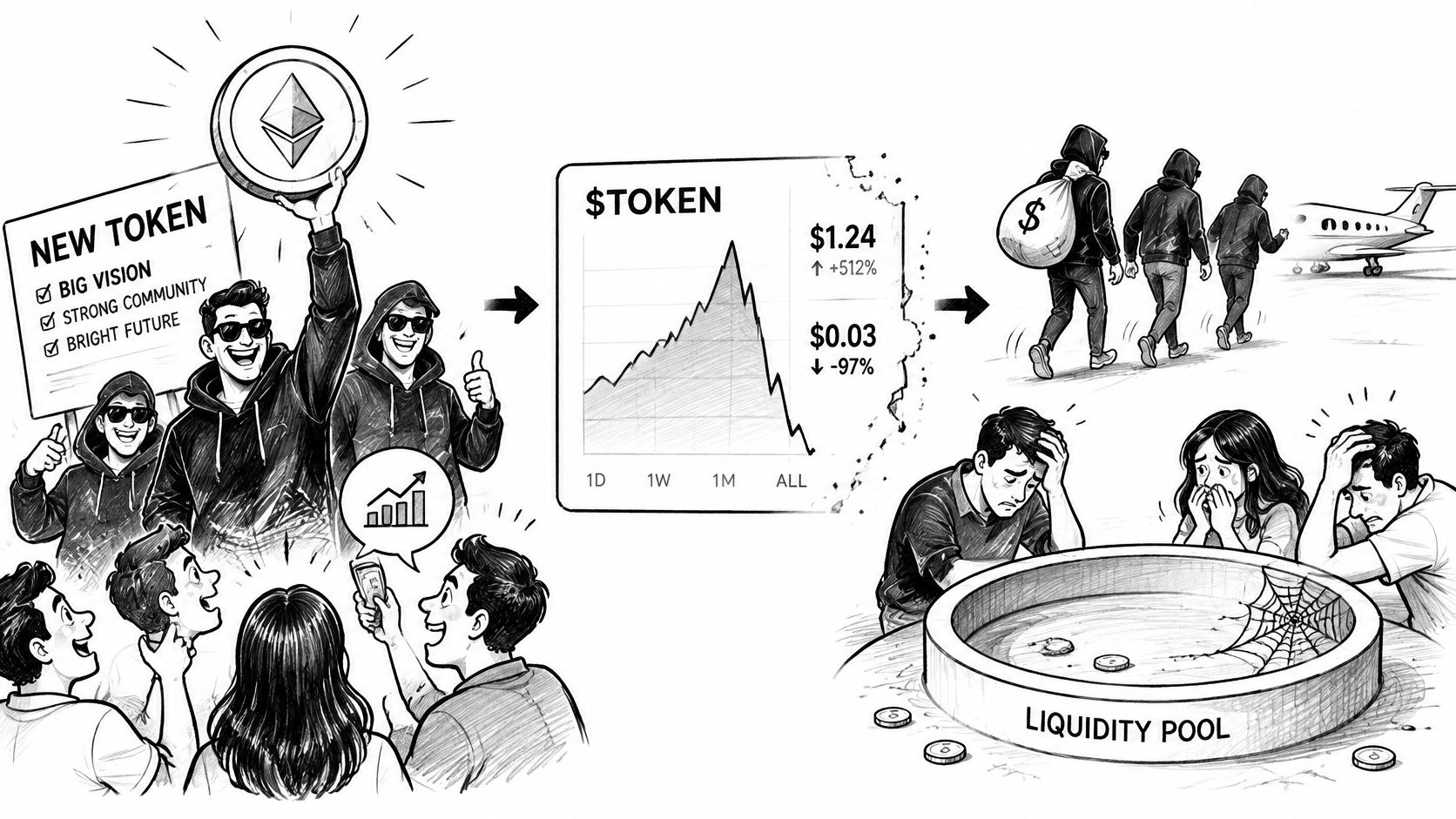
How a Rug Pull Unfolds Step by Step
Say a new Solana token is paired with SOL on a decentralized exchange. The quoted price is only the ratio of tokens to SOL sitting in that pool. Change one side, and the price jumps.
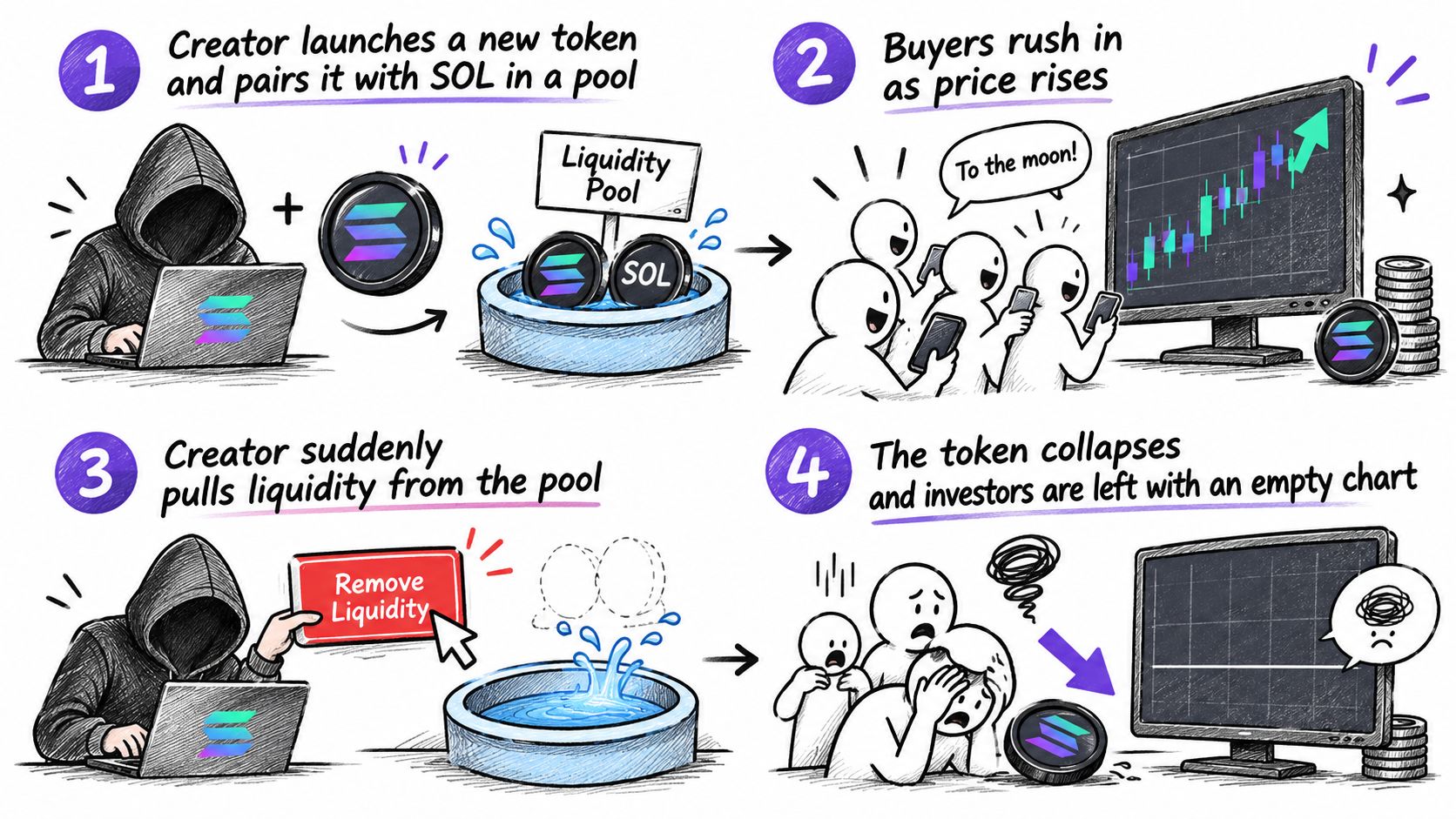
A practical Solana description of the pattern is simple. The developer creates a token, pairs it with SOL, attracts buyers, then withdraws the pool's assets. Here is one version with round numbers so you can see where your SOL goes.
- The creator seeds the pool. They launch the token and add 50 SOL beside a large token supply. Buyers now have a market, because the pool can swap the token for SOL.
- Buyers add the valuable side. Traders purchase the token, and their SOL pushes the pool to around 150 SOL. The chart looks healthy because outside money increased the reserve, not because the project earned anything.
- The creator removes the SOL. They withdraw nearly all of that SOL and keep it. Taking one side out of the pool changes the reserve ratio, so the quoted price collapses while the attacker receives the base asset buyers contributed.
- Sells break. Remaining holders try to exit and hit extreme slippage, or the swap fails, because the pool can no longer support a meaningful trade.
- The market disappears. Trading slows or stops. Your token balance still sits in the wallet, but it can't be turned into SOL at a fair price.
Why this isn't a normal dip
An ordinary drop leaves liquidity in place. Sellers still meet real buyers, and the pool's SOL shrinks only as those sales clear. Here the market-making reserve is deliberately taken out. That's why a chart can look tradable in one block and unusable in the next. The holder doesn't see a smaller profit. They see a balance that no longer converts.
Rug Pull Tactics and When They Show Up
The table lists five tactics, how each costs holders money, and when it usually appears. A rug pull isn't one sudden event, so match each row to something you can watch on-chain.
| Tactic | How holders lose out | When it usually shows up |
|---|---|---|
| Liquidity pull | The paired asset is removed, so holders cannot sell at a fair price | Often right after launch, sometimes in a single transaction |
| Honeypot | Buys succeed but sell transactions are blocked by contract logic | Only once holders try to sell |
| Privileged minting | The creator mints new supply and sells it, diluting holders | Ongoing, as long as minting rights stay active |
| Freeze authority abuse | An account can block a holder's transfers | Can happen after the buy, when the holder tries to move tokens |
| Pump and dump | Artificial price growth is followed by concentrated selling from creator-linked wallets | After a sharp price rise |
Liquidity pull. The paired asset leaves the pool. Say the SOL reserve drops from 150 SOL to a few SOL right after launch. Holders still own tokens, but they can't sell them at anything close to the last quote. If you see the reserve fall in one transaction, don't add more SOL.
Honeypot. Buys succeed and sells are blocked by contract logic. A buyer picks up 1,000 tokens, then every sell attempt fails and the wallet stays stuck with that balance. Test a tiny sell, or read recent failed sells, before you size up.
Privileged minting. The creator prints new supply and sells it. Your share of the pool shrinks even if nobody touched the liquidity. This can continue for as long as mint rights stay active, so an open mint is a reason to wait, not a detail to ignore.
Freeze authority abuse. An authorized account can block a holder's transfers after a buy that looked fine. The token appeared tradable at launch, then your transfer doesn't go through.
Pump and dump. Price is pushed up, then creator-linked wallets sell into that demand. The pool may still hold liquidity. Insiders are just exiting into public buyers after a sharp rise.
One tactic on its own doesn't prove fraud. A real project can keep mint authority for a stated reason.
Several tactics together are a different story. Check each one before you buy, and pass when two or more are already visible.
Real Examples of How Fast Liquidity Collapses
Say a Solana meme token's pool holds several thousand dollars. You buy a few hundred dollars' worth, the chart ticks up, and you try to sell a minute later. After the deployer removes most of the reserve, even that modest sell moves the price far more than the quote suggested. You're not fighting other traders. You're pushing against a pool that no longer has a real bid.
An analysis of more than 7 million Pump.fun tokens on Solana, covered by DeepStrike, reported that 98.6% fell below $1,000 in liquidity, while approximately 97,000 retained more than $1,000. The set was tokens with at least five trades. The threshold was treated as evidence of market collapse, not proof of criminal intent.
What the dollar figure changes
A pool that falls from several thousand dollars to under $1,000 is hard to exit. A small sell can reprice the whole market. Treat that drop as a warning to act on, not as a courtroom verdict. A failed or abandoned launch can also go quiet without anyone stealing the reserve.
Use three labels, and let the label pick your next move.
| Label | What it means | Next move |
|---|---|---|
| Liquidity failure | Pool fell under $1,000 and exit is hard, but intent is unproven | Reduce exposure and monitor |
| Possible rug pull | Liquidity and holder signals match the collapse pattern | Avoid new buys and prepare to exit |
| Confirmed scam | On-chain evidence shows a malicious withdrawal or block | Stop trading and treat the position as lost |
Liquidity failure means the market broke and you still don't know why. A possible rug pull means the pattern matches, so you stop adding size. A confirmed scam means the withdrawal or the block is already on-chain, and hoping for a bounce won't put the SOL back.
Pre-Trade Checks for Spotting a Rug Pull
Run these eight checks before every Solana buy. Each row names where the data lives and the red flag that should stop you.
| Check | Where to look | Red flag |
|---|---|---|
| Mint authority | Token contract details | Still active, so new supply can be created |
| Freeze authority | Token contract details | Still active, so transfers can be blocked |
| Liquidity pool status | Pool details | Not burned or locked, or withdrawable by one wallet |
| Top 10 holders | Holder list | A large share of supply held by a few wallets |
| Creator-linked transfers | Recent transactions | Tokens sent to multiple fresh wallets |
| Sell failures | Recent transactions | Repeated failed sells or extreme slippage |
| Liquidity size | Pool data | Under $1,000 and still falling |
| 24-hour price move | Price chart | Drop of more than 50% in 24 hours |
What each red flag is telling you
Mint authority sits in the token's contract details. If it's still active, the creator can create new supply and sell into your buy. Freeze authority is in the same place. If it's still on, an account can block transfers after you've already paid.
Liquidity pool status is on the pool page. If the liquidity isn't burned or locked, or one wallet can withdraw it, that wallet can remove the reserve you plan to sell into. Top 10 holders come from the holder list. A large share in a few wallets means those wallets can sell together and crush the price.
Creator-linked transfers show up in recent transactions. Tokens sent to multiple fresh wallets often mean supply is being staged for a sale that won't look like one wallet dumping. Sell failures are in that same feed. Repeated failed sells or extreme slippage point to a honeypot or a pool that's already thin.
Liquidity size is the pool's current value. Under $1,000 and still falling means a normal sell won't clear. The 24-hour price move is on the chart. A drop of more than 50% in 24 hours means a collapse may already be underway, so you're not early.
You can pull authority status, holder concentration, and pool flags in one pass with a Solana token check before the buy button.
Any single red flag means slow down and look harder. Several together mean don't buy.
A clean pass doesn't prove the token is safe. Risk changes after launch, when authorities are revoked, liquidity is added or pulled, or a quiet creator wallet wakes up. Repeat the same checks after you're in, not only at the listing.
Make a Rug Pull Check Part of Every Trade
Run the pre-trade checks before every Solana buy. An active mint or freeze authority, or a pool accessible to concentrated holders, is a reason to pass.
After you're in, do three things:
- Set alerts for state changes. Watch for a revoked authority, liquidity removed, or a dormant creator wallet that starts moving.
- Set them within the first hour. On new launches the dangerous window is often minutes, not days, so a check you run tomorrow is late.
- Exit early. If liquidity falls sharply or insider wallets start selling, don't wait for a social-media explanation.
Rugcheck scores every token from 0 to 10 across 20+ risk factors, including snipers, bundlers, insider wallets, and authority status. Scores 0 to 2 are labeled Low on-chain risk, 3 to 5 Moderate, 6 to 8 High, and 9 to 10 Critical. The score reads token mechanics and holder data. It can't verify off-chain claims such as asset backing or team identity, and a low score doesn't make a token safe. Researchers who want a second view of the same wallet links can use on-chain risk checks for crypto researchers alongside their own transaction reads.
Act on the checks, not on the hype in the chat.
Solana Tracker is a real-time Solana trading terminal with charts, swaps, and Rugcheck built into the same view you use to trade. Use it to read authority status, holder concentration, and liquidity risk on a token before you send SOL. Visit Solana Tracker and run the check on the next token you're about to buy.